From Sink to Source: The Race to Defend Earth’s Permafrost Carbon

A Thawing Legacy: What the Permafrost Crisis Teaches Us About Enterprise Resilience
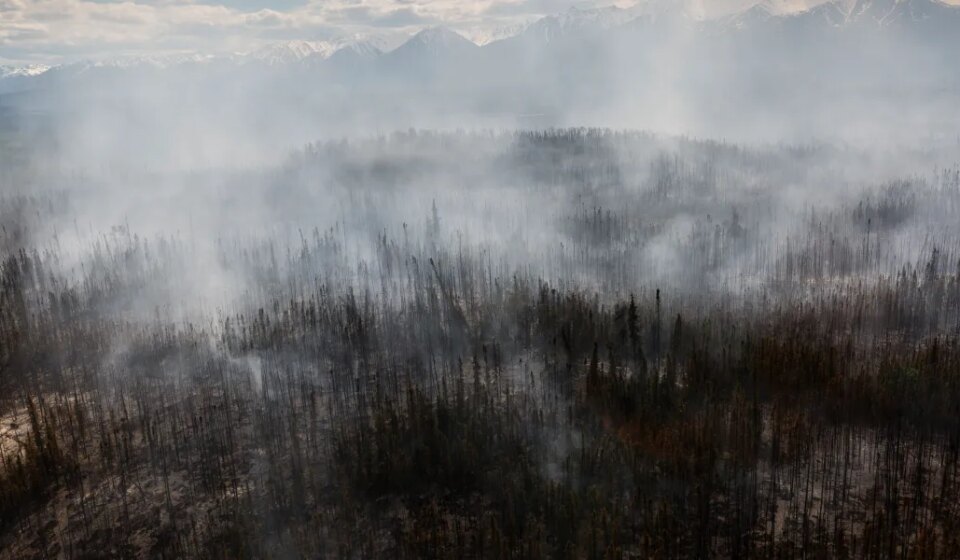
There’s a moment in a recent climate report that stopped me cold: a researcher places a simple T-shaped metal rod into the ground outside a burn scar and hits solid permafrost at a foot down. Just metres away, where a fire has stripped away the insulating topsoil, that same probe plunges three times deeper. The difference isn’t decades of incremental warming. It’s a single fire event.
That image is a canary in the coal mine-not just for the Arctic, but for how we build and manage complex systems. For years, we’ve treated climate risk as a slow, linear curve. The data says otherwise. Wildfires in Canada’s boreal forests have already released more carbon than the nation’s entire fossil fuel economy. The permafrost isn’t thawing gradually; it’s cracking open in sudden, nonlinear shifts. This is exactly the kind of “regime change” we architects fear in our own legacy systems-the moment when a hidden dependency fails catastrophically, not because of one bad deployment, but because of years of accumulated neglect.
Measuring the Unseen
What struck me most was the tool itself. A thaw probe. A single-point measurement in a landscape the size of continents. We spend billions on satellite imagery and advanced climate models, yet the ground-truth validation still depends on a person walking to a spot and pushing a rod into the earth. In our world, we call that “having a single source of truth” – and we know how fragile that is.
Every enterprise architecture I’ve encountered suffers from the same blind spot: we monitor the obvious metrics (uptime, response time, throughput) but miss the silent variables that precede collapse. The organic-rich topsoil that insulates permafrost is like a well-tested database index-it protects the underlying structure from harsh external conditions. When a fire removes it, the entire system’s thermal equilibrium is destroyed. We see this in software when we strip away a caching layer or eliminate a redundant failover path. The failure isn’t immediate, but the degradation accelerates, and subsequent shocks-a traffic spike, a bad deploy-push the system past a tipping point.
The researchers are now talking about sending human firefighters to protect carbon stores, not homes. That’s a profound shift. We’re finally treating the invisible infrastructure (the soil, the sequestered carbon) as a first-class citizen. This is the same paradigm shift we need in enterprise architecture: treat your data lineage, your regulatory compliance, your third-party dependencies as critical assets worth protecting, not as afterthoughts.
The Architecture of Prevention
The article also highlights controlled burns and rapid detection systems. For me, that’s the enterprise equivalent of chaos engineering. We deliberately introduce failures to test resilience-but how many organisations run a literal “fire drill” on their supply chain or their LLM pipelines? Very few. We wait for the megafire and then say, “Who could have predicted it?”
The lesson is that proactive intervention, while it seems to add cost, is infinitely cheaper than the compounded interest of inaction. The boreal forests are a massive carbon sink. If they flip to a source, the feedback loop accelerates. In business terms, this is a classic case of “technical debt” on a planetary scale. Every year we delay, the debt compounds.
The Bharat and Northeast Lens
This narrative has a direct parallel in the forests of Northeast India, where shifting cultivation and seasonal fires alter soil structure, often leading to landslides and biodiversity loss. We have the Digital Public Infrastructure-from Bhuvan to the AI-based forest fire alert systems-but the challenge remains the same as in Alaska: the last mile. The thaw probe teaches us that high-tech satellites must be paired with low-tech, rugged, ground-level sensing. For the Northeast, this could mean deploying low-cost IoT soil sensors across vulnerable hill slopes, creating a data mesh that integrates with national climate models. Frugal innovation isn’t just about cost; it’s about accuracy at the edge.
Three Takeaways for Every CTO
First, observability must be proactive, not reactive. If you aren’t measuring the “soil temperature” of your system-the health of your data pipelines, model drift, team burnout-you’re flying blind. Second, design for sudden shifts. Your architecture should expect nonlinear failure modes, not just linear growth. Build in circuit breakers and kill switches. Third, treat environmental risk as a P&L line item. For founders and CEOs, climate risk is no longer an ESG report footnote; it’s a core strategic threat to your supply chain and your customer base.
The permafrost is not just a scientific curiosity. It is a mirror held up to our own architectures. We can ignore the thawing, but the ground will eventually give way. The only way forward is to sense early, act deliberately, and protect the invisible layers that keep our systems-and our planet-stable.
About the Author: Sanjeev Sarma is the Founder Director and Chief Software Architect at Webx Technologies. With a core focus on Generative AI integration, Cloud-Native Scalability, and Enterprise Software Architecture, he has spent over two decades driving digital transformation across Northeast India and beyond. Beyond his corporate leadership, Sanjeev is deeply invested in shaping the future of the IT industry. He serves as an Industry Expert on the Board of Studies for Assam Don Bosco University’s School of Technology, advises state technology committees, and actively mentors emerging tech startups at STPI. He brings a unique, dual perspective of high-level enterprise execution and future-ready academic curriculum development.