Bigger Bets, Bolder Ambitions: Peak XV’s Playbook for India’s $100B Founders

Ambition Is an Architecture Problem
In 1986, long before India had a startup ecosystem worth the name, a small software company made a decision that would look eccentric in any decade: it would handcraft its entire stack – its own database, its own memory manager, even its own programming language. Forty years later, at TechSparks 2026 in Bengaluru, one of the country’s most influential venture firms was urging founders to stop thinking in millions and start dreaming in $100 billion.
Two different generations. One identical argument: India’s next leap will not come from adopting technology. It will come from owning it.
Two stages, one signal
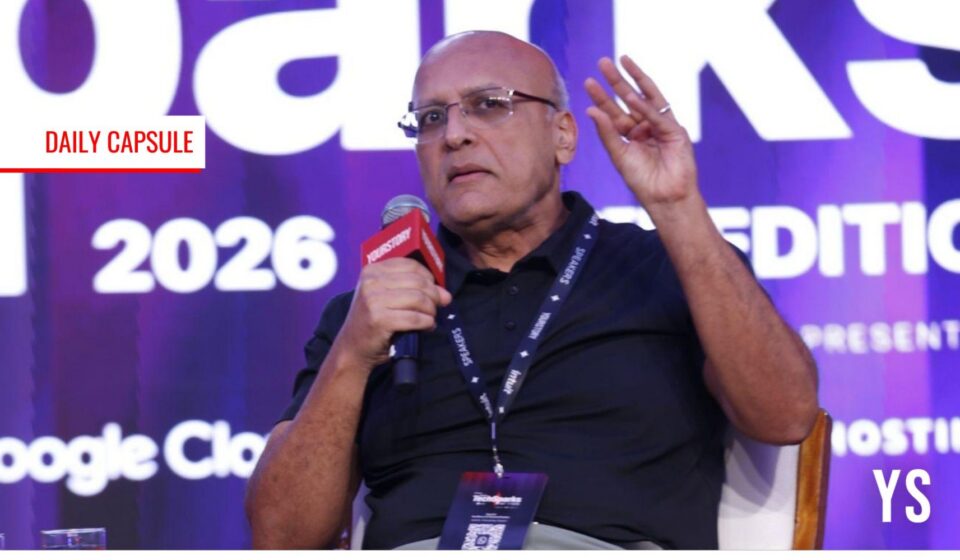
At the event, Peak XV’s Mohit Bhatnagar observed that Indian founders now routinely aspire to build $50–100 billion companies – a shift driven, he noted, by successes like Zomato and the growing acceptance of startups in our public markets. On the same stage, the leadership of Tally Solutions – nearly three million customers deep into four decades – traced that longevity to one obsession: ownership. Add a Rs 50 crore innovation foundation announced in Delhi and Peak XV’s new book, The Lift-Off Nation, making the case for India’s startup golden age, and the week quietly sketched a blueprint.
The compounding math of ownership
Here is the uncomfortable part: we celebrate ambition, but ambition is not a mindset – it is an architecture. A $100 billion company cannot be assembled out of SaaS subscriptions, managed services, and a hundred duct-taped API calls, however elegant the demo. Technical debt is a tax levied on future ambition, and too many startups structure themselves to pay it at the worst possible moment – at scale.
Tally’s counterexample defies current fashion. In an era that worships abstraction, they built and kept their core. That path is slow and expensive in year one, and compounds for forty. Tejas Goenka’s founding principle – “the cost post-purchase should be near zero” – is not a pricing tactic; it is an architectural constraint. Reliability engineered into the system, not staffed into a support desk. Contrast that with today’s enterprise reality: spiraling cloud bills, vendor lock-in dressed up as agility, microservice sprawl nobody dares unwind.
The lesson for CTOs and founders alike: your durable moat is whatever you own that abstraction cannot rent away – proprietary data models, core engines, domain depth, earned trust. Everything else is a lease.
AI compressed the start. It cannot compress the middle.
Bhatnagar’s hope for a “10x unleashing of entrepreneurial energy” is well-founded; AI has collapsed the cost of going from idea to prototype. But when everyone can build version one in a weekend, differentiation migrates to what AI cannot generate: reliability, domain expertise, owned IP, and the patience to iterate for a decade. Anthropic’s internal modelling suggesting AI could lift US economic output by nearly 50% by 2030 under certain conditions is directionally fascinating – but the gap between such projections and production reality is precisely where architects and researchers earn their keep. Likewise, the Rs 1 lakh crore RDI scheme and calls for deeper corporate R&D will only matter if that capital funds foundational IP, not another thin distribution layer atop someone else’s model.
The view from the periphery
“Rooted in India, built for the world” applies as much in Guwahati as in Bengaluru. Having mentored early-stage founders at STPI for years, I can say the bottleneck for Tier-2 and Tier-3 entrepreneurs is no longer tools – or even seed capital, with state-level vehicles like Delhi’s new foundation multiplying. It is calibrated ambition: the discipline to build owned intellectual property rather than engineer a quick exit. And Tally’s planned push into the Middle East and Africa proves a quiet point – engineering built for Indian frictions travels remarkably well to markets with similar ones.
What I’d put on the whiteboard
- Ambition must be architected. If you intend to build at $100B scale, set your debt ceiling on day one, not at Series C.
- Ownership compounds; renting doesn’t. Decide early which layers of your stack are strategic – and own them outright.
- Design for total cost of ownership, not demo-day dazzle. Reliability is a decision, not a headcount.
- Use AI to compress prototyping – then reinvest the savings in depth, not just more launches.
Tally didn’t survive forty years by predicting the future. It survived by building something worth keeping. In a week full of billion-dollar headlines, that may be the most radical ambition on the table.
About the Author: Sanjeev Sarma is the Founder Director and Chief Software Architect at Webx Technologies. With a core focus on Generative AI integration, Cloud-Native Scalability, and Enterprise Software Architecture, he has spent over two decades driving digital transformation across Northeast India and beyond. Beyond his corporate leadership, Sanjeev is deeply invested in shaping the future of the IT industry. He serves as an Industry Expert on the Board of Studies for Assam Don Bosco University’s School of Technology, advises state technology committees, and actively mentors emerging tech startups at STPI. He brings a unique, dual perspective of high-level enterprise execution and future-ready academic curriculum development.