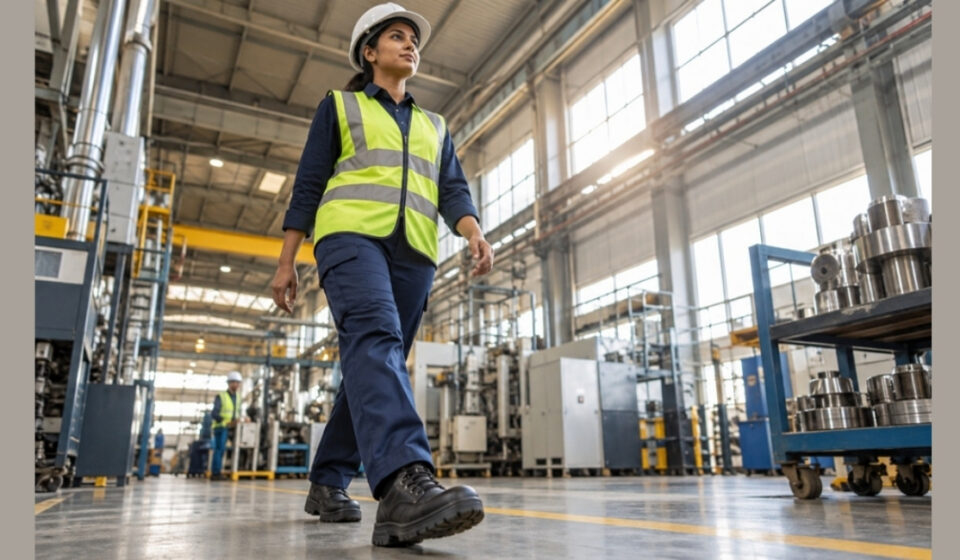

Safety shoes for women should be designed around women’s specific foot anatomy rather than offered merely as smaller versions of men’s models, according to research highlighting the gaps in workplace protective equipment. A 2001 study by R.E. Wunderlich and P.R. Cavanagh found that female feet differ from male feet in several important shape characteristics, including the arch, outer side, big toe and ball of the foot. The researchers concluded that women’s feet and legs are not simply scaled-down versions of men’s, supporting greater investment in footwear designed around women’s fit, sizing, comfort and style.
The issue has gained importance as more women enter construction, manufacturing, metal fabrication and other labour-intensive sectors. India’s Economic Survey 2025-26 says 17 states and union territories have removed prohibitions on women working in designated hazardous industries. Around 22 states and union territories permit women to work night shifts in factories, while 33 allow such shifts in commercial establishments. The survey says these reforms are expanding employment opportunities and labour-market flexibility, while higher female participation could support fairer labour markets, household welfare and India’s economic transformation toward Viksit Bharat by 2047.
Protective requirements must still be determined primarily by the hazards workers face. The specifications needed in manufacturing, construction or another industrial environment may differ, and safety footwear must comply with the standards relevant to each workplace. However, matching those requirements does not justify forcing women to wear down-sized men’s shoes. A safety shoe that does not fit properly may be uncomfortable or difficult to use consistently, making comfort and appearance important considerations alongside protection.
Two stereotypes continue to restrict the development of women’s safety footwear. The first is the assumption that women do not perform physically demanding work and therefore do not need rugged protective shoes. The growing presence of women in industrial jobs challenges that assumption. The second is the belief that a smaller, lighter men’s model can adequately meet women’s requirements. The Wunderlich and Cavanagh study shows why this approach is inadequate, as average male and female foot shapes are not interchangeable.
Some manufacturers are beginning to recognise the demand. KARAM Safety has introduced a selection of women-focused safety shoes through its online store, an early step toward a more developed category. However, greater investment is still needed in research, sizing and product design. As women become a larger part of India’s workforce, employers, manufacturers and safety specialists must treat properly fitted women’s safety shoes as essential protective equipment rather than an optional feature.
Original Source: https://nenow.in/business/safety-shoes-for-women-what-nobody-talks-about.html
Category: Business
Tags:
Publish Date: 2026-09-28 16:01:00