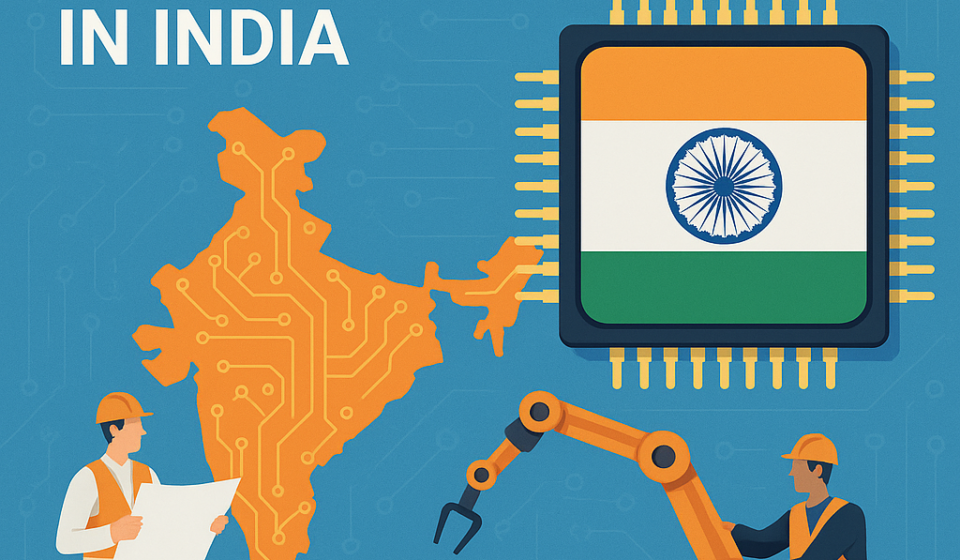
Architecting a Sovereign Semiconductor Supply Chain in India

We cheer headline investments – and rightly so – but the hard part always begins after the press conference. Building a silicon-component line on Indian soil is not merely a capital allocation; it is an exercise in systems design at national scale.
The signal: A major wafer-equipment supplier has announced a multi-thousand-crore commitment to build its first silicon-component manufacturing base in India and is simultaneously scaling R&D and a talent-upskilling program with academic partners. The company frames this as vertical integration: ingot-to-wafer capabilities, supplier partnerships, and an export-oriented manufacturing hub.
Why this matters (and what most coverage misses)
- Strategic depth, not just jobs: Upstream silicon activities – ingots, wafer processing, precision materials, metrology – are where supply-chain resilience is built. For enterprises and governments, that reduces single-point dependencies and shortens lead times for advanced packaging and foundry access.
- It reframes product–software roadmaps: When hardware availability becomes less brittle, software architects can be bolder about hardware-aware optimizations (edge silicon offloads, specialized accelerators, deterministic latency SLAs). Conversely, inconsistent hardware supply forces engineers to adopt defensive, lowest-common-denominator designs that increase technical debt.
- Talent is the multiplier: Announcements of training initiatives are more than CSR; they are capacity-building for an ecosystem that needs process engineers, metrology specialists, chemists, and cleanroom technicians – roles that academic curricula rarely produce at industrial scale today.
Architecture and policy trade-offs every CTO and policymaker should weigh
- Speed vs. maturity: Fast-tracked manufacturing may bring product timelines forward, but immature local supply chains can create quality variance. Enterprises must balance go-to-market velocity with rigorous qualification-think multi-stage validation rigs and longer MPN (manufacturer part number) qualification cycles.
- Vertical integration vs. supplier diversity: Localising upstream capabilities helps resilience but can concentrate systemic risk (regulatory, environmental, geopolitical). Maintain diversified sourcing strategies and enforce traceability and provenance in component sourcing.
- Sustainability and operational cost: Semiconductor fabs are water-, energy-, and chemistry-intensive. Any long-term manufacturing plan must build for circularity (recycling, zero-liquid-discharge), on-site renewables, and pollutant controls – these are non-negotiable for global market access and ESG compliance.
Actionable steps for leaders and founders
- For enterprise architects: Start hardware-awareness audits. Map your product lines to potential changes in silicon cadence and create fallbacks for critical paths – virtualize the hardware dependency where possible, and invest in modular abstraction layers.
- For startup founders in materials, tooling, and metrology: This is prime market timing. Build rigorous quality management systems and early customer-validation plans with OEMs and fabs; standards and certifications will become currency.
- For policymakers and training institutions: Align curricula to industrial processes (metrology labs, cleanroom internships). Apprenticeship pipelines matter more than one-off bootcamps.
A practical Bharat lens
There’s a real opportunity for regions like Northeast India to plug into this shift – not necessarily as full fabs initially, but as clusters for precision machining, assembly, and talent incubation. Local STPI centres and university labs can become feeder nodes: upskilling technicians, running focused R&D projects, and helping MSMEs qualify as Tier-2/3 suppliers.
Takeaways
- Investments in silicon upstream change the engineering game: expect more hardware-rich product roadmaps but also the need for robust qualification pipelines.
- Talent and supplier capability are the real scarce resources; training targets and university partnerships are as strategically important as capex.
- Sustainability, standards, and certification will determine who gets to export – not just who builds the factory.
Closing thought
Capital opens the door; standards, skills, and systems keep it open. If India wants a durable semiconductor ecosystem, we must design it as thoughtfully as any large distributed system – with observability, redundancy, and upgrade paths baked in.
About the Author: Sanjeev Sarma is the Founder Director and Chief Software Architect at Webx Technologies. With a core focus on Generative AI integration, Cloud-Native Scalability, and Enterprise Software Architecture, he has spent over two decades driving digital transformation across Northeast India and beyond. Beyond his corporate leadership, Sanjeev is deeply invested in shaping the future of the IT industry. He serves as an Industry Expert on the Board of Studies for Assam Don Bosco University’s School of Technology, advises state technology committees, and actively mentors emerging tech startups at STPI. He brings a unique, dual perspective of high-level enterprise execution and future-ready academic curriculum development.