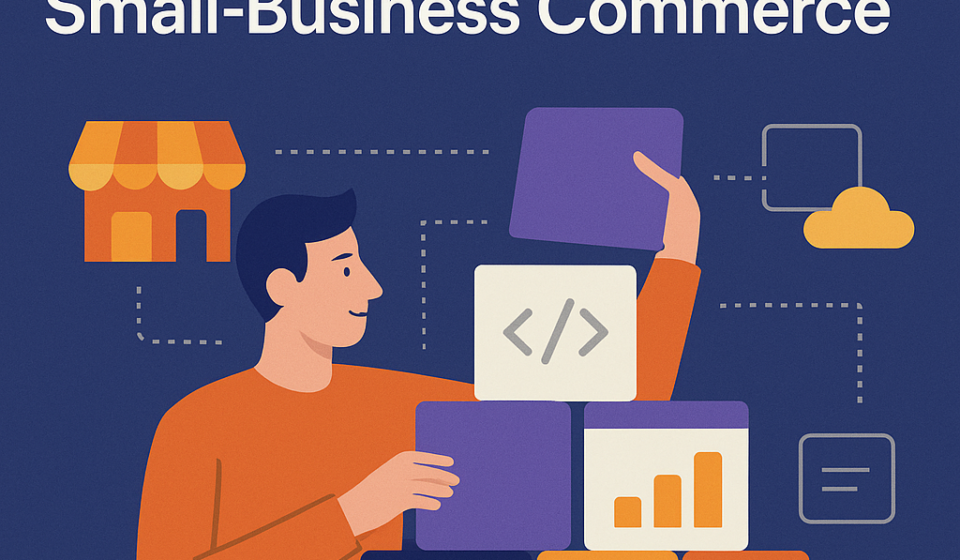
Architecting No‑Code Platforms for Scalable Small‑Business Commerce

The convenience narrative has won: anyone can launch a storefront, portfolio or booking site in an afternoon. That’s a powerful shift – but convenience is not a substitute for architecture. If we only celebrate low-friction website builders, we miss the harder conversation about what this shift means for data ownership, composability and long-term resilience.
Why this matters now
Modern, templated website platforms have lowered the barrier to entry for small businesses and creators. Discounts, free trials and ecosystem perks accelerate adoption – which is great for market participation. But beneath the surface the same pattern repeats: rapid adoption driven by convenience, then a slow realization that business requirements (payments, inventory, customer data, tax compliance, offline POS) expose gaps that templates weren’t designed to solve.
What I look for as an enterprise architect
I read these developments through the lens of systems thinking and long-term technical debt. There are several trade-offs leaders must acknowledge:
-
Agility vs control: Low-code platforms grant speed but abstract away control points – from database schemas to integration hooks and backup strategies. That abstraction reduces short-term costs but increases vendor dependency for capabilities you may need tomorrow.
-
Data portability and ownership: For an enterprise-grade view, the value in a web presence is not the site itself but the data it generates: customers, transactions, content, analytics. Without clear export formats, APIs and contractual rights, moving that data into CRM, ERP or analytics pipelines becomes costly and error-prone.
-
Composability vs monolith SaaS: A modern digital stack should be composable – independent services wired together via stable APIs. Many single-vendor website builders nudge teams toward monolithic outcomes: you inherit their payment flows, inventory logic, and reporting models. That’s fine for a test or MVP, but risky if you envision growth, multiple channels, or proprietary product logic.
-
Integration surface and compliance: Selling across online and in-person channels demands reliable integrations (payments, invoicing, inventory sync). In markets with specific tax or invoicing rules, the cost of retrofitting compliance can be higher than the initial convenience gains.
-
Cost signals and commitment: Promotional pricing and annual discounts drive sign-ups. But they can obscure the true total cost of ownership – migration, custom integrations, training, and the cost of switching providers when limits are reached.
A practical lens for CTOs and founders
Treat “website builders” as a strategic choice, not merely a marketing channel. Ask these questions before you commit:
- Can I export my full dataset in machine-readable form? How often and how complete is the export?
- Are there documented APIs and webhooks for the functionality I’ll need (payments, inventory, CRM sync)?
- What parts of the stack are replaceable without a full rebuild?
- How does the platform handle compliance, backups, encryption and role-based access?
- What’s the plan when the platform’s feature roadmap diverges from my product roadmap?
The India angle – why this should matter to Bharat
For Indian MSMEs and digital-first entrepreneurs, the calculus includes additional dimensions: integration with UPI, GST invoicing, multi-language content, and intermittent connectivity in many regions. Choosing a platform that supports easy integration with local payment rails and government-mandated invoicing formats – or one that allows you to own your transactional records – is not just a convenience, it’s a risk-management decision. Young enterprises in the Northeast and beyond can use low-friction builders to validate demand, but they should design a migration path that aligns with India’s Digital Public Infrastructure and regulatory expectations.
Takeaways (practical)
- Prototype fast, but design for exportability from day one.
- Prefer platforms with open APIs and good webhook support.
- Keep critical transactional data in systems you control or can replicate.
- Validate local payment and tax integration before scaling.
- Treat promotional pricing as a marketing input, not a long-term forecast.
Closing thought
Democratizing web creation is a tectonic win for inclusion and entrepreneurship – but real digital resilience comes when speed is paired with intentional architecture. Build for today’s traction, and design for tomorrow’s sovereignty.
About the Author: Sanjeev Sarma is the Founder Director and Chief Software Architect at Webx Technologies. With a core focus on Generative AI integration, Cloud-Native Scalability, and Enterprise Software Architecture, he has spent over two decades driving digital transformation across Northeast India and beyond. Beyond his corporate leadership, Sanjeev is deeply invested in shaping the future of the IT industry. He serves as an Industry Expert on the Board of Studies for Assam Don Bosco University’s School of Technology, advises state technology committees, and actively mentors emerging tech startups at STPI. He brings a unique, dual perspective of high-level enterprise execution and future-ready academic curriculum development.