Sovereignty by Design: Architecting Multi‑Plane Cloud Platforms

Title: Sovereignty Isn’t a Region Dropdown – It’s a Platform Topology
We obsess over choosing a cloud region as the answer to “where my data lives.” That’s necessary, but it’s incomplete. The real leverage for auditors, regulators and engineering teams comes from how we partition control, state, telemetry and workflows across a platform – not just from where a VM or bucket is provisioned.
Context
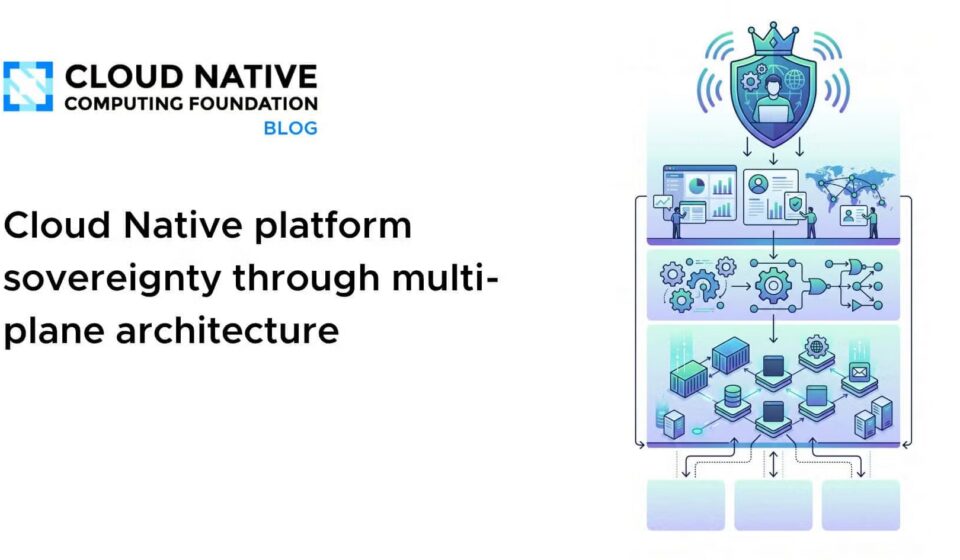
A recent CNCF community discussion used a multi‑plane topology as an architectural lens for cloud sovereignty: control, data, observability, workflow and experience each live in separate clusters (or planes) and communicate via outbound, mutually authenticated connections. That pattern reframes sovereignty from a location checkbox to a provable mapping of responsibilities.
Analysis – what this means for enterprise architecture
Treat sovereignty as an architectural property, not a deployment detail. There are four practical concerns auditors and procurement teams raise again and again: jurisdiction of any component that can touch tenant data; vendor‑independence; external access to keys/state; and whether changing provider requires rewriting workloads. A multi‑plane topology maps neatly to those questions.
-
Control vs runtime separation: Put desired state, reconciliation logic and orchestration in a control plane that never directly accepts inbound connections from regulated workloads. Let data planes own runtime state and serve traffic even when disconnected. That separation shrinks blast radius and gives a straightforward place to attach jurisdictional claims.
-
Outbound-only connection model: If observability, CI and other planes open mutually authenticated outbound connections to a control gateway (instead of the control plane dialing into clusters), API servers with regulated workloads do not need public exposure. Practically, this reduces attack surface and simplifies “who can reach what” explanations during audits.
-
Declarative sovereignty = auditability: Express data‑plane placement, observability sinks and promotion paths as version‑controlled manifests. When a tenancy or telemetry decision is a reviewed Git commit, the answer to “why is this data here?” is a diff and an approval trail, not tribal knowledge or screenshots.
-
Platform vs infrastructure responsibilities: Virtual clusters (tenant control planes hosted as pods) are a cost‑efficient isolation primitive, but they do not substitute for jurisdictional placement, telemetry routing or promotion policies – those belong in the platform layer. Conversely, if your threat model requires hardware isolation, you must choose physical data planes. Design decisions should be registration choices, not code rewrites.
-
Tradeoffs to plan for: More planes = more operational overhead. The pattern pays when legal, regulatory or risk boundaries matter; it’s overkill for benign multi‑tenant setups. Invest in automation (upgrades, backups, observability) and keep the number of physical clusters tied to jurisdictions rather than to tenants.
Recommendations for CTOs and architects
- Model sovereignty as first‑class, declarative objects in Git; require PR reviews for placement or telemetry changes.
- Adopt outbound, mTLS‑based connectivity for non‑invasive orchestration.
- Map identity/authorization consistently across planes (OIDC/OAuth/SPIFFE) so human or agent access is auditable.
- Use virtual clusters to lower cost where hardware isolation isn’t required; reserve physical clusters for high‑assurance tenants.
- Automate lifecycle operations aggressively – the pattern shifts cost from scale‑per‑tenant to scale‑per‑jurisdiction.
- Integrate supply‑chain attestations, SBOMs and workload identity as complementary controls, not substitutes.
A practical note for India
For Indian organisations and DPI initiatives, the pattern is especially useful: it makes residency guarantees provable and reduces the number of physical clusters you must operate to meet regulatory intent. Small and medium teams can use virtual clusters to contain costs while still producing the commit trails that auditors and procurement teams require.
Takeaways
Sovereignty is an architectural conversation about boundaries, connectivity and evidence. Separate planes for control, runtime, telemetry and workflows – expressed as declarative, versioned objects – convert contractual promises into operational, auditable reality. The choice is not between security and agility; it is about modelling trade‑offs explicitly so you can manage them.
Closing thought
If sovereignty is a promise to users and regulators, then Git is the ledger that makes that promise verifiable.
About the Author: Sanjeev Sarma is the Founder Director and Chief Software Architect at Webx Technologies. With a core focus on Generative AI integration, Cloud-Native Scalability, and Enterprise Software Architecture, he has spent over two decades driving digital transformation across Northeast India and beyond. Beyond his corporate leadership, Sanjeev is deeply invested in shaping the future of the IT industry. He serves as an Industry Expert on the Board of Studies for Assam Don Bosco University’s School of Technology, advises state technology committees, and actively mentors emerging tech startups at STPI. He brings a unique, dual perspective of high-level enterprise execution and future-ready academic curriculum development.