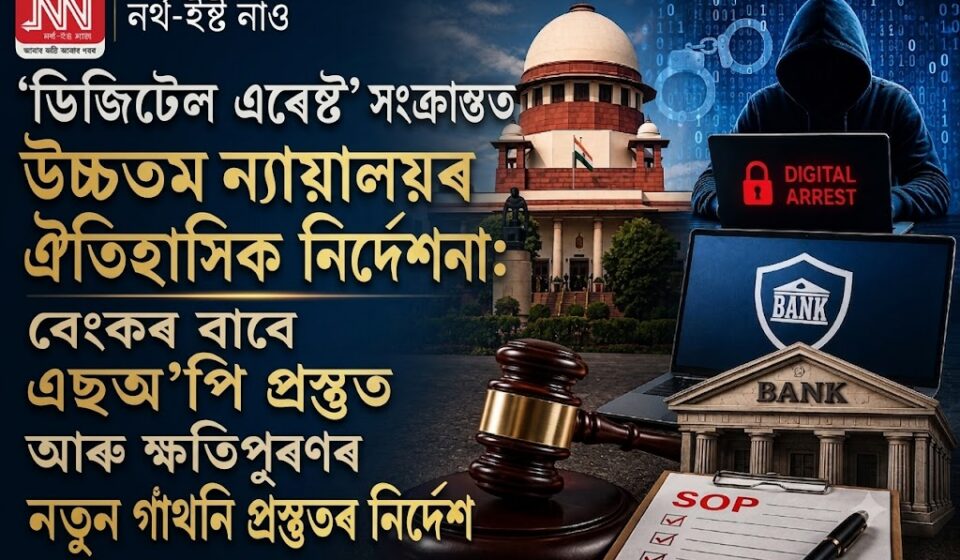

The Supreme Court on Tuesday issued a string of orders aimed at curbing the rising tide of “digital arrests” and cyber financial fraud, directing banks, law enforcement and central agencies to quickly tighten safeguards and streamline victim relief. A bench led by Chief Justice Surya Kant, with Justices Jaymaly Bagchi and V. Mohan hearing a suo motu matter on cybercrime, asked the Reserve Bank of India, the Centre and state authorities to move within strict timelines. Attorney General R. Venkataramani, Solicitor General Tushar Mehta and amicus curiae senior advocate N.S.N. Nappinai appeared and advanced their arguments before the court.
The court told the Reserve Bank of India to issue, publicize and enforce a standard operating procedure (SOP) for banks within four weeks. The SOP must allow banks to temporarily suspend or freeze debits in accounts linked to cyber fraud, and must set out clear grievance-redressal mechanisms, processes for recovery of diverted funds, and measures to raise public awareness about such scams.
To ensure speedy handling of complaints, the Supreme Court directed registrars general of all high courts to notify subordinate courts to accord priority to cyber-fraud complaints. The court also made it mandatory for every state and union territory to make its State Cyber Crime Coordination Centre operational within four weeks, and asked the Ministry of Home Affairs and the Indian Cyber Crime Coordination Centre to help roll out an electronic FIR (e-FIR) system to expedite reporting and tracking.
The court ordered the formation of an inter-departmental committee to examine a joint liability and compensation framework for victims of cybercrime, a step aimed at simplifying civil remedies and ensuring victims can seek restitution more effectively. In parallel, the Central Bureau of Investigation was asked to consider lowering the monetary threshold for taking up cyber-fraud cases and to explore the aggregation of many small-value frauds into consolidated investigations.
The bench also directed the Ministry of Electronics and Information Technology, the Department of Telecommunications and the I4C to study the feasibility of imposing time-based restrictions on voice and video call services to deter certain kinds of fraud and report back to the court. These measures are intended to create technical and procedural barriers that make it harder for fraudsters to exploit real-time communication channels.
Taken together, the orders seek to build a faster, coordinated response across banks, law enforcement and regulators for prevention, detection and victim relief in cyber financial fraud. The court’s directions emphasize both procedural fixes — like SOPs and e-FIRs — and technical and investigative changes, including inter-agency coordination and possible regulatory limits on communication channels, with strict short deadlines to push implementation.
Original Source: https://assam.nenow.in/supreme-court-digital-arrest-rules-direct-rbi-to-issue-bank-sops-within-four-weeks-and-examine-a-compensation-framework-for-cyber-fraud-victims/
Category: Popular Stories,দেশ,শীর্ষ সংবাদ
Tags:
Publish Date: 2026-08-05 07:54:00