Architecting Resilient Energy Supply Chains After the Strait of Hormuz Shock

The geopolitics of a sea lane can become the architecture problem of an entire industry
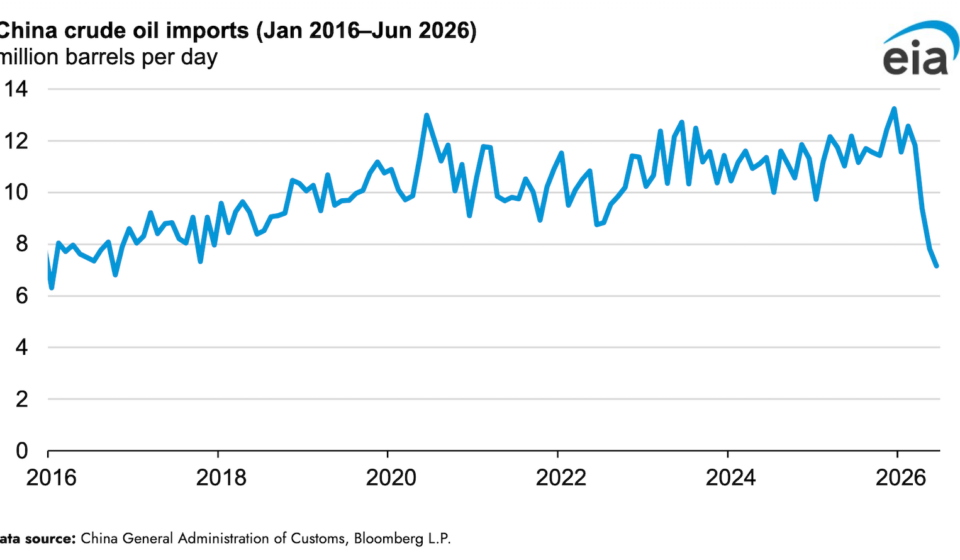
A recent analysis in Today in Energy highlighted a striking shift: China, the world’s largest crude importer, materially cut waterborne imports in Q2 2026 after higher prices and tanker-route disruptions through the Strait of Hormuz. The drop-driven by reduced tanker arrivals rather than pipeline flows-exposed how supply-chain shocks ripple through global inventories, refinery throughput and pricing dynamics.
Why this matters beyond oil traders
Most coverage frames this as a commodity-market story. As an enterprise architect, I see it as a systems-design problem with three enduring lessons for any organisation that depends on global supply chains and real-time operational decisions.
- Observability and data fabric are no longer optional
When tanker flows and port operations become the signal that shifts markets, organisations must fuse disparate, near-real-time feeds (vessel tracking, customs arrivals, refinery intake, inventory levels, spot prices, geopolitical risk indicators). The architect’s job is to build a data fabric that makes these signals discoverable, auditable and actionable. That requires API-first ingestion, common schemas, and a single source of truth-so forecasting models and operational orchestration systems don’t fight over “whose number is correct.”
Trade-off: upstream investment in data engineering and governance vs. downstream speed of decision-making. In my experience, teams that skimp here pay later in brittle playbooks and missed hedges.
- Scenario-first design: from “just-in-time” to “just-in-case” flexibility
Many modern supply chains lean hard on JIT efficiency. Geopolitical or chokepoint shocks expose the fragility of that model. Architecturally, this calls for modular orchestration platforms that can switch between modes: normal operations, constrained-supply optimization, and strategic-drawdown management (inventory-to-refinery triage). That means simulation-driven controls-digital twins that can stress-test throughput, allocations and pricing strategies under multiple shock scenarios.
Actionable pattern: run probabilistic scenario libraries continuously, not as an annual exercise. Embed simulation outputs into procurement and trading workflows so rules-based automation can execute within pre-approved risk envelopes.
- Integration of commercial and sovereign decision layers
The article underscores how national strategic stocks and commercial flows interact. For enterprises and national stakeholders this means building interoperable systems-data exchanges that allow commercial actors to coordinate with strategic reserve managers during extreme events without leaking sensitive commercial signals. Practically, that looks like federated data models and privacy-preserving analytics (e.g., differential privacy or secure enclaves) to enable coordinated action without compromising competitive positions.
The India angle (why this matters to Bharat)
India is a major oil importer and increasingly active in strategic stock accumulation and refinery optimization. The Q2 2026 episode is a reminder for Indian energy firms, refineries and policy planners to invest in resilient digital stacks: vessel and terminal observability, integrated refinery-control systems, scenario simulation for regional demand shocks, and APIs that connect commercial operators with state-owned reserve managers. For innovators in Northeast India, there’s an opportunity to build lightweight orchestration and forecasting modules geared for regional refineries and inland logistics-frugal, resilient solutions that tolerate intermittent connectivity.
Practical takeaways for CTOs and Heads of Supply Chain
- Treat geopolitical and maritime signals as first-class telemetry; ingest AIS, customs and port-call data in real time.
- Build a simulation layer (digital twin) that runs continuous stress-tests against refinery throughput and inventory policies.
- Adopt federated data governance for coordinated public–private response to supply shocks.
- Balance JIT gains with configurable “just-in-case” buffers tied to automated playbooks.
- Invest in explainable forecasting-decision-makers must trust model outputs when markets move fast.
Closing thought
Markets will continue to be shaped by events outside any single firm’s control. Our leverage lies in the systems we design: observability, simulation and governed collaboration. Architecture isn’t about preventing shocks-it’s about building organisations that respond with speed, clarity and composure when the next one arrives.
About the Author: Sanjeev Sarma is the Founder Director and Chief Software Architect at Webx Technologies. With a core focus on Generative AI integration, Cloud-Native Scalability, and Enterprise Software Architecture, he has spent over two decades driving digital transformation across Northeast India and beyond. Beyond his corporate leadership, Sanjeev is deeply invested in shaping the future of the IT industry. He serves as an Industry Expert on the Board of Studies for Assam Don Bosco University’s School of Technology, advises state technology committees, and actively mentors emerging tech startups at STPI. He brings a unique, dual perspective of high-level enterprise execution and future-ready academic curriculum development.