Home Market Electrification: The New Industrial Strategy for Auto Dominance

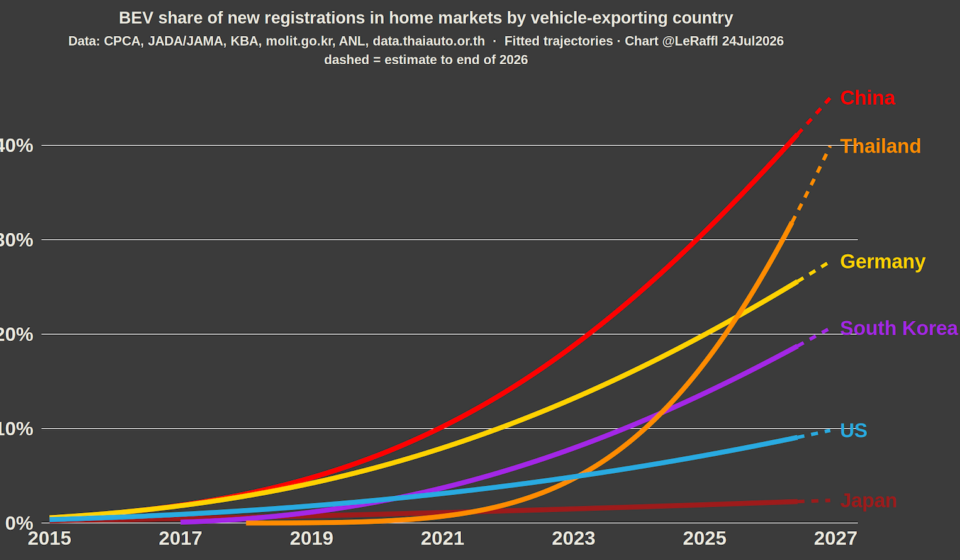
We often measure automotive competitiveness by who sells the most cars abroad. A recent analysis I read flips that metric: the long game is being won at home. Rapid domestic EV adoption – not just production or exports – builds the scale, skills, and platform depth that turn national industries into global leaders.
The signal: countries that force a fast domestic transition to battery vehicles create the conditions for export dominance. That’s not just about subsidies or factory gates – it’s about an ecosystem: charging networks, supplier modularity, software teams, standards, and a workforce retooled for electrified, software-defined mobility.
What this means for enterprise architects and technology leaders
-
The vehicle is now a distributed software system. OEMs are competing on software ecosystems as much as hardware. For enterprises building software for manufacturing, supply chains, or mobility services, that elevates API design, over-the-air update strategies, telemetry architectures, and edge/cloud balance from nice-to-have to mission-critical. Design for safe, incremental rollouts (feature flags, phased OTA) rather than big-bang updates.
-
Domestic adoption accelerates platform learning loops. High local BEV share produces richer operational data (charging patterns, degradation, usage profiles). Architects must plan data pipelines that turn telemetry into product improvement while respecting privacy and local data-governance rules. The ability to iterate rapidly on software and services becomes a durable competitive advantage.
-
Supply-chain architecture becomes a system-of-systems problem. Rapid electrification stresses battery, power-electronics, and semiconductor supply chains. Enterprises should model supplier risk as part of system availability planning, invest in multi-sourcing strategies, and treat logistics and inventory systems as real-time control layers rather than batch processes.
-
Standards and interoperability win. When a market moves quickly, winners are those who coalesce around common interfaces – charge payment standards, telematics formats, battery swap protocols, and cybersecurity baselines. Architects should prioritise modular, standards-first designs that allow integration with multiple OEMs and regional infrastructures.
-
Cybersecurity and resilience are non-negotiable. Connected vehicles and chargers expand the threat surface. Zero‑trust principles, secure boot for embedded systems, and supply-chain integrity checks must be baked into product roadmaps, not added post-facto.
Trade-offs CTOs must manage
Speed vs. Stability: Rapid field updates create learning, but increase operational risk. Balance with robust staging, canary deployments, and rollback mechanisms.
Vertical control vs. ecosystem openness: Owning the whole stack can accelerate differentiation but risks lock-in and higher capital needs. Consider platform playbooks where control points (customer data, OTA, billing) are owned while other layers remain partner-friendly.
Localization vs. global sourcing: Local manufacturing and data residency buy resilience and policy alignment; global sourcing reduces cost. Build architectures and contracts that allow flexible sourcing without long-term coupling.
Relevance for India (and Northeastern states)
India has the policy levers to chart its course – manufacturing incentives, standards, and charging infrastructure can catalyse a domestic learning loop similar to the ones described above. For Northeast India, success will come from targeted supply‑chain nodes (component assembly, battery recycling), bridging last‑mile connectivity for charging and telematics, and aligning regional skilling programs with the software‑defined mobility opportunity. These are practical, high-leverage choices rather than a race to replicate others’ factories.
Practical takeaways for leaders
- Treat domestic adoption as a strategic KPI: measure not only production but local usage, charging penetration, and fleet electrification velocity.
- Design software and data platforms for iterative learning: telemetry → model → update → measure.
- Prioritise interoperable standards to reduce integration friction for partners and regulators.
- Build supply‑chain resilience into architectural SLAs – map single points of failure and plan multi-sourcing.
- Invest in cyber resilience from chip-to-cloud; vehicle fleets will be judged by their safety as much as by range.
Closing thought
Industrial leadership in the electrified era will reward nations and companies that convert local demand into platform advantage – those who see rapid domestic adoption as the engine of enduring capability.
About the Author: Sanjeev Sarma is the Founder Director and Chief Software Architect at Webx Technologies. With a core focus on Generative AI integration, Cloud-Native Scalability, and Enterprise Software Architecture, he has spent over two decades driving digital transformation across Northeast India and beyond. Beyond his corporate leadership, Sanjeev is deeply invested in shaping the future of the IT industry. He serves as an Industry Expert on the Board of Studies for Assam Don Bosco University’s School of Technology, advises state technology committees, and actively mentors emerging tech startups at STPI. He brings a unique, dual perspective of high-level enterprise execution and future-ready academic curriculum development.