Architecting Equitable EV Markets: Incentives, Supply, and Allocation

A Turning Point for BEVs – and a Reminder that Policy Design Matters
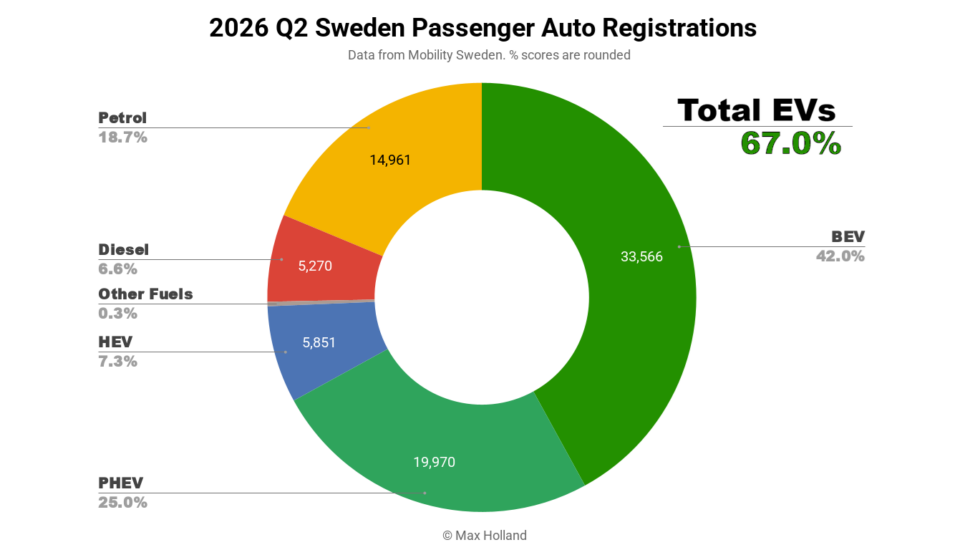
Sweden’s Q2 2026 registrations – where plugin EVs captured roughly 67% of the market (about 42% BEV, 25% PHEV) – are not just another quarterly data point. They are a live experiment in how incentives, product refresh cycles, and manufacturer allocation decisions combine to accelerate or stall the transition away from internal combustion. I recently studied a CleanTechnica report on these numbers and their drivers; below I draw out the implications for enterprise architects, policy makers, and mobility strategists.
What the headline misses (but the data implies)
The immediate signals are straightforward: refreshed model lineups (Kia, BMW, Volvo) plus targeted incentives produced strong BEV volume growth (roughly +42% YoY for BEVs). At the same time, legacy group performance (notably parts of Volkswagen Group) dropped, suggesting deliberate allocation choices rather than purely demand-driven decline. This combination – policy nudges plus product timing – makes the Swedish market a near-term case study in demand shaping.
Three strategic lessons for enterprise and public-sector architects
-
Incentives change behaviour – and create second-order effects. Targeting subsidies at low-income or rural buyers can increase penetration where it matters most, but it also creates rent-seeking opportunities if the subsidy is captured by OEMs through price anchoring or selective trim allocation. For architects of public programmes, the lesson is to design traceable, conditional incentives: time-bound rebates, mandatory price transparency, and audit trails that connect subsidy disbursement to verified end-user prices.
-
Allocation is the new supply-chain lever. OEMs can throttle supply to manage margins and inventory – effectively deciding who benefits from subsidies. For enterprise architects in OEMs and large fleets, the countermeasure is demand-sensing systems that integrate real-time market data, policy signals, and dealer inventory into allocation algorithms. This reduces deadweight loss and preserves the brand’s customer promise while keeping margin pressure visible to executives.
-
The software stack becomes the strategic asset. As product cycles accelerate and electrified platforms proliferate, the differentiators are not paint or leather but software: OTA management, battery health telematics, integrated energy services, and dealer-to-customer digital experiences. Companies that treat their data platforms as core IP – with modular APIs, strong data governance, and edge/cloud balance – will win both retention and aftermarket revenue.
Where India (and similar markets) should pay attention
There’s a clear bridge to India’s EV ambitions. Targeted rural/low-income incentives are essential for equitable adoption, but without binding transparency and mechanisms that prevent price inflation at point of sale, public money risks subsidising manufacturer margins. India’s Digital Public Infrastructure (DPI) and IndiaStack-style identity/payment rails provide a structural advantage: incentive delivery can be tied to verified vehicle registration, indexed to ex-showroom list prices, and conditioned on demonstrable end-user delivery. Similarly, last-mile charging in semi-urban and rural geographies needs to be paired with demand management software and distributed microgrid thinking – not just capital grants for chargers.
Practical takeaways for CTOs, policy teams and founders
- Policy teams: build incentives with measurable end-user incidence and auditability (rebates at registration, price floor rules, or clawbacks for non-compliance).
- OEM CTOs: invest in demand-signal integration, dealer transparency dashboards, and MLOps for allocation optimization.
- Mobility founders: focus on energy services, battery lifecycle solutions, and dealer-to-customer UX – these are the new value layers.
- Investors: watch for companies that own the charging-to-data stack; hardware margins will compress, software and services won’t.
Final thought
Markets don’t electrify because of an ideal; they electrify where policy, product timing, and data-driven allocation align. Sweden’s Q2 2026 surge is a useful, real-world reminder that the technology transition is equally a governance and architecture challenge – and those who treat it that way will shape the next decade of mobility.
About the Author: Sanjeev Sarma is the Founder Director and Chief Software Architect at Webx Technologies. With a core focus on Generative AI integration, Cloud-Native Scalability, and Enterprise Software Architecture, he has spent over two decades driving digital transformation across Northeast India and beyond. Beyond his corporate leadership, Sanjeev is deeply invested in shaping the future of the IT industry. He serves as an Industry Expert on the Board of Studies for Assam Don Bosco University’s School of Technology, advises state technology committees, and actively mentors emerging tech startups at STPI. He brings a unique, dual perspective of high-level enterprise execution and future-ready academic curriculum development.