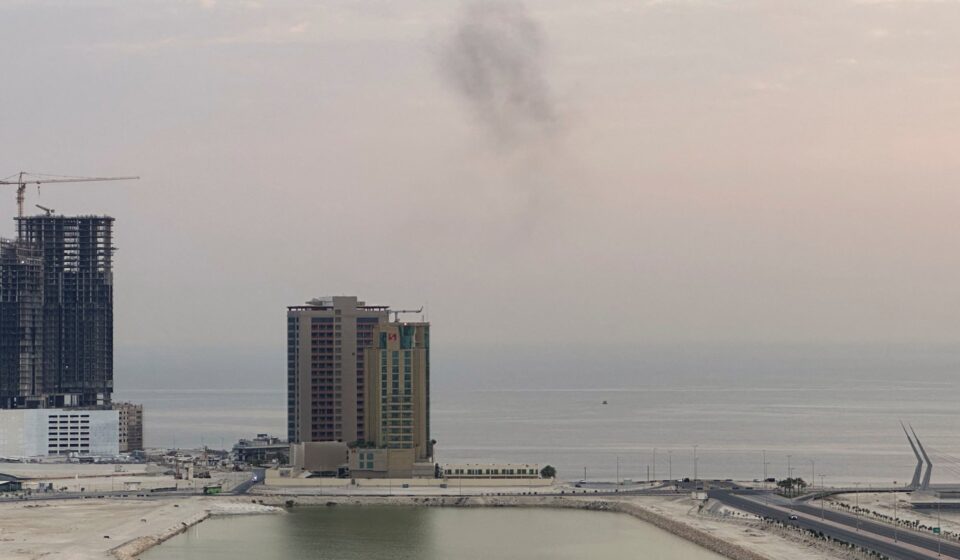

The United States launched strikes against Iran for a third consecutive night late on Monday, and Iran responded on Tuesday with multiple waves of retaliatory attacks across the Gulf, striking UAE‑flagged oil tankers in the Strait of Hormuz and hitting US military facilities in Bahrain and Kuwait. Both sides reported damage and military action as regional tensions intensified and commercial shipping faced significant disruption.
US Central Command (CENTCOM) said the latest US strikes began at 4:45pm ET (20:45 GMT) on Monday and were intended to degrade Iran’s ability to attack “innocent civilians and commercial shipping.” CENTCOM later said the operation lasted five hours and that US forces “successfully struck military targets across Iran including Bushehr, Chah Bahar, Jask, Konarak, Abu Musa, and Bandar Abbas.”
Iranian state media and semi‑official agencies reported explosions along the country’s southern coast overnight, including in Bandar Abbas, on Kish and Qeshm islands, and in Jam in Bushehr province. The Fars news agency cited the regional governor’s office saying a projectile struck western Bandar Abbas but caused no casualties.
Iran’s Islamic Revolutionary Guard Corps (IRGC) said it had launched a broader retaliatory campaign against US allies and interests across the Gulf. Tasnim news agency reported Iranian forces struck several “violating” vessels in the strait and shot down a US‑made drone near Bandar Abbas.
The United Arab Emirates said two UAE‑flagged oil tankers were hit by Iranian cruise missiles in Omani waters in the Strait of Hormuz; the UAE reported one Indian crew member was killed and eight others were wounded. Tasnim cited an IRGC statement saying two “offending” supertankers had been hit.
Iran’s army said it had launched drone attacks on US military targets in Kuwait, naming a Patriot missile system, fuel tanks, a watchtower, an ammunition depot and communications systems. The IRGC also said it struck weapons storage depots, a satellite communications centre and a building used by US forces at al‑Juffair base in Bahrain and attacked the US Fifth Fleet with missiles and drones; air sirens were heard multiple times in Bahrain on Tuesday. Jordan’s army said it shot down four missiles fired from Iran, and the IRGC later said it launched ballistic missiles at US forces and facilities at a Jordanian airbase; Iran publicly framed those strikes as aimed at the US military presence, not at Jordan itself.
On the diplomatic and political front, US President Donald Trump formally notified Congress on July 10 that fighting had resumed on July 7 and invoked authority to keep US forces in combat for another 60 days. At a Monday press conference he said Iran’s offensive capabilities were being dismantled, added that “a deal is possible,” and repeated demands that Gulf nations help cover the cost of protecting shipping. Trump also threatened to “take out” a suspected nuclear site near Natanz known as Kuh‑e Kolang Gaz La or Pickaxe Mountain. The US Navy‑led Joint Maritime Information Centre (JMIC) confirmed a US blockade of Iran’s southern ports and terminals was due to begin at 20:00 GMT on Tuesday.
Iranian parliamentarians moved to introduce a bill on management of the Strait of Hormuz, and Ebrahim Azizi, head of the parliamentary National Security Committee, said on X that Iran would “remain steadfast in defending our red lines.” The fighting has already affected markets and trade: Brent crude rose more than 9% on Monday to about $81 a barrel, a mid‑June high, while ship‑tracking firm Kpler reported that transits through the strait fell roughly 52% between July 10 and July 12 compared with the previous week, underscoring the immediate impact on shipping and global energy supplies.
Original Source: https://www.aljazeera.com/news/2026/7/14/us-bombs-iran-again-tehran-strikes-gulf-tankers-whats-the-latest
Category:
Tags:
Publish Date: 2026-07-14 14:38:00