Beyond Opacity: Engineering Evidence Standards for Onboard Hydrogen Claims

A cleaner-looking exhaust is not the same as a cleaner system – and that distinction matters for technologists, procurement teams, and regulators.
Why the visual trick matters
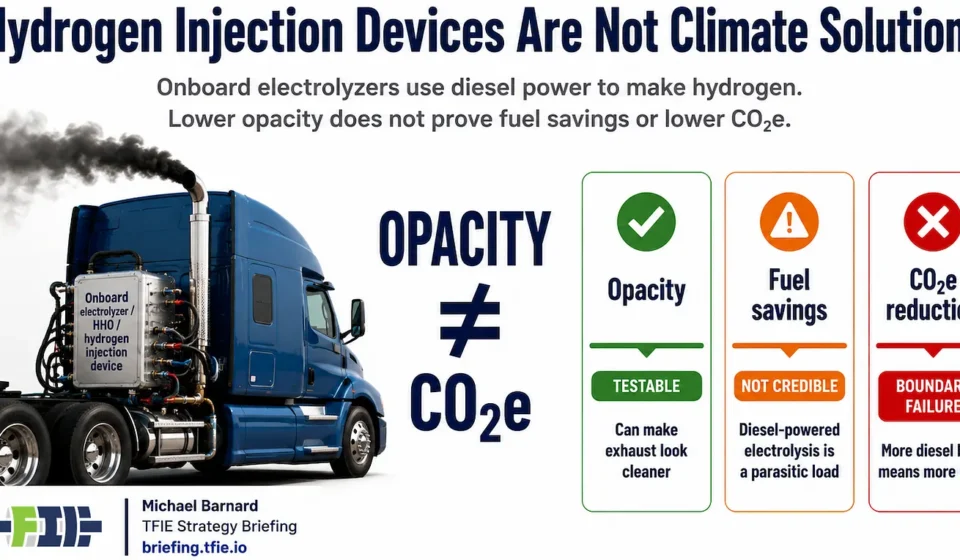
I recently came across an evidence-led analysis of onboard hydrogen-injection devices for diesel engines. The core observation is simple but important: injecting a small hydrogen or oxyhydrogen stream can change flame chemistry and reduce visible smoke (opacity). What it does not reliably show is net fuel savings, lower CO2e, reduced particulate mass, or improved lifecycle emissions – especially when the hydrogen is produced using electricity generated by the same diesel engine.
A systems-architect’s reading
This is a classic systems-design problem. Energy flows, not appearances, determine whether a technology is beneficial. When diesel engine shaft work drives an alternator, which powers an electrolyzer that creates hydrogen to be re-burned in the same engine, you introduce a closed loop with parasitic losses (mechanical, electrical, electrochemical, and control). Any claimed benefit from altered combustion must exceed those aggregated losses – and that requires rigorous measurement, not a photo of “cleaner smoke.”
From an enterprise architecture standpoint the parallels to software observability are instructive: surface metrics (what a user sees) can be misleading if they aren’t correlated with underlying health signals (resource consumption, error rates, tail latencies). Similarly, opacity is a visible indicator but a poor proxy for energy efficiency or emissions performance.
What decision-makers should require
If you are advising a transport operator, fleet CTO, procurement lead, or a policy maker, the bar for acceptance must be high and evidence-driven. Practically, that means:
- Full energy-balance tests: weighed fuel consumption, measured electrical demand (alternator load), and independently measured injected gas flow under repeatable duty cycles.
- Emissions testing beyond opacity: particulate mass, particle number, NOx, and CO2e measured with calibrated instruments.
- Aftertreatment and OBD impact assessment: does the device change regeneration cycles, sensor readings, or DPF/SCR behaviour?
- Independent, third‑party validation and statistical treatment across representative operating regimes – urban, highway, idling, and high-load cases.
- Lifecycle and boundary clarity: differentiate onboard electrolytic generation from externally produced hydrogen (the latter is a different category with external energy accounting).
These requirements protect procurement teams from buying into clever marketing that won’t deliver fuel or climate benefits. They also protect regulators from inadvertently approving systems that interfere with certified emissions controls.
The Bharat context (brief and practical)
For India – where diesel fleets remain large and public procurement decisions affect urban air quality and public expenditure – the implications are immediate. State road transport undertakings and municipal agencies should insist on the test protocols above before accepting retrofits. Equally, consider prioritizing proven pathways that reduce Scope 1 emissions: fleet renewal with cleaner-compliant engines, electrification where feasible, route optimisation, and modal shifts for freight.
Quick takeaways
- Don’t conflate visible smoke reduction with efficiency or climate benefit.
- Demand full-system energy balance and pollutant-specific measurements under controlled conditions.
- Treat onboard electrolytic hydrogen as a closed-loop energy system with parasitic costs; require independent validation.
- For public procurement, include clear acceptance tests, warranty clauses, and telemetry requirements to detect adverse interactions with aftertreatment.
- Prioritise structural solutions (electrification, vehicle replacement, operational efficiency) over hopeful add-ons.
Closing thought
Technology that makes a system look better is not the same as technology that makes the system better – architects and leaders must design measurement and procurement standards that make that distinction unambiguous.
About the Author: Sanjeev Sarma is the Founder Director and Chief Software Architect at Webx Technologies. With a core focus on Generative AI integration, Cloud-Native Scalability, and Enterprise Software Architecture, he has spent over two decades driving digital transformation across Northeast India and beyond. Beyond his corporate leadership, Sanjeev is deeply invested in shaping the future of the IT industry. He serves as an Industry Expert on the Board of Studies for Assam Don Bosco University’s School of Technology, advises state technology committees, and actively mentors emerging tech startups at STPI. He brings a unique, dual perspective of high-level enterprise execution and future-ready academic curriculum development.