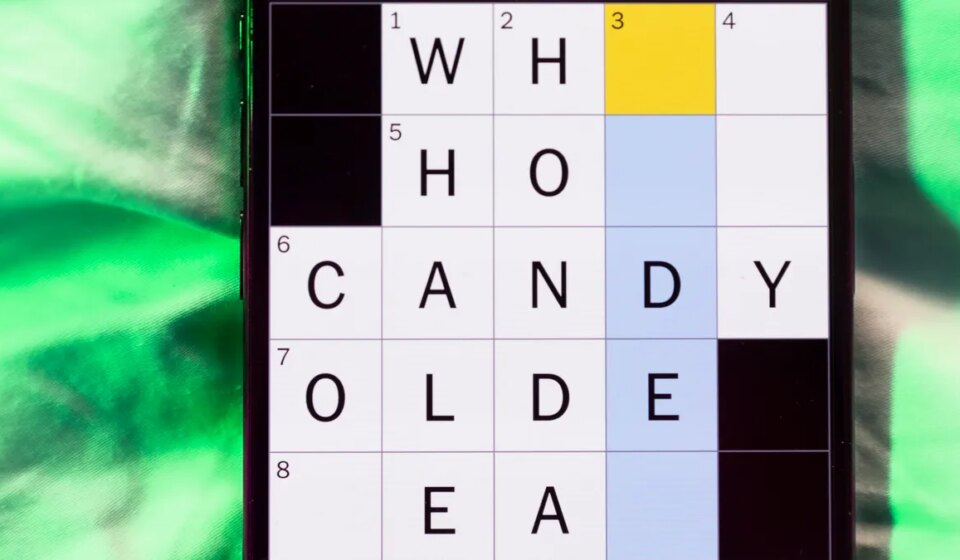

We spend billions debating the next big platform, but the single most persistent product behaviour often lives in five minutes of daily leisure: the Mini Crossword. Small, repeatable digital rituals-answers posted, hints offered, habit loops reinforced-teach us more about product design, audience economics and operational trade-offs than many enterprise-scale launches.
The signal: CNET published a quick-hit piece with answers and hints for The New York Times Mini Crossword for May 18, 2026. It’s straightforward content-today’s completed grid, across/down answers and a short how-to for solvers-but its existence and distribution trace a larger set of strategic forces worth unpacking.
What this means for architects and founders
1. Micro-content fuels macro-retention. A five-minute puzzle is a remarkably sticky product. It converts casual attention into routine behaviour; daily visitors drive repeated sessions, habitual use of a property, and predictable traffic flows that are gold for subscription or ad models. For platform owners, the lesson is not to dismiss “small” features: micro-interactions can be primary retention levers.
2. Friction is the competitive battleground. The value of a mini-puzzle is inversely proportional to the friction around it. Fast load, contextual hints (without spoilers), sensible caching and a one-tap reveal are what make the experience delightful. As architects we must choose between “feature-rich” and “friction-minimal.” Speed wins more often than a glossy UI on resource-constrained devices.
3. Content syndication and SEO create operational responsibilities. Aggregate sites republishing answers (the CNET model) show how derivative, time-sensitive content can generate steady search volume. But this creates obligations: accurate metadata, timestamping, and mechanisms to avoid spoiling for users who prefer discovery. It also raises licensing and IP considerations-automated republication at scale must respect rights and signal attribution.
4. Ethics of spoilers and personalization. Hints and full answers live in tension. Offering layered nudges-hint, partial reveal, full solution-is a simple UX pattern that respects both completionists and learners. Personalization can further enrich this: adaptive difficulty, starter puzzles for newcomers, or targeted nudges based on past performance. But personalization must be transparent and privacy-preserving.
5. Instrumentation over intuition. Measure time-to-first-hint, completion rates, churn after failure, and viral shares. These micro-metrics inform product decisions far faster than quarterly surveys. Chief architects should insist on lightweight telemetry early: it’s the difference between optimizing for “most-clicked” and optimizing for “most-valued.”
Practical moves for technology leaders
– Design micro-experiences as first-class products: prioritize boot-up latency, progressive loading and compact data models.
– Implement layered content delivery (hints → partial reveals → answers) with clear user controls to avoid accidental spoilers.
– Treat syndicated, ephemeral content like a stream: timestamp everything, expose canonical source links, and respect licensing.
– Instrument with micro-metrics: daily completion cohorts, hint-conversion rates, and retention by difficulty segment.
– Consider “frugal UX”: offline caching, low-bandwidth assets, and small payloads for markets with constrained connectivity.
A note on India – and why this matters locally
In regions such as Northeast India, where mobile-first is the norm and connectivity can be intermittent, these design principles are not luxury features but necessities. An offline-friendly, vernacular-friendly mini-game can be an effective tool for digital literacy and habit formation. Puzzles also make excellent lightweight training grounds for logical thinking in school- and community-level programs-small features, outsized social impact.
Takeaways
– Never underestimate daily micro-rituals; they are powerful retention engines.
– Build for speed and graceful degradation before building bells and whistles.
– Respect user agency with progressive reveal patterns and clear timestamps.
– Use lightweight telemetry to iterate rapidly-and always consider local connectivity realities when deploying to diverse markets.
Closing thought
In product strategy, greatness often arrives in tiny, repeatable experiences. The Mini Crossword is more than a diversion; it’s a reminder that building for habit, not just headline features, is where long-term engagement-and therefore long-term value-really lives.
About the Author Sanjeev Sarma is the Founder Director of Webx Technologies Private Limited, a leading Technology Consulting firm with over two decades of experience. A seasoned technology strategist and Chief Software Architect, he specializes in Enterprise Software Architecture, Cloud-Native Applications, AI-Driven Platforms, and Mobile-First Solutions. Recognized as a “Technology Hero” by Microsoft for his pioneering work in e-Governance, Sanjeev actively advises state and central technology committees, including the Advisory Board for Software Technology Parks of India (STPI) across multiple Northeast Indian states. He is also the Managing Editor for Mahabahu.com, an international journal. Passionate about fostering innovation, he actively mentors aspiring entrepreneurs and leads transformative digital solutions for enterprises and government sectors from his base in Northeast India.