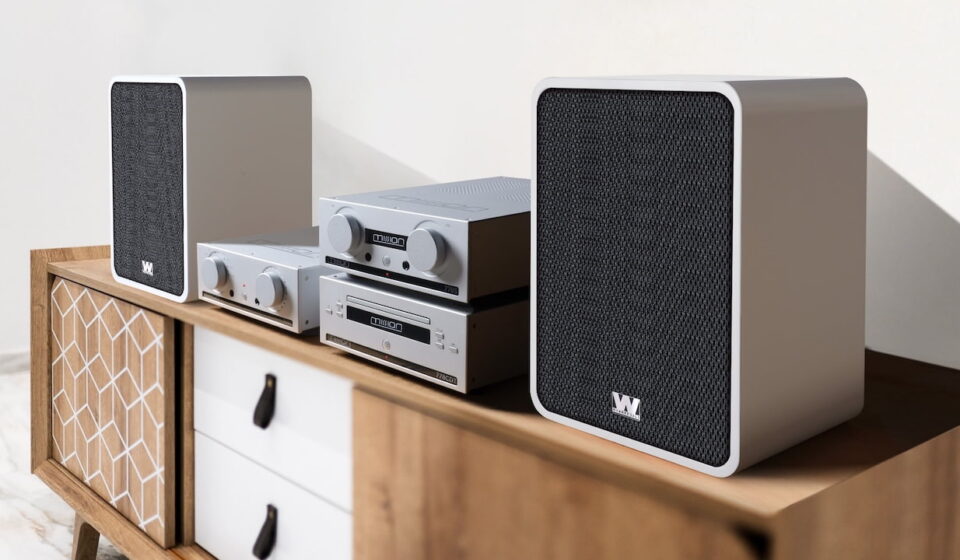

We love nostalgia – especially in product categories where provenance signals craftsmanship. But nostalgia without purposeful engineering is decoration. The more interesting move is when a heritage brand uses its legacy as a platform for a modern technical idea that actually improves user experience in real-world conditions. Wharfedale’s new Denton 1S, with its coaxial point‑source driver and compact, install‑friendly cabinet, is exactly that kind of move.
The signal: Wharfedale repositioned the Denton name around a clean‑sheet coaxial driver, a compact cabinet with wall‑mounting and a Brilliance EQ, and tuning aimed at tighter rooms rather than large, reverberant listening spaces. It’s a pragmatic reframe – keeping brand DNA while solving a practical problem for modern living.
What matters architecturally – in audio and software – is coherence. In loudspeaker design, a coaxial driver that radiates from a single acoustic center simplifies phase relationships and time‑alignment between midrange and treble. The result is often more stable imaging across a wider listening area, which matters in real rooms where listeners move, sit off‑axis, or simply don’t have a perfect “sweet spot.” That’s a product decision: optimize for the user’s context, not a lab ideal.
There are trade-offs. Coaxial drivers are mechanically and acoustically more complex to design well: driver breakup modes, crossover integration, and thermal management all require careful attention. Small cabinets mean limited bass extension, so systems must accept practical boundaries (or design for integration with a subwoofer). Sensitivity and impedance specs then dictate amplifier choices; designing for system compatibility – not maximal headline numbers – produces better end‑user outcomes. These are the same trade-offs software architects face when choosing tightly integrated platforms versus loosely coupled microservices: coherence and predictable behavior versus flexibility and cost.
From a product strategy standpoint, Wharfedale’s approach is instructive for founders and CTOs. First, heritage is an asset, not a roadmap. Use it to build trust, but don’t let it dictate engineering choices that undermine contemporary use cases. Second, solve for the environment: small urban homes and flexible installs require different design assumptions than dedicated listening rooms. Third, communicate realistic system expectations – matching speakers to appropriate electronics, and being honest about bass limits or the need for a sub – reduces returns and increases long‑term satisfaction.
Actionable guidance for technology leaders (audio or software):
– Design for the real environment. Validate in representative contexts, not just in ideal labs.
– Prioritize coherent systems over feature count. A single well‑integrated experience often outperforms many loosely joined features.
– Make interfaces that accommodate real‑world placement and constraints – physical mounting, adaptive EQ, or runtime configuration – so installations are resilient.
– Be explicit about compatibility. Provide recommended pairings and clear operational envelopes (power, sensitivity, latency).
– Embrace measurable metrics. For audio that means impulse/step response and off‑axis measurements; for software, SLA curves and end‑to‑end latency budgets.
A brief note for Indian contexts: the Denton 1S’s focus on compactness and wall‑mounting maps well to dense urban housing and multi‑use living spaces common across Indian cities and the Northeast. Products designed around realistic room behavior – rather than showroom ideals – are more likely to deliver consistent value to users here.
Takeaways
– Coherence beats nostalgia: aim for engineering that improves everyday experience.
– Design trade‑offs should be explicit and communicated.
– Validate products in the environments where they will live.
– Small form factor + thoughtful tuning can unlock new use cases if matched with appropriate system partners.
Whether you’re designing loudspeakers, platforms, or enterprise systems, the lesson is the same: craftsmanship without context is form over function. The smarter play is to use legacy as a launching pad for clarity – a coherent product that understands where and how it will be used.
About the Author
Sanjeev Sarma is the Founder Director of Webx Technologies Private Limited, a leading Technology Consulting firm with over two decades of experience. A seasoned technology strategist and Chief Software Architect, he specializes in Enterprise Software Architecture, Cloud-Native Applications, AI-Driven Platforms, and Mobile-First Solutions. Recognized as a “Technology Hero” by Microsoft for his pioneering work in e-Governance, Sanjeev actively advises state and central technology committees, including the Advisory Board for Software Technology Parks of India (STPI) across multiple Northeast Indian states. He is also the Managing Editor for Mahabahu.com, an international journal. Passionate about fostering innovation, he actively mentors aspiring entrepreneurs and leads transformative digital solutions for enterprises and government sectors from his base in Northeast India.