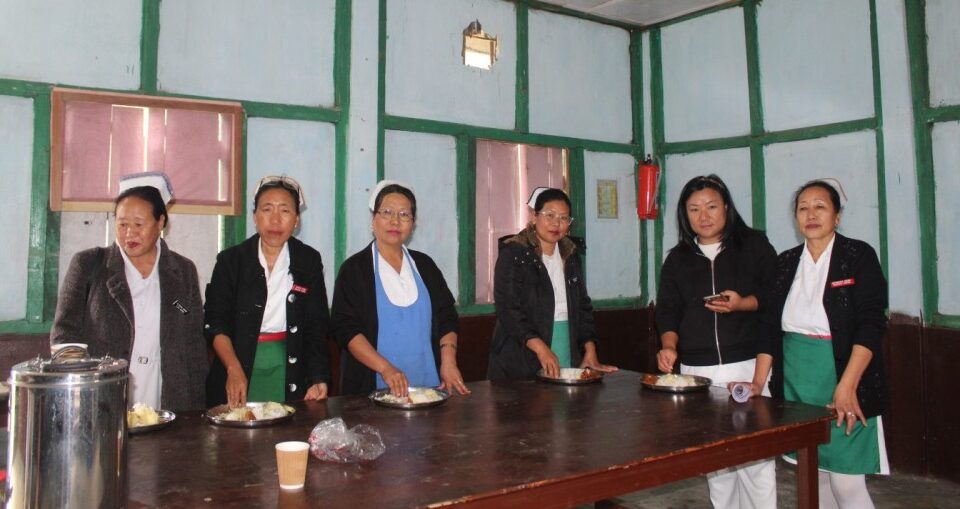

On International Nurses Day 2026 at Hezukhu Memorial District Hospital (HMDH) in Zunheboto, two veteran nurses reflected on decades of service across Nagaland’s remote, underserved areas, describing a career defined by faith, long nights, difficult terrain and persistent staffing and facility shortages. The nurses — Assistant Nursing Superintendent (ANS) Incharge Khekhuli Jimo and Nursing Sister Ghovili — spoke about the challenges of rural nursing, their personal sacrifices and the enduring compassion that guides their work.
Khekhuli Jimo, appointed in 1994, served at Aghunato PHC and spent most of her career in Satakha before transferring to Zunheboto District Hospital in July 2023. A native of Xuivi village, she said nursing is “a very noble profession” carried out “through faith and prayer,” and credited hard work for her progress: “I never missed my classes during my training at Naga Hospital Authority Kohima (NHAK). I always tried my level best.”
Recalling an era of few roads and no vehicles, Khekhuli described walking from village to village to assist deliveries, sometimes delivering babies by the light of an oil lamp because mothers could not reach the hospital. She estimates she helped deliver more than 2,000 babies in Satakha, over 100 in Aghunato and about 20–30 so far in Zunheboto. “Sometimes we deliver at least four babies in a day here,” she said, and stressed that nurses must respond with kindness: “Patients are already suffering. Speak softly to them. Discipline, patience, and smiling care are what matter.”
A vivid memory from her training at NHAK involved two alleged militants brought in under tight security. While many were afraid to treat them, Khekhuli said she nursed them through a hunger strike and helped revive them by convincing them to drink water disguised as medicine; they later told her, “You are a good, smart, and intelligent nurse.” During the COVID-19 pandemic she said nurses “left everything behind and dedicated our lives to serving patients.” As president of the Sumi Totimi Hoho Satakha, she also cooked for quarantined patients and offered moral support.
Khekhuli highlighted severe staffing and facility gaps at the district hospital: “We have only around 15 active nurses,” many assigned across ICU, OPD and other sections, and she described the nurses’ duty room and accommodation as inadequate. Approaching retirement in March 2027, she urged young nurses to wear their uniforms proudly: “The uniform defines you and your profession. Nurses are like angels.”
Ghovili, also appointed in 1994, began at Satoi and moved to Zunheboto in 2024; she is due to retire in 2029. Though she once dreamed of studying theology, family circumstances led her to nursing — a choice she now thanks God for. She recalled travelling in a Nissan 4W73 carrying firewood and walking long distances to collect medicines and vaccines, and urged younger nurses to remain faithful and dedicated, saying, “Never forget prayer because it is your foundation.”
Dr Josia Sema, Medical Officer at HMDH, paid tribute to the nursing fraternity, calling nurses the “backbone” of healthcare and thanking them for their personal care of patients. The accounts of Khekhuli and Ghovili underline both the human cost and the moral commitment of rural nursing in Nagaland, and spotlight persistent needs for more staff and better facilities at district hospitals.
Original Source: https://www.morungexpress.com/oil-lamps-no-roads-and-unshaken-calling
Category: Morung Exclusive , Nagaland
Tags:
Publish Date: 2026-05-12 23:38:00