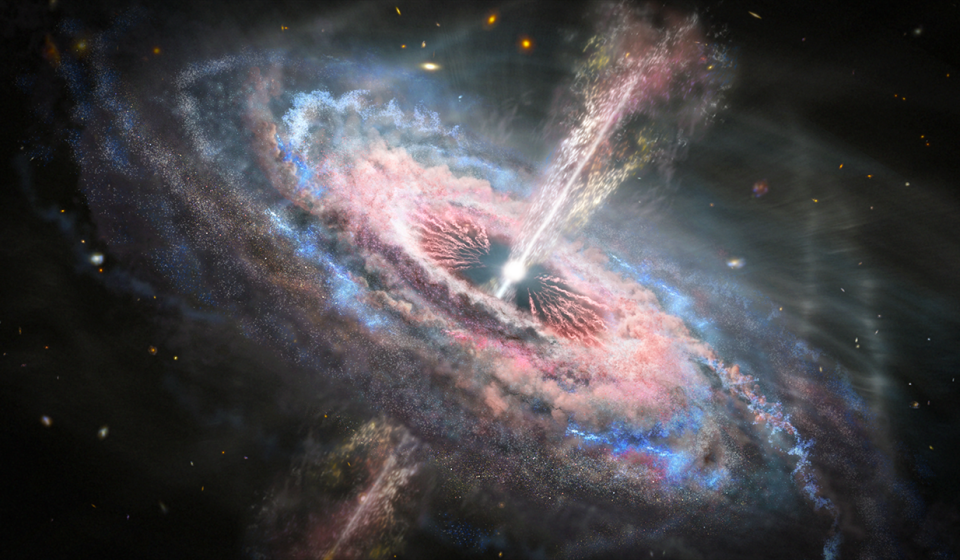

A University of Arizona team using the James Webb Space Telescope has found an unexpected population of powerful, galaxy-scale winds from quasars less than one billion years after the Big Bang, a discovery that offers a plausible mechanism for why many early galaxies stopped forming stars. The team observed 27 high-redshift quasars and identified six with extreme outflows reaching about 5,000 miles per second (≈8,000 km/s). These “super quasars” were at least four times more common at early times and carried roughly 100 times more kinetic energy on average than lower-redshift counterparts, the researchers report in Nature.
Quasars are galaxies whose central supermassive black holes are rapidly accreting matter and releasing enormous radiation. That energy can drive broad, multi-directional winds-distinct from narrow, relativistic jets-that sweep gas out of the host galaxy. Such outflows have long been predicted by cosmological simulations as a way to “quench” star formation by removing the cold gas that fuels new stars, but direct evidence from the right cosmic epoch has been scarce until now.
“Many of those galaxies looked ‘old,’” said Weizhe Liu, first author and JASPER postdoctoral scholar at Steward Observatory, summarizing the long-standing puzzle of massive early galaxies that had already stopped forming stars. Xiaohui Fan, a Regents Professor and associate head of Arizona’s Department of Astronomy, noted the difference between jets and winds: “They essentially just punch a narrow hole into the galaxy,” he said of jets, adding that the radiation-driven outflows detected by JWST act more like a widespread stellar wind.
The team estimates these extreme outflow phases are short-lived-around 100 million years-yet highly destructive: a galaxy hosting such a quasar could lose gas at rates equivalent to thousands of solar masses per year. “That is a very high rate of mass loss,” Liu said, noting that sustained loss over even a million years can strip a galaxy of the gas needed to form stars.
Because the winds are so fast, they may escape into the intergalactic medium and influence regions hundreds of thousands of light-years away. The observations therefore provide a missing link between growing supermassive black holes and the early shutdown of star formation, suggesting that quasar-driven winds played a major role in shaping galaxy evolution during the universe’s first two billion years.
Original Source: https://news.arizona.edu/news/cosmic-blowtorches-how-quasars-shut-down-star-formation-early-universe
Category:
Tags:
Publish Date: 2026-05-07 02:28:00