
In the heart of northern Mauritania’s Adrar Plateau, a rich tapestry of human history unfolds against a backdrop of stunning desert landscapes. This remote area of northwestern Africa is dotted with Paleolithic stone tools, ancient Neolithic cave paintings, and remnants of medieval towns that once thrived along the routes of caravans crossing the vast Sahara Desert.
From a distance-or better yet, from space-the natural beauty of the landscape takes center stage. Winds have carved vibrant seas of sand dunes, while plateaus are scoured to reveal dark desert pavements. Additionally, ancient waterways have sculpted valleys and residual networks of dried riverbeds, further enhancing the site’s geological intrigue.
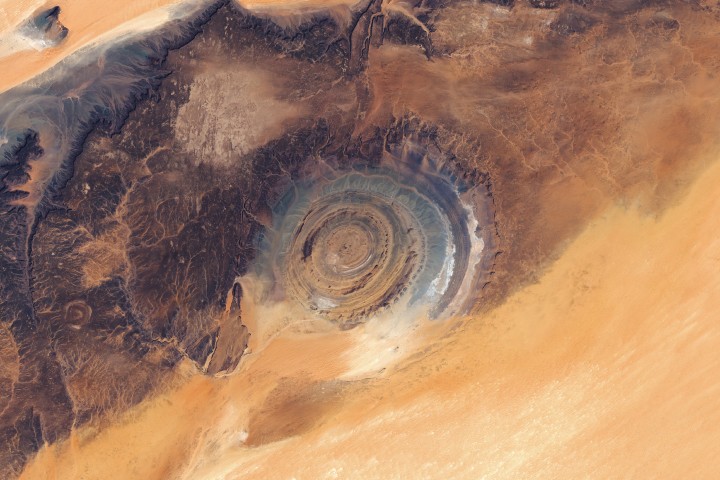
However, the most captivating feature of this region is the Richat Structure, often referred to as “The Eye of the Sahara.” This massive geological formation showcases concentric ridges and spans a remarkable 40 kilometers (25 miles) in diameter. French geographers initially documented the structure in the 1930s, dubbing it the “buttonhole” due to its distinctive appearance. The Richat Structure achieved greater notoriety after NASA astronauts Ed White and James McDivitt captured it from space during the historic Gemini IV mission, cementing its status as a unique geological marvel.
Initially mistaken for an impact crater, the Richat Structure has since been identified as a deeply eroded geologic dome. This formation is the result of rock uplift above an underground intrusion of igneous material. Over time, varying erosion rates among the different rock types in the dome led to the creation of circular ridges, known as cuestas. The striking orange and gray hues found within and around the structure are indicative of the diverse sedimentary and igneous rock types that characterize this geological wonder.
Research into the Richat Structure continues to yield fascinating insights. A study published by Abdeina et al. in 2024 explored the polyphase history of this intriguing site, shedding light on its geologic significance. Their findings, along with earlier research, suggest that the formation’s layered geology holds vital clues to understanding the region’s geological past.
The Richat Structure is not only a scientific marvel but also a cultural treasure, reflecting the intricate interplay between humans and their environment over millennia. Local inhabitants have long recognized its prominence, incorporating it into their stories and traditions, linking their lives to the enduring landscape.
As interest in the Richat Structure continues to grow, it has become a point of attraction for researchers and tourists alike, leading to a deeper appreciation of this natural wonder’s geologic and cultural significance. This iconic feature stands as a testament to the power of natural forces, as well as the rich history that permeates through the sands of the Sahara.
The Eye of the Sahara remains a focal point for scientific inquiry and cultural exploration, bridging the realms of geology and human history in this enchanting corner of Africa. As ongoing studies pour more light onto its origins and transformations, the Richat Structure promises to captivate both scholars and adventurers for years to come.
Original Source: https://science.nasa.gov/earth/earth-observatory/eyeing-the-richat-structure/
Category :
Tags:
Publish Date: 2026-04-17 23:03:00