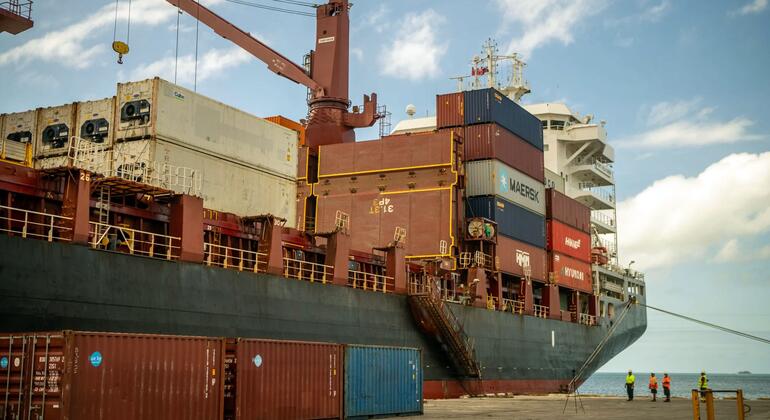
“Despair in the Pacific: How the Middle East Conflict Strangles Supply Chains and Dims Our Future”

Tuya Altangerel, a senior official with the UN Development Programme (UNDP) for the Pacific, underscored the profound impacts of the current energy crisis, stating, “We are at the end of the supply chain, so this energy crisis is really impacting our communities.” As a key hub in the Pacific, Fiji plays a pivotal role for surrounding island nations, which span thousands of miles across the world’s largest ocean. Unfortunately, this geographic isolation poses significant logistical and financial challenges. From Fiji to Tuvalu and the Marshall Islands to the Solomon Islands, governments are implementing measures to conserve fuel, protect vulnerable families, and maintain essential services.
Concerns are escalating regarding how disruptions in the Middle East are affecting Pacific nations like Kiribati. The Strait of Hormuz, critical for global supply chains, has been largely blocked, disrupting approximately 20% of the global seaborne oil and gas trade. For the Pacific region, rising oil prices and freight costs stemming from these disruptions pose immediate threats, exacerbating the already tenuous shipping links that connect these remote island communities to Asian markets.
The United Nations Conference on Trade and Development (UNCTAD) notes that the Pacific Small Island Developing States (SIDS) have some of the weakest maritime connectivity in the world. With limited direct shipping routes, goods-including food and fuel-often have to be transferred between multiple vessels, driving prices up. In fact, SIDS paid nearly double for international transport of imports compared to developed nations in 2022. This precarious dependence on fossil fuels makes these islands highly susceptible to any disruptions in global oil supply chains. In many cases, transport accounts for around 70% of the region’s fuel imports, leaving countries like Tuvalu reliant on diesel for over 90% of their energy needs.
In response to the escalating crisis, Pacific governments are taking swift action. In Fiji, the government has urged citizens to refrain from panic buying amid rising fuel prices. As the primary regional distribution hub, Fiji’s situation further complicates supply chains across other Pacific nations. Tuvalu has declared a state of emergency, while the Marshall Islands is under a 90-day economic emergency. The Solomon Islands has also noted a fuel reserve of just 40 to 50 days. Meanwhile, Vanuatu has alerted its citizens to expect increases in electricity pricing, and other nations like Palau, Nauru, and Kiribati are contemplating similar measures.
The situation is particularly dire for households, with many experiencing blackouts and unstable services. Altangerel remarked on Tuvalu’s struggle with daily power outages, a sentiment echoed in parts of Fiji despite its relatively robust economy. These crises have been compounded by recent cyclones affecting the region.
Looking ahead, Altangerel cautioned that the worst may still be yet to come if fuel prices continue to escalate. “The last thing we want is for critical work to stop due to this energy crisis happening worldwide,” she stated. She highlighted the potential adverse effects on Tuvalu’s Coastal Adaptation Plan, designed to safeguard against rising sea levels. For Pacific islanders, the message is clear: a distant crisis can quickly manifest into a pressing local issue, placing additional strain on vulnerable communities already grappling with the effects of climate change and extreme weather events.
Original Source: https://news.un.org/feed/view/en/story/2026/04/1167303
Category :
Tags:
Publish Date: 2026-04-15 17:30:00