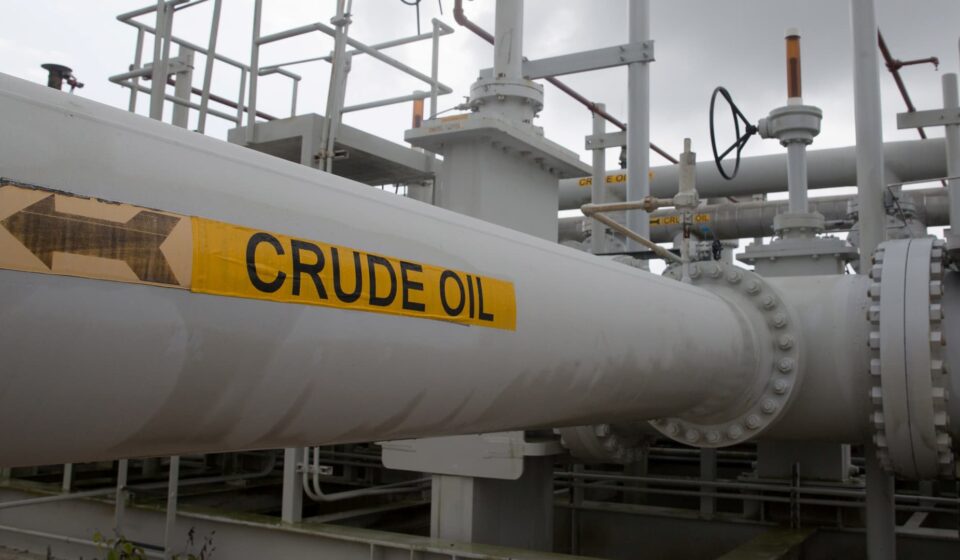

Oil prices saw a slight uptick in volatile trading on Friday amid escalating tensions in the Strait of Hormuz, a critical maritime route for global oil supply. Despite a recent ceasefire agreement between the U.S. and Iran, significant disruptions have kept shipping operations in this vital passage substantially limited. As of 1:06 PM ET, West Texas Intermediate (WTI) crude futures for May delivery rose by 0.4%, reaching $98.29 per barrel, while the international benchmark, Brent crude for June delivery, increased by 0.56% to $96.48 per barrel.
On Thursday, U.S. President Donald Trump issued a stern warning to Iran, urging the country to “stop now” its alleged charges on tankers seeking to transit the strait. This warning raises concerns about the fragility of the two-week ceasefire, which hinges on the reopening of this crucial waterway. The Strait of Hormuz previously accounted for around 20% of the world’s oil supply, and continued restrictions have left markets jittery. Trump criticized Iran’s handling of oil transit, stating in a post on Truth Social that they are “doing a very poor job, dishonorable some would say,” in allowing oil to pass through the strait.
Trump’s chief economic advisor, Kevin Hassett, emphasized that successfully getting just one oil tanker across the strait could significantly alleviate current supply shortages. Concurrently, attacks on Saudi Arabia’s energy infrastructure have further hampered oil production. According to the Saudi Press Agency, these strikes have reduced the country’s oil output capacity by approximately 600,000 barrels per day, with disruptions in the East-West Pipeline causing a reduction of around 700,000 barrels per day in flows.
The state news agency reported that Iranian strikes recently targeted a pumping station along this pipeline, which transports crude oil from facilities near the Persian Gulf to the Red Sea export terminal at Yanbu. In light of ongoing conflict, Riyadh has increasingly relied on this pipeline for exports as the Strait of Hormuz has become more dangerous for shipments. Separate attacks on Saudi Arabia’s Manifa and Khurais oil fields have further cut production capacity, compounding the supply challenges.
The U.S.-Iran ceasefire agreement reached on Tuesday was contingent upon Iran permitting vessels to pass through the strait. However, the chief executive of the United Arab Emirates’ state oil firm noted on Thursday that the waterway remains largely closed to shipping. With imports into the Gulf now dropping below 2 million barrels per day and transit times stretching to several weeks, analysts at Goldman Sachs predict that buyers will have to draw on stockpiles and alternative supplies for at least another month. This situation is exacerbated by rising fuel prices, which may eventually dampen demand.
As the geopolitical landscape evolves and oil supply remains constrained, stakeholders will be closely monitoring these developments for their broader implications on global markets.
Tags: Oil Prices, Strait of Hormuz, U.S.-Iran Relations, Saudi Arabia, Global Oil Supply, Energy Infrastructure.
Original Source: https://www.cnbc.com/2026/04/10/oil-price-wti-brent-saudi-pipeline-attack-middle-east-war.html
Category :
Tags:
Publish Date: 2026-04-10 10:38:00