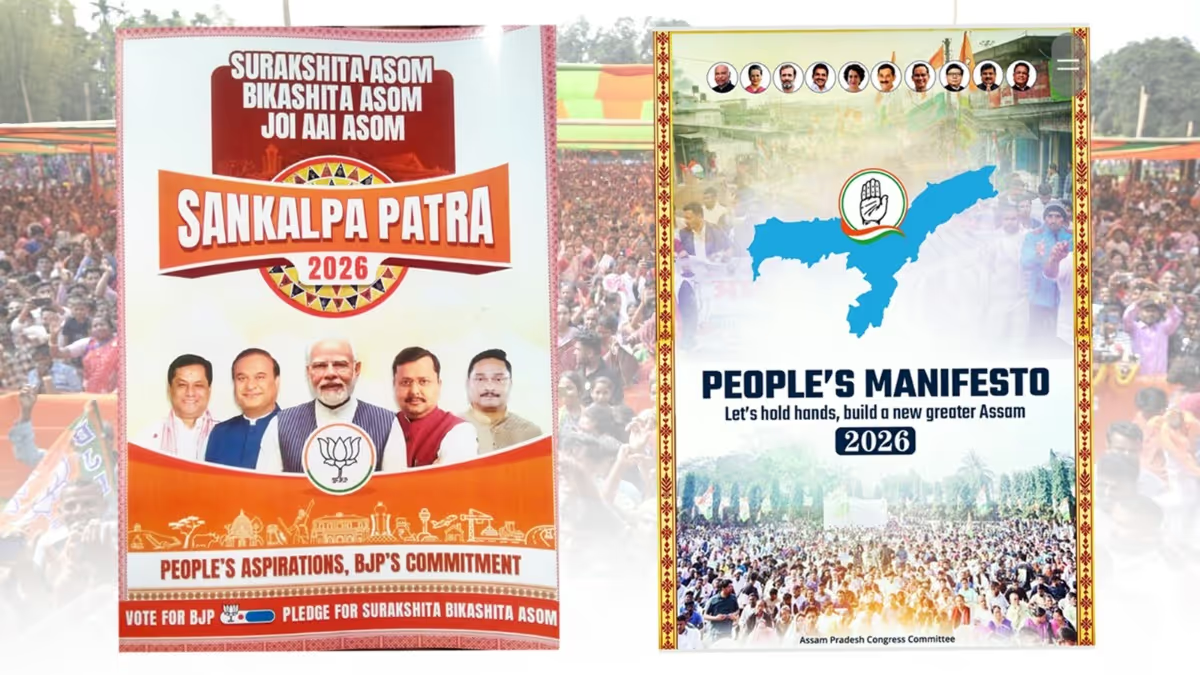

With less than a week before Assam votes on April 9, the state’s two principal contenders have published starkly different blueprints for government. The BJP’s 80-page Sankalp Patra frames its case as a catalogue of past delivery and future scale, while Congress’s 32-page People’s Manifesto leads with immediate, big-ticket promises and an emotional appeal to restore a shared Assamese identity. Together, the documents map competing answers to who Assam is, what ails it and who should govern next.
The BJP opens with a data-heavy ledger — what it calls “Paribartan Spashta” — comparing UPA and NDA-era indicators before listing 31 forward pledges across themes such as security, infrastructure, youth, women and farmers. Its economic ambition is sweeping: a target to double Assam’s economy to $150 billion by 2031 and Rs 5 lakh crore in infrastructure under an Asom Gati Shakti plan, citing projects like a Rs 27,000 crore semiconductor plant and the Rs 10,600 crore Namrup fertiliser project.
Congress, by contrast, begins with five bold “Pratishrutis” — unconditional monthly cash transfers to every woman, Rs 50,000 seed capital for businesses, Rs 1,250 monthly pensions for seniors, justice for Zubeen Garg within 100 days, conversion of Eksoniya pattas into Miyadi pattas for 10 lakh indigenous people — followed by a broader “Natun Bor Axom” vision. Its approach mixes immediate welfare promises (a Rs 25 lakh cashless health cover per family) with an implementation roadmap for 100 days, one year and five years.
Identity politics divides the manifestos. The BJP emphasises protection of “land, heritage and dignity” of indigenous people, pledging to implement the Immigrants (Expulsion from Assam) Act, legislate against what it terms “Love Jihad” and “Land Jihad”, and pursue a Uniform Civil Code outside Sixth Schedule areas. Congress frames identity as “Shared Assamese Identity”, focusing on legal safeguards such as the Assam Accord, the Sixth Schedule and the Forest Rights Act while promising land rights and probes into large corporate allotments.
Both parties highlight women as a pivotal constituency. The BJP proposes raising Orunodoi transfers from Rs 1,250 to Rs 3,000 over time and expanding coverage by 15 lakh households, alongside entrepreneurship grants and an all-women police battalion. Congress offers an unconditional monthly transfer to every woman’s bank account, Rs 50,000 start-up grants, up to 40% reservation in government jobs and extended maternity leave.
On health and floods the contrast is scale versus access. The BJP promises a Rs 50,000 crore Assam Swasthya Utkarsha Abhijan and large hospitals and centres of excellence; Congress promises higher cashless cover, guaranteed ambulances, a Family Doctor Programme and a Brahmaputra Basin Plan with a Climate Resilience Fund. Tea workers, youth employment, and revival of traditional industries feature in both manifestos with different emphases and instruments.
Neither document addresses the fiscal arithmetic in depth: cumulative commitments — from Rs 5 lakh crore in infrastructure to Rs 25 lakh health covers — appear to exceed the state’s budgetary capacity. Stripped to their core, the BJP’s pitch is confidence — delivery and a “double engine government” with Delhi — while Congress’s is yearning for inclusive redress and restored plural identity. The election will hinge on which emotional register — ledger or longing — moves voters across the Brahmaputra and Barak Valley.
Original Source: https://www.indiatodayne.in/elections/story/bjp-vs-congress-which-party-has-the-better-manifesto-in-assam-1370225-2026-04-04?utm_source=rssfeed
Category:
Tags:
Publish Date: 2026-04-04 12:28:00