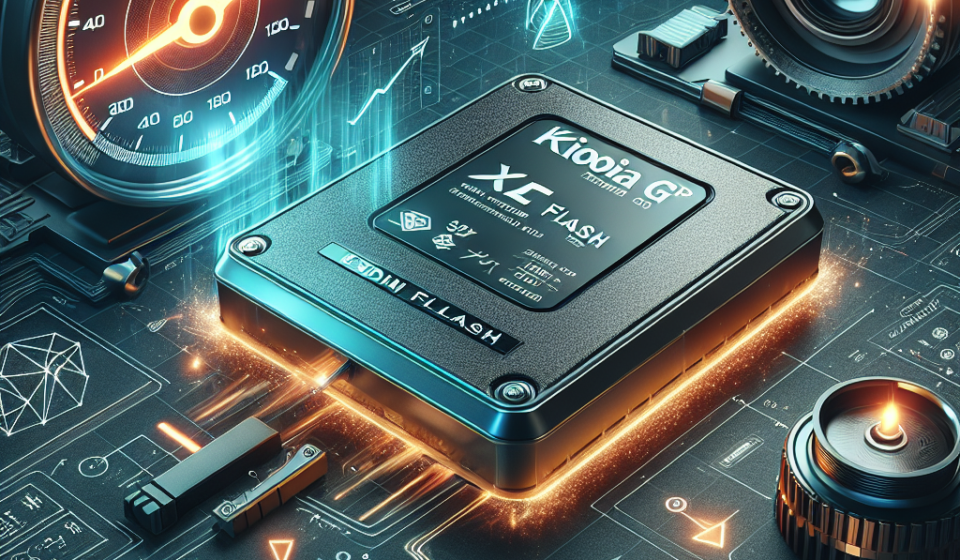

We obsess about GPU FLOPS, PCIe lanes and TFLOPS – but the single biggest limiter for large-scale AI today is increasingly the memory hierarchy. If GPUs are the engines, memory is the fuel tank; making that tank larger without bankrupting the organization is the architectural problem we must solve next.
Context
Kioxia’s GP Series (announced at NVIDIA GTC 2026) introduces an SSD-class product – based on Storage Class Memory (XL-FLASH) – that’s explicitly designed to act as a GPU-accessible memory tier. It’s not about sequential throughput; it targets low latency and very high random IOPS to serve workloads (KV caches, embedding stores, large context windows) that can’t fit in HBM alone.
Analysis – why this matters for architecture and strategy
1) A new tier in the memory hierarchy changes system design, not just hardware choices. Historically we architected for two fast tiers (HBM / DRAM) and one slow tier (NAND/NVMe). SCM blurs that boundary: it sits closer to DRAM in latency but costs and scales like storage. The immediate consequence is an architectural split – workloads need to be refactored to exploit a small ultra-fast tier (HBM), a mid-tier (SCM), and a large, cheaper tier (SSD/remote storage).
2) Software and orchestration are the gating factor. Hardware alone won’t solve it. GPUs and frameworks must support direct-attached SCM, efficient DMA, coherent caching, prefetching, and fine-grained paging strategies. Expect a period where custom software layers (paging policies, KV cache placement, embedding lookup routing) decide winners and losers.
3) Trade-offs are explicit: latency vs. capacity vs. endurance. XL-FLASH chooses millions of random IOPS and low latency over raw sequential throughput. That’s perfect for random-access KV stores and inference-heavy pipelines, but less so for sequential training checkpoints. Also consider SSD endurance modes (SLC vs. TLC) – higher endurance comes at cost and capacity trade-offs.
4) Vendor, ecosystem and standards risk. Successful adoption requires broad ecosystem support – from GPU vendors (for direct-access APIs) to OS kernel drivers and orchestration platforms. Past attempts to introduce similar tiers (e.g., earlier persistent-memory efforts) failed partly due to lack of software maturity and integration. Architects should budget for integration effort and avoid assuming “plug-and-play.”
5) Security, observability and reliability become first-class concerns. When GPUs can DMA into persistent or semi-persistent storage, encryption, access control, and secure deallocation are essential. Operationally, monitoring IOPS, hot-spotting, and wear-leveling metrics become part of normal SRE practices.
What CTOs and founders should do next
– Profile before you buy: benchmark your real workloads (KV cache sizes, random IOPS, latency sensitivity) and quantify HBM pressure.
– Design a hybrid memory strategy: treat SCM as an extension of volatile memory for specific subsystems (e.g., KV cache offload, embedding stores) rather than as a blanket replacement.
– Build an abstraction layer: a small library or service that hides tiering complexity from model code, enabling fallback across HBM/SCM/SSD without major model changes.
– Plan for lifecycle and governance: define encryption, secure erase, and replacement policies; factor in endurance and vendor support SLAs.
– Start small with staged pilots: validate cost-per-parameter and operational playbooks before large rollouts.
Relevance for India and regional labs
For cost-sensitive AI teams and public sector labs in India (including smaller innovation centres in the Northeast), SCM could lower the barrier to experimenting with larger models without acquiring more HBM-heavy GPUs. Pragmatically, this means more local experimentation, provided we invest modestly in software integration and operational training – an area where ecosystem support (STPI centres, academic partnerships) can play a catalytic role.
Takeaways
– SCM is not a silver bullet; it’s a tactical lever to extend GPU memory affordably.
– Software and orchestration maturity will determine adoption speed.
– Short pilots, real workload profiling, and secure operational practices are non-negotiable.
– For emerging AI ecosystems, SCM can democratize access to larger models – if matched with software investment.
Closing thought
Hardware innovations change what is possible; software and architecture determine what is practical. The next wave of AI competitiveness will be won by teams that treat memory as a first-class architectural variable – not an afterthought.
About the Author Sanjeev Sarma is the Founder Director of Webx Technologies Private Limited, a leading Technology Consulting firm with over two decades of experience. A seasoned technology strategist and Chief Software Architect, he specializes in Enterprise Software Architecture, Cloud-Native Applications, AI-Driven Platforms, and Mobile-First Solutions. Recognized as a “Technology Hero” by Microsoft for his pioneering work in e-Governance, Sanjeev actively advises state and central technology committees, including the Advisory Board for Software Technology Parks of India (STPI) across multiple Northeast Indian states. He is also the Managing Editor for Mahabahu.com, an international journal. Passionate about fostering innovation, he actively mentors aspiring entrepreneurs and leads transformative digital solutions for enterprises and government sectors from his base in Northeast India.