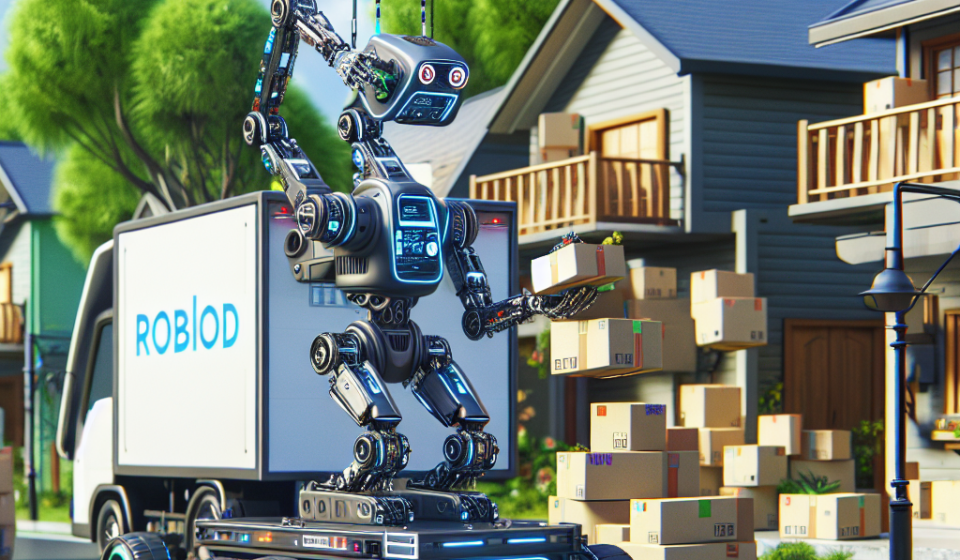

The day an e‑commerce giant buys a tiny startup built to climb stairs should make every architect, CTO and city planner sit up. This is where software’s scalability challenge meets the messy physical world – thresholds, curbs, narrow stairwells and human behaviour – and the software-first playbook needs urgent rethinking.
Context (the signal)
I recently read about a Zurich‑based robotics startup, Rivr, whose four‑legged, wheeled, stair‑climbing delivery robot was acquired by Amazon. The move – following pilots and investor interest from Amazon‑affiliated funds – signals a shift from lab demos to commercial doorstep deployments.
Why this matters (the strategic zoom‑out)
For two decades we’ve been solving scale in a virtual sense: more users, more data, more uptime. Bringing scale to the physical world adds dimensions that software rarely faces: mechanical tolerances, unpredictable environments, regulatory boundaries, and social acceptance. When a company like Amazon acquires a niche robotics team, they are buying more than locomotion IP – they are buying local knowledge about how machines behave in human spaces and the engineering maturity to integrate hardware into complex logistics flows.
Three architectural implications every technology leader should register
1. Systems thinking must extend to “mechanical downstreams.”
Software architects already account for network latency, failover and transactional integrity. Now include mechanical failure modes and recovery-battery degradation, motor stalls, sensor occlusion, and the human interventions they demand. Design for graceful degradation: if a robot can’t reach a doorstep, how does the orchestration layer reroute the delivery, notify the customer, and maintain SLA transparency?
2. Build vs Buy becomes a strategic portfolio decision – sooner than you think.
Rivr’s acquisition illustrates why platform owners buy specialized robotics teams: years of mechanical iteration, field data and safety validation are expensive and slow. For enterprises evaluating automation, consider a hybrid approach: buy proven subsystems (perception stacks, chassis modules) while retaining integration, operations and customer experience in‑house. That reduces time to market without surrendering control of critical UX and data flows.
3. The operational plane (people + policy) is as important as the technical plane.
Robots operate where people live and move. Safety certifications, insurance, public policy sandboxes and human‑in‑the‑loop processes will determine whether deployments scale. Expect regulators to demand clear liability models and audit trails for decisions made by “physical AI.”
Localization – why this matters for India and the Northeast
This is not only a Western urban problem. In India – and especially in our Northeast cities and towns – the last mile is characteristically complex: multi‑storey tenements with narrow staircases, irregular sidewalks, monsoon‑era drainage, and congested lanes. A robot that works on Austin pavements may struggle in Guwahati or Shillong without re‑engineering for local constraints. For Indian founders and state IT planners, the priority should be prototyping for conditions that matter: low bandwidth connectivity, ruggedized hardware, and simple, recoverable failure modes that a delivery agent or neighbour can resolve. There is also an opportunity for frugal innovation – low‑cost modular attachments or human‑assist protocols that preserve value without expensive full autonomy.
Practical actions for CTOs, founders and policymakers
– Treat field pilots as system tests, not demos: instrument everything and plan for iterative mechanical improvements.
– Define clear APIs and standards for fleet orchestration, telemetry, and safety logs – interoperability reduces lock‑in.
– Build human recovery workflows: quick‑response teams, remote teleoperation, and clear user notifications.
– Engage regulators early with sandbox proposals – liability, privacy and public safety must be addressed before scale.
– Localize aggressively: test for weather, stairs, narrow alleys and local user expectations.
Takeaways
– The frontier of scale is now physical: success requires combining software rigor with mechanical fieldcraft.
– Acquisitions will shortcut hard hardware learning but integration and ops remain the battleground.
– In India, localized pilots and frugal engineering will decide whether doorstep robotics are a novelty or a real solution.
Closing thought
We are moving from cloud scale to curb scale – and those who architect across both planes (digital and physical) will set the rules for the next decade of delivery systems.
About the Author
Sanjeev Sarma is the Founder Director of Webx Technologies Private Limited, a leading Technology Consulting firm with over two decades of experience. A seasoned technology strategist and Chief Software Architect, he specializes in Enterprise Software Architecture, Cloud-Native Applications, AI-Driven Platforms, and Mobile-First Solutions. Recognized as a “Technology Hero” by Microsoft for his pioneering work in e-Governance, Sanjeev actively advises state and central technology committees, including the Advisory Board for Software Technology Parks of India (STPI) across multiple Northeast Indian states. He is also the Managing Editor for Mahabahu.com, an international journal. Passionate about fostering innovation, he actively mentors aspiring entrepreneurs and leads transformative digital solutions for enterprises and government sectors from his base in Northeast India.