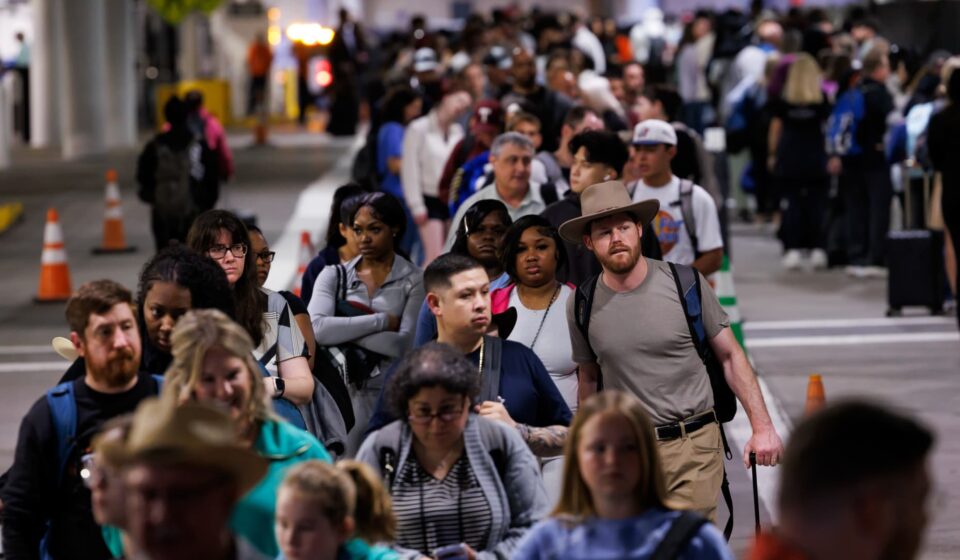

Travelers at William P. Hobby Airport in Houston, Texas, are experiencing longer waits as the aviation industry grapples with surging fuel prices following recent military actions involving the U.S. and Israel against Iran. The increase in jet fuel costs is already pushing airlines to hike airfares as customer demand remains robust for travel in 2026.
Cathay Pacific announced it will double its fuel surcharges starting March 18, joining other airlines like Qantas, which recently increased fares to offset rising costs. Scandinavian Airlines has also raised ticket prices, citing an “unusually rapid and substantial” uptick in fuel expenses. Air New Zealand is holding off on its financial forecasts until market conditions stabilize, warning that ongoing instability could lead to further fare increases and operational adjustments.
Airline executives will brief investors at the J.P. Morgan Industrials Conference in Washington, D.C., where analysts predict a hit to earnings, especially in the first half of the year. UBS airline analysts Atul Maheswari and Thomas Wadewitz noted, “A hit to 1Q EPS appears almost certain.” United Airlines CEO Scott Kirby supports this view, indicating that higher fares are on the horizon due to ballooning fuel prices. Despite this, he and other industry leaders reaffirmed that travel demand remains solid.
Travelers are advised to book flights early to lock in prices, particularly if they avoid restrictive economy tickets. Scott Keyes, founder of the flight deal site Going, emphasizes that customers have options: if they purchase a ticket that later drops in price, they can claim the difference in a credit, making early bookings a low-risk strategy.
Jet fuel has risen to approximately $3.78 per gallon, significantly increasing operational costs for airlines. United Airlines reported spending $11.4 billion on fuel last year, with prices averaging $2.44 per gallon. The spike in fuel expenses is expected to have its most profound impact within the next 30 to 90 days, as carriers adhere to pricing they had set earlier, assuming lower fuel costs.
Market dynamics are exacerbated by ongoing geopolitical tensions, including the recent conflict in the Middle East, which has contributed to airspace restrictions and increased operational complexities. More than 46,000 flights to and from the region have been canceled since late February, leading to constrained capacity that further inflates ticket prices.
Airlines have historically adapted to fuel price fluctuations by implementing added fees and operational changes. United Airlines, for instance, has previously reduced in-flight magazine weight to cut fuel costs. Courtney Miller, an aviation industry expert, notes that while higher fares may set an expectation among consumers, airlines will not hesitate to adjust capacity in response to demand.
As airlines face these turbulent market conditions, the industry shift from hedging against fuel price volatility-fewer U.S. carriers are engaging in these practices-leaves them more vulnerable to price swings. Kirby indicated that sustained higher fuel prices could affect United’s financials in the coming quarters, though demand from regions impacted by flight cancellations is on the rise. Industry analysts suggest the equilibrium between demand and fuel costs will ultimately influence fare adjustments going forward, shaping the travel landscape in the months ahead.
For more updates on airline trends and travel forecasts, stay tuned to CNBC for trusted insights into the evolving market conditions.
Original Source: https://www.cnbc.com/2026/03/12/airfare-prices-jet-fuel-iran-war.html
Category :
Tags:
Publish Date: 2026-03-12 22:18:00