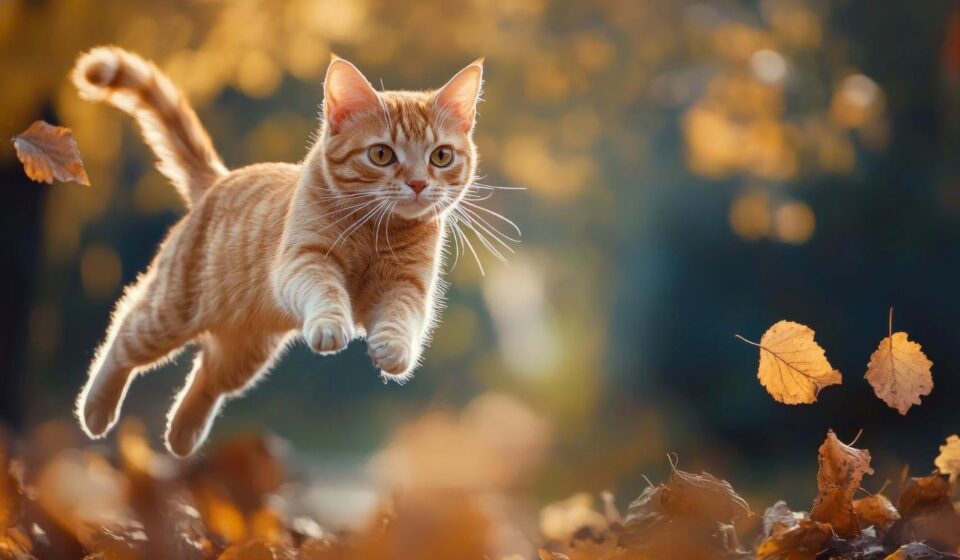
Unveiling the Marvel: Scientists Discover the Incredible Secret Behind How Cats Defy Gravity and Always Land on Their Feet!

Have you ever marveled at a cat’s uncanny ability to land on its feet after a tumble? Known as the “air-righting reflex,” this fascinating phenomenon has intrigued pet owners and scientists alike for centuries. A recent study from Yamaguchi University in Japan offers new insights into the biomechanics behind this extraordinary skill.
Researchers investigated the flexibility of the feline spine during twisting motions to determine how this physical characteristic helps cats achieve their remarkable landings. By examining five cat spines in a controlled laboratory setting, they measured the strength, range of motion, and stiffness in both the thoracic (chest) and lumbar (lower back) regions. The team also documented two cats as they executed their famed air-righting maneuver.
Findings from the study revealed significant differences between the thoracic and lumbar spine. Notably, the thoracic spine displayed remarkable flexibility, enabling a wide range of motion and easy bending. Researchers identified a “neutral zone” of approximately 47 degrees, where the thoracic spine could rotate freely without resistance. In sharp contrast, the lumbar spine was characterized by greater rigidity and strength, with no neutral zone present.
Through the live recordings of the cats, a clear pattern of body rotation emerged during the air-righting maneuver. Initially, the front half of the cat’s body would twist, followed by the rear half. This staggered movement aligns perfectly with the anatomical features of the spine, illustrating that cats do not simply rotate in one fluid motion while falling.
This efficient coordination highlights the interplay between the two spine regions: the flexible thoracic spine initiates the twist, while the more rigid lumbar spine maintains control and stability, ensuring a safe landing. The results not only enhance our understanding of feline anatomy but also underscore the air-righting reflex as a sophisticated biomechanical strategy rather than just a playful party trick.
This research illuminates the intricate engineering behind a cat’s graceful acrobatics, showcasing a blend of flexibility and stability that allows them to navigate their environment with ease. As the study concludes, it solidifies the notion that beneath their seemingly effortless leaps and tumbles lies an impressive anatomical design that has evolved over time.
For animal lovers and cat owners, understanding these mechanics can deepen appreciation for our feline friends’ remarkable abilities. This research not only contributes to the field of animal biomechanics but also inspires curiosity about how other animals adapt their bodies for survival.
The findings are detailed in the academic journal The Anatomical Record, authored by Yasuo Higurashi, Yasufumi Kaino, Makoto Habara, Shiki Okamoto, Kyoko Yoshizaki, Masashi Sakurai, and Masahiro Morimoto. Their work significantly enhances our knowledge of the falling cat problem, revealing the unique adaptations that allow these agile creatures to defy gravity.
In summary, the air-righting reflex is a prime example of nature’s ingenuity, showcasing how the interplay of different spine regions gives cats their extraordinary ability to fall with grace. This discovery not only highlights a fascinating piece of feline biology but also serves as a reminder of the marvels that exist in the animal kingdom.
Original Source: https://www.techexplorist.com/spine-secret-behind-cats-landing-feet/102257/
Category :
Tags:
Publish Date: 2026-03-12 15:38:00