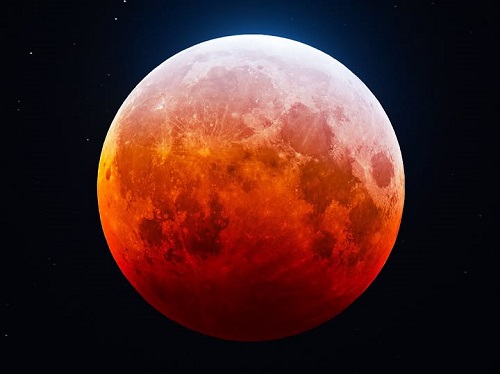

A total lunar eclipse, also called a Chandra Graham, will occur on March 3, 2026, and will be visible across India. The India Meteorological Department (IMD) says the event has a magnitude of 1.155 and will coincide with the Hindu festival of Holi, offering a rare early-evening spectacle for observers nationwide and abroad. The eclipse will also be visible in parts of East Asia, Australia and the Americas.
A total lunar eclipse happens when the entire Moon passes into Earth’s umbral shadow; a partial eclipse occurs when only a portion of the Moon is shadowed. As sunlight filters through Earth’s atmosphere, shorter blue wavelengths scatter and the remaining red and orange light bends toward the Moon, producing the reddish “Blood Moon” hue seen during totality.
According to the IMD, “Most of the places of India will observe the ending of the lunar eclipse at the time of moonrise except some places of North‑East India and Andaman and Nicobar Islands where the end of the totality phase of the eclipse will also be visible.” This means many locations will see the eclipse conclude as the Moon rises, while observers in parts of the northeast and the islands may witness the final moments of totality.
In India the eclipse is scheduled to begin at 3:20 pm on March 3 and end at 6:48 pm, lasting approximately 3 hours and 27 minutes. The IMD and astronomical calculations note this will be the last total lunar eclipse visible from many regions until late 2028 and early 2029, making the March 3 event especially significant for enthusiasts, educators and students.
The Moon is visible to the naked eye, but binoculars or a small telescope will enhance the view. Optical aid reveals the slow sweep of Earth’s shadow across the lunar surface during partial phases and brings cratered terrain and mountain ranges into clearer relief under the warm glow of totality.
Original Source: https://nenews.in/science/total-lunar-eclipse-on-march-3-timings-and-visibility-across-india/43680/
Category: Science,astronomy,India Meteorological Department (IMD),Lunar Eclipse
Tags:
Publish Date: 2026-03-02 22:31:00