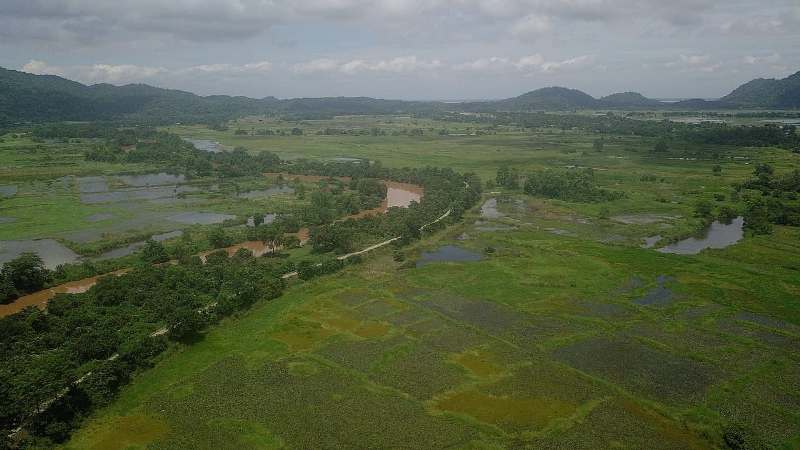

Guwahati’s fragile ecology faces a major threat as the proposed 121-km Guwahati Ring Road-awarded by the National Highways Authority of India (NHAI) to Dineshchandra R Agrawal Infracon Pvt. Ltd under a Build–Operate–Toll (BOT) contract at an estimated cost of Rs 5,729–5,730 crore-is set to cut through wetlands, forested hills and wildlife habitats along the city’s eastern and southern flanks. Officials say the project will ease congestion and provide a northern bypass, but environmentalists warn the gains may come at the cost of flood buffers, biodiversity and human safety.
The scheme is being developed in three phases: a 56-km, four‑lane, access‑controlled Northern Guwahati Bypass; widening of a 7.76–8 km stretch of NH‑27 from four to six lanes between Khanapara and Sonapur; and upgradation of an existing 58‑km NH‑27 bypass. Major components include a nearly 3‑km, six‑lane bridge over the Brahmaputra linking Kuruwa with eastern Guwahati and a new greenfield road from Baihata Chariali to Kuruwa. The alignment runs through Baihata Chariali, Kamalpur, Karara, Mandakata, Chandrapur and Sonapur, and crosses areas linked to the Amchang Wildlife Sanctuary.
Two important wetlands-Khamrenga Beel and Borbila Beel-are directly in the project’s path. Khamrenga Beel, part of the Amchang landscape near Thakurkuchi village, is an important bird area where surveys by conservation group Aaranyak recorded up to 46 species in a single day. Borbila Beel spans about 929 hectares and supports at least 34 species of aquatic macrophytes, serving as a key micro‑habitat and a natural flood buffer. “If the ring road passes through Borbila and Khamrenga wetlands, it will threaten both migratory and water birds… Destroying wetlands is a far more serious offence than felling trees,” said conservation activist Karuna Sharma.
Forest records show 7.12 hectares of forest inside Amchang have been identified for diversion for the road. Officials confirm 2,224 trees inside the sanctuary will be felled, part of an estimated 4,500 trees to be removed across the project; at least 2,000 trees lie within the Khanapara–Sonapur widening. Environmentalists warn that hill cutting, tree felling and diversion will weaken Amchang’s role as a green buffer that absorbs runoff, stabilises slopes and connects wildlife habitats.
Amchang is a critical elephant habitat and movement corridor. A 2019–2021 study published in 2025 in the Israel Journal of Ecology and Evolution found elephants accounted for over 71% of recorded human–wildlife conflicts in five fringe villages around Amchang, largely driven by food and water shortages. Guwahati has seen repeated elephant incursions — including a tusker reaching GS Road in April 2019 — and deadly incidents, such as a female elephant electrocuted in March 2015 and an Army personnel trampled in February 2023. An injured male elephant roamed the Amchang–Jorabat–Satgaon belt in August 2025, attacking vehicles.
Wildlife experts caution that a high‑speed, access‑controlled highway through this corridor will fragment habitat further and likely increase human–elephant conflict. Actor‑activist Arghadeep Baruah criticised approvals made without comprehensive biodiversity assessments and raised concerns about inadequate public consultation. Environmental journalist Mubina Akhtar called the plan “an environmental crime,” arguing alternatives exist-such as widening and connecting the road at Jagiroad or Najirakhat-that could spare trees and wildlife. With bids already invited for tree felling inside Amchang, conservationists warn the window to prevent irreversible damage is rapidly closing.
Original Source: https://nenow.in/top-news/how-guwahati-ring-road-project-puts-wetlands-elephants-in-amchang-and-city-at-risk.html
Category: Assam,Environment,Northeast News,Top News
Tags:
Publish Date: 2026-02-11 00:20:00