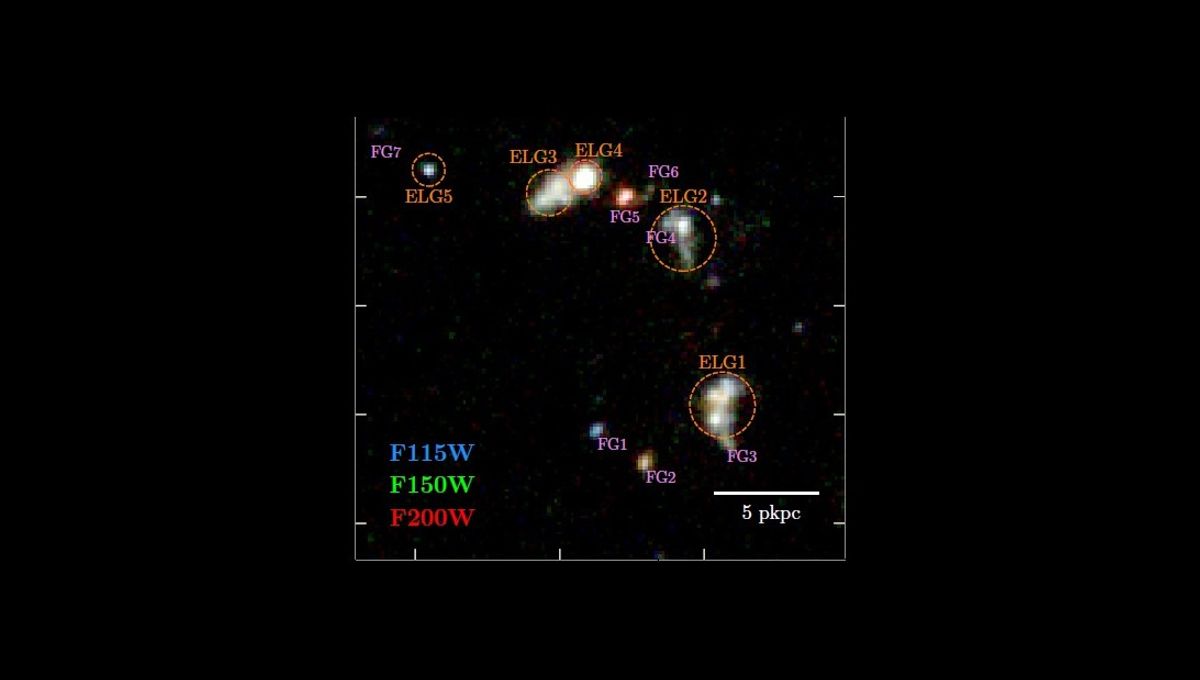

In a groundbreaking discovery, the James Webb Space Telescope (JWST) has unveiled a remarkable group of five galaxies merging in the early universe, a phenomenon previously thought to be a rarity at that stage of cosmic history. This extraordinary merger occurred when the universe was just 800 million years old, a time when galaxies were expected to be forming in simpler configurations, typically involving only two to three galaxies. “What makes this remarkable is that a merger involving such a large number of galaxies was not expected so early in the universe’s history,” said lead author Dr. Weida Hu from Texas A&M University.
The merging process of galaxies plays a crucial role in galactic evolution. When larger galaxies absorb smaller ones, they experience rejuvenation, and collisions between similarly sized galaxies can lead to transformations, often resulting in elliptical shapes from spiral formations. This newly observed quintet not only challenges preconceived notions about the timeline of galaxy formation but also reveals surprising details about their composition.
The researchers discovered that this group is enriched with heavier elements, particularly oxygen, at levels not anticipated until approximately 1 billion years after the Big Bang. These elements typically result from nuclear fusion in stars, and the presence of oxygen indicates that these galaxies were forming stars at a staggering rate of 250 solar masses per year-significantly higher than the average rate during that epoch. Such activity highlights a sophisticated level of galactic development previously unrecognized at this stage.
Positioned merely tens of thousands of light years apart, this quintet occupies a relatively small area compared to other known galaxies. For context, the nearest galaxies to our Milky Way, the Large and Small Magellanic Clouds, are over 160,000 light years away, while Andromeda, on a collision course with our galaxy in the far future, is more than 2.5 million light years distant.
In their analysis, the research team also identified the presence of both oxygen and hydrogen around the merging galaxies. This indicates that oxygen must have been formed within these galaxies, where stellar processes enriched the interstellar medium. The interactions among the quintet may have dispersed these elements into intergalactic space, showcasing the significant role of galaxy mergers in shaping both their constituents and surrounding environments.
Co-author Professor Casey Papovich added, “By showing that a complex, merger-driven system exists so early, it tells us our theories of how galaxies assemble-and how quickly they do so-need to be updated to match reality.” This finding signals a reassessment of our understanding of galaxy evolution and formation processes.
Previously, JWST has detected large, seemingly mature galaxies from the early universe, raising questions about the mechanisms driving their formation. If mergers like this quintet were more common, they may have significantly contributed to the emergence of these unexpected celestial objects. The early universe remains a subject of intrigue, and further observations by JWST will be vital for unraveling its mysteries.
This groundbreaking research is detailed in a recent publication in the journal Nature Astronomy, marking a significant advancement in our understanding of galactic collisions and evolution in the cosmos.
Original Source: https://www.iflscience.com/not-expected-five-way-galaxy-merger-in-the-early-universe-spotted-by-jwst-82412
Category :
Tags:
Publish Date: 2026-02-02 16:54:00