
If you want to witness the true dynamics of Delhi, observe what unfolds the moment any Manipuri politician or activist lands at Indira Gandhi International Airport. The tensions that have brewed for months in Manipur dissipate within minutes. An MLA who was vocally challenging the government in Imphal quickly transforms into a jovial ally of the very minister he was vilifying just a day before. They embrace, share meals, and indulge in laughter at Manipur Bhavan, conveniently setting aside their labels of “rebel” and “opposition.”
Civil society leaders, once ready to protest in Khwairamband Keithel, find themselves exchanging pleasantries with the Chief Minister’s representatives in the lobbies of hotels in Connaught Place. This has been the established pattern for two decades; Delhi acts as a great equalizer where identity divisions-Kukis, Meiteis, Valleys, Hills-fade into the background, leaving behind only Manipuris.
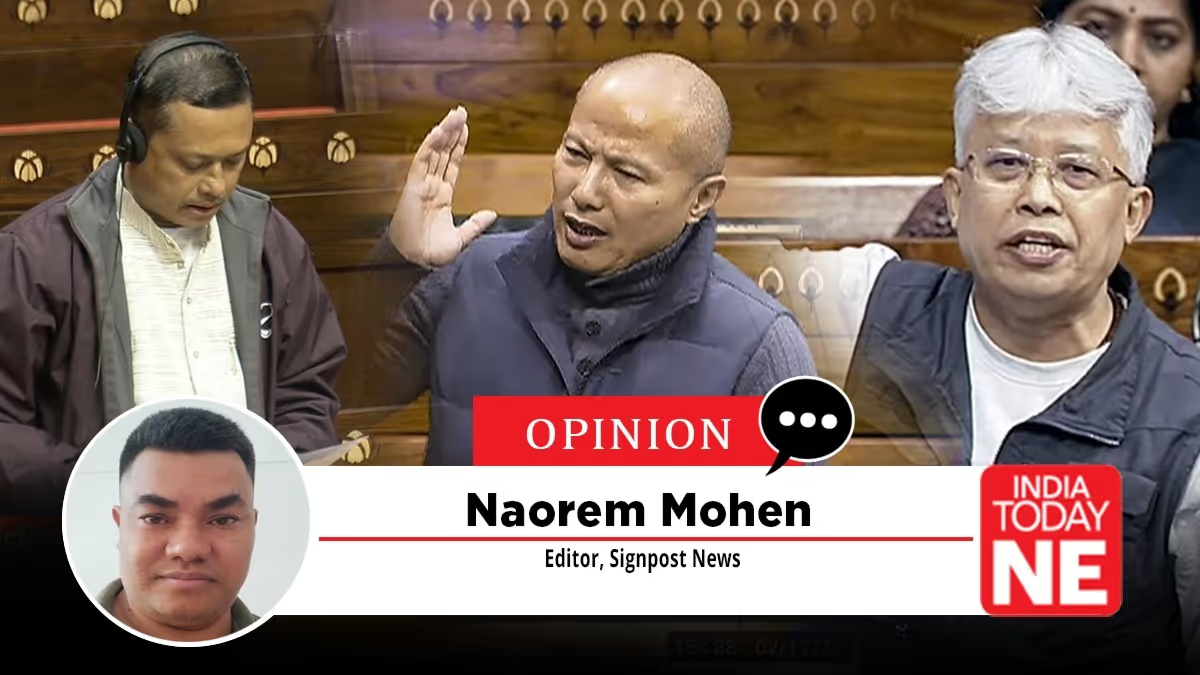
The urgency of the Winter Session of Parliament-drawing to a close on December 19-cannot be overstated. It is here that the same unifying magic must be forced to occur within the House, not just outside of it. Our representation comprises three MPs: Rajya Sabha member Maharaja Leishemba Sanajaoba (BJP) and Lok Sabha members Dr. Angomcha Bimol Akoijam and Alfred Kanngam Arthur (both Congress), voices that collectively represent 3.2 million people among a total of 788 in Parliament.
If these three voices were to unite even once, they could compel the nation to reconsider its focus on the eastern part of India. These are not mere tragedies specific to Congress or BJP; these are “oxygen tragedies,” impacting lives quietly when no one advocates on their behalf.
What is required from our MPs is exceedingly simple yet vital: to sit together once. Just one table, one hour, and one shared list of essential questions. If they cannot even manage this, the last hope that Delhi can intervene in our crisis will extinguish with the final session on December 19, leaving 70,000 individuals under makeshift shelters to comprehend that no help is forthcoming.
As Parliament convenes for its final eleven sittings before the December recess, these displaced Manipuris face another season of emptiness. For the third consecutive year, they will miss out on familial celebrations like Ningol Chakkouba and will not light Christmas candles. Their weary question is no longer one of anger; it’s one of exhaustion: “Will anyone in Delhi mention our names before the session concludes?”
The highways now stand as silent boundaries marked by dread. The cost of a one-way ticket from Imphal exceeds what the majority of families bring in for a month. An Assembly they voted for in 2022 remains unutilized, cold, and inactive. Farmers have seen three planting seasons turn barren. Hundreds of sacred sites lie in ruins, many are occupied, with their bells and conches silenced indefinitely.
Currently, Manipur holds only three seats in Parliament, equating to a mere 0.38 percent of its total strength. Less than half a percent. If these voices were to unite in purpose for even a week, they would be impossible to disregard. However, when divided, they negate one another and fade into silence.
In a chamber where Uttar Pradesh holds 80 MPs and Tamil Nadu 39, our representation becomes almost invisible. In this scenario, cooperation is not optional; it is essential. Yet we act as if division is feasible.
The Winter Session is notoriously brief. Opposition MPs struggle to secure even five minutes for debate, while ruling party members have direct access to ministers and an extended leeway in the Upper House. If these advantages are united, Manipur’s concerns can be magnified; if they remain fragmented, our voices will stay unheard.
The fight for Manipuri to be acknowledged as a classical language exemplifies missed chances. On September 22, 2020, Rajya Sabha MP Leishemba Sanajaoba made a strong case in the Upper House, reminding the government of the four criteria required for classical status and noting that Manipuri meets them all. He lamented that no Tibeto-Burman language had ever been recognized, stating, “If these four criteria are the defining factors, Manipuri should be among the classical languages of the country.”
However, on October 3, 2024, the Union Cabinet again approved classical status for other languages, leaving Manipuri aside. The following day, a disheartened Maharaja Sanajaoba shared on Facebook, “I am very EMOTIONAL & SHOCKED today,” acknowledging that years of lobbying had failed due to insufficient political pressure and action from their own side. He vowed to continue his struggle until his tenure ended.
Fourteen months later, during the current Winter Session’s opening on December 1, 2025, Lok Sabha MP Dr. Angomcha Bimol Akoijam asked about the government’s next steps regarding this issue through Unstarred Question No. 152. The response was disappointingly cold: no proposal had been received from the Manipur government-yet another door remained closed, echoing the same answers given five years prior.
As of December 4, with only eleven days left in the session, thousands of internally displaced persons will spend yet another Christmas in relief camps. These individuals face daily dilemmas, such as deciding between essential medicine for their children and a ₹30,000 flight to Delhi. Meanwhile, another farmer in Sugnu prepares to take a third harvest loss. It has been 946 days since violence erupted on May 3, 2023.
An emotional message from an internally displaced person in Sugnu to Outer Manipur MP Alfred Kanngam Arthur highlights a critical sentiment: they did not vote for a party but for a commitment to speak for victims in the valley-yet those very voters now feel forgotten.
Valley areas like Wabagai, Kakching, and others delivered overwhelming support to MP Alfred, yet the displaced Meitei families who crossed ethnic lines believe that he will voice their pain with the same intensity he advocates for the hills. They continue to await the recognition of their ravaged villages in Parliament’s discussions.
There are but eleven days remaining, one table, and three MPs-two from the opposition able to pose difficult questions without the threat of party discipline, and one from the treasury benches. As the Winter Session approaches its critical conclusion, the nation can no longer ignore Manipur.
With over 70,000 citizens displaced for more than two and a half years, and democratic governance suspended, the state’s infrastructure and services remain in turmoil. It is imperative that crucial issues concerning their plight be addressed on the floor of Parliament before the session ends.
Immediate needs include a structured return and resettlement plan for displaced persons, the restoration of the Legislative Assembly, free movement on vital highways, capping of excessive airfares, an economic rehabilitation package for the affected, a detailed disclosure of the crisis’s financial status, official recognition of Manipur as a hill state, and initiatives to ensure access to relief and political representation for all displaced individuals.
The citizens of Manipur have waited long enough, and these are not mere bureaucratic details; they are matters of essential justice and dignity. The elected assembly, composed of 60 MLAs chosen with hope in March 2022, remains sidelined under President’s Rule, with decisions about lives being made by bureaucrats unfamiliar with the realities of crisis.
Back in the relief camps and hills, the community will no longer watch the repetitive cycle of outrage in Imphal followed by camaraderie in Delhi, yielding no tangible results. Manipur has shed its tears; it is now left with a dwindling hope-only eleven days remain to grasp it.
Original Source: https://www.indiatodayne.in/manipur/story/three-mps-eleven-days-one-last-chance-1312825-2025-12-04?utm_source=rssfeed
Category:
Tags:
Publish Date: 2025-12-04 16:23:00