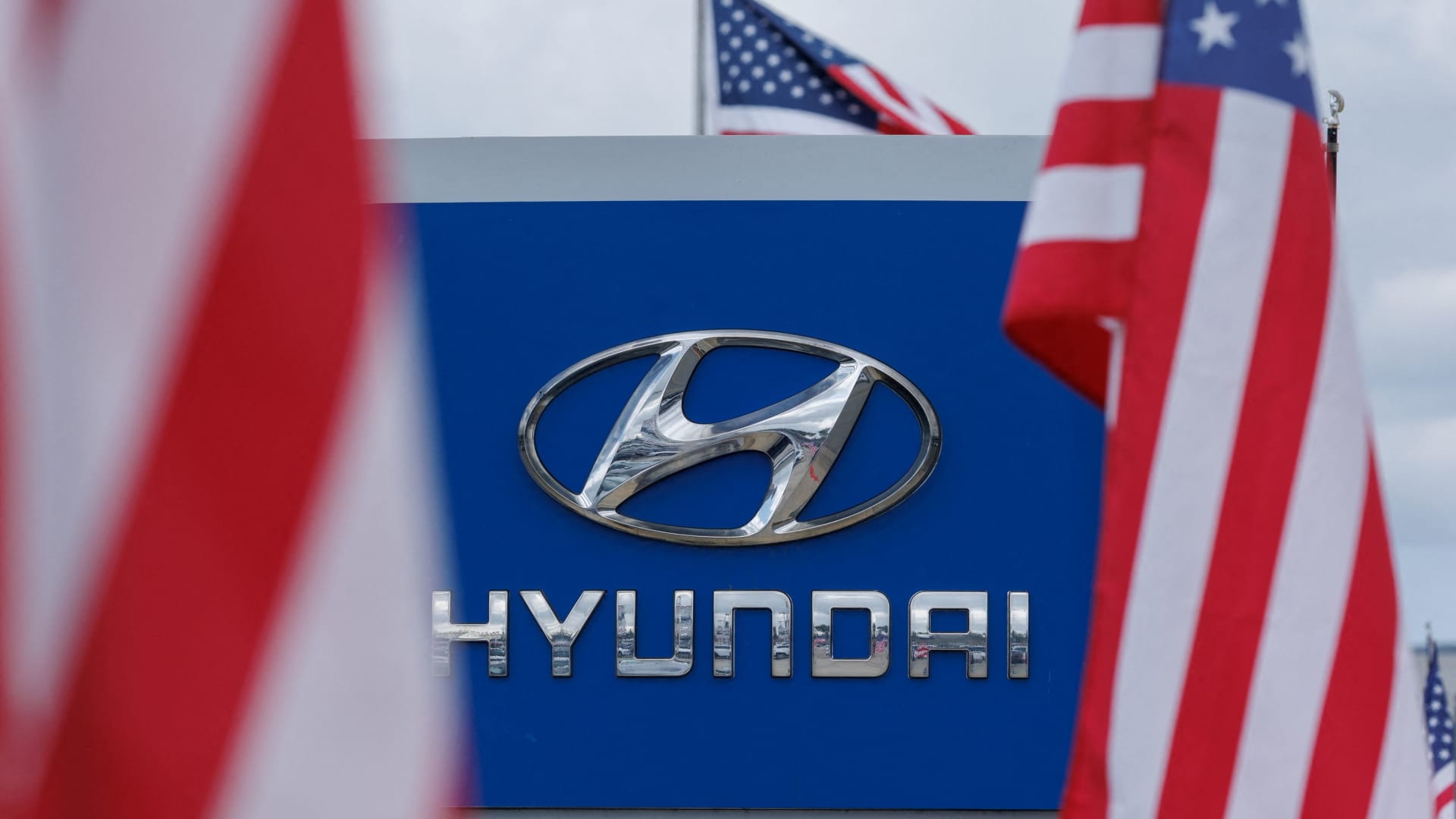

American flags flutter outside a Hyundai dealership in Irvine, California, signaling a fresh chapter for U.S.-Korea trade relations. Hyundai Motor and General Motors are poised to gain significantly from a recent reduction in U.S. tariffs on imported vehicles from South Korea. This change comes as part of a broader trade agreement, which will lower tariffs from 25% to 15% for specific products, including automobiles, as confirmed by the Trump administration.
Hyundai stands as the largest U.S. importer of vehicles from South Korea, with GM following closely behind. Both companies have faced substantial financial burdens due to these tariffs, having paid billions in levies since President Trump implemented the 25% tariffs in spring 2025. Recent reports indicate that Hyundai incurred 1.8 trillion won ($1.2 billion) in tariff-related costs in the third quarter, a steep rise from 828 billion won ($565 million) the previous quarter. GM, meanwhile, anticipates tariffs will hit between $3.5 billion and $4.5 billion in 2025, significantly affecting its operations.
GM’s CFO, Paul Jacobson, expressed optimism over the tariff reduction, noting that initial cost estimates had projected the burden at $2 billion for South Korean imports. With the recent reprieve, Jacobson indicated the company might reduce that impact to around $1 billion or less by 2026, framing the tariff adjustments as a beneficial “tailwind” for the automaker.
The U.S. announced these tariff changes following South Korea’s pledge to invest $350 billion in the U.S. over several years, a commitment deemed vital for strengthening economic partnerships and supporting domestic jobs, as noted by U.S. Commerce Secretary Howard Lutnick.
Hyundai North America CEO Randy Parker acknowledged the challenges posed by tariffs but expressed relief that the rate has now been reduced. He highlighted that reaching a 15% rate represents significant progress on a journey filled with complex negotiations. The automaker’s ambitions are substantial: it aims for over 80% of its U.S. vehicle sales to be sourced locally by 2030, an increase from the current level of approximately 40%. This year, Hyundai is expected to import nearly 1 million vehicles from South Korea, with projections of 951,000 vehicles in 2025, comprising models from both Hyundai and its luxury division, Genesis.
GM is also expected to import around 422,000 vehicles from South Korea in 2025, a slight increase from the previous year. The automaker has been leveraging South Korean facilities to produce popular models like the Chevrolet Trailblazer and Buick Encore GX, which cater to the entry-level market segment. GM emphasized in a recent statement the importance of its South Korean operations in maintaining affordable and quality crossovers that complement its domestic production.
The recent trade agreement arrives amidst rising tensions between the U.S. and South Korea, sparked by a federal immigration raid involving a Hyundai and LG Energy Solution battery plant in Georgia. That raid led to the arrest of about 475 workers, including more than 300 South Koreans, illustrating the complex dynamics at play between trade partnerships and domestic policies.
As both Hyundai and GM navigate these changes, the road ahead appears more favorable, with expectations of fostering stronger economic ties and expanding U.S. operations.
Original Source: https://www.cnbc.com/2025/12/03/trump-south-korea-tariffs-vehicles-hyundai-gm.html
Category :
Tags:
Publish Date: 2025-12-04 07:52:00