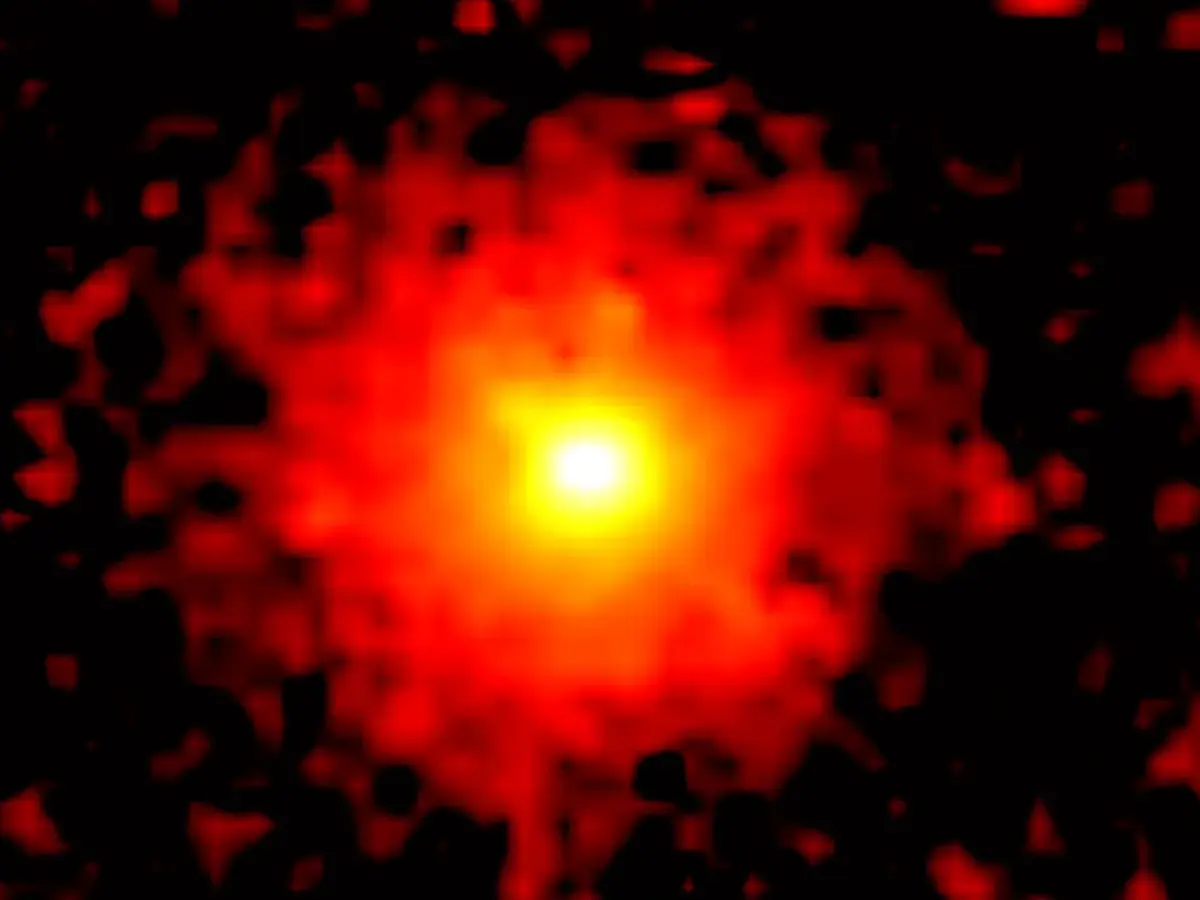

Interstellar comet 3I/Atlas is on a fast trajectory toward the Sun, captivating scientists and space enthusiasts alike. As this interstellar traveler approaches, our Sun is becoming increasingly active in its current solar cycle. Researchers are keenly anticipating a significant event: a coronal mass ejection (CME) is predicted to collide with 3I/Atlas around September 25, 2025. This extraordinary intersection marks a unique occasion, as it combines the passage of the third known interstellar comet with a solar phenomenon.
3I/Atlas, the third interstellar visitor following ‘Oumuamua and Comet Borisov, originates from outside our solar system. Recent observations from the Minor Planet Centre and the International Astronomical Union reveal that it has a dust-filled coma and has developed a tail after a period of dormancy. The comet’s nucleus measures over 5.6 kilometers, with a mass estimated at more than 33 billion tons. Harvard astrophysicist Avi Loeb describes this as an anomaly for a comet; should it be a naturally occurring space rock, its size implies we should have encountered hundreds of thousands of smaller interstellar objects before reaching 3I/Atlas.
As the comet nears the Sun, the anticipated CME poses intriguing questions. Reports from Spaceweather.com, citing a new NASA forecast model, indicate the CME’s impact should coincide with the comet’s passage. While experts are excited about the potential effects, including possible alterations to the comet’s tail and even trajectory, NASA suggests the impact from the solar plasma will likely not change 3I/Atlas’s course.
History provides context for these events. On April 20, 2007, Comet Encke passed through a CME, during which NASA’s STEREO A spacecraft observed the comet’s tail break off temporarily due to the plasma’s disturbance. Although 3I/Atlas may experience similar effects, scientists caution that the interactions might not be visually captured, as the comet will move behind the Sun shortly after the predicted impact.
Traveling at a brisk speed of 221,000 km/hr (about 60,000 km/s), 3I/Atlas is set to pass close to Mars on October 3. This convergence presents a remarkable opportunity for several Mars missions to closely observe the comet. Instruments such as the CaSSIS camera on the European Space Agency’s Trace Gas Orbiter and the High-Resolution Stereo Camera onboard Mars Express are prepared to document this cosmic encounter, offering insights into this alien visitor.
As this interstellar comet continues its journey, the scientific community remains on edge, hoping to glean answers from the dynamic interaction between 3I/Atlas and the Sun’s powerful forces. The excitement surrounding this event emphasizes the mysteries of our universe and fuels ongoing discussions about the nature of comets, celestial phenomena, and the vastness of space.
As we look to the skies, the upcoming months promise to unveil new cosmic wonders and deepen our understanding of interstellar objects. Keep an eye on 3I/Atlas, a comet that may reshape our comprehension of the universe.
Original Source: https://www.wionews.com/trending/interstellar-comet-3i-atlas-could-soon-lose-its-tail-following-a-beating-by-our-sun-1758870238505
Category :
Tags:
Publish Date: 2025-09-26 12:50:00