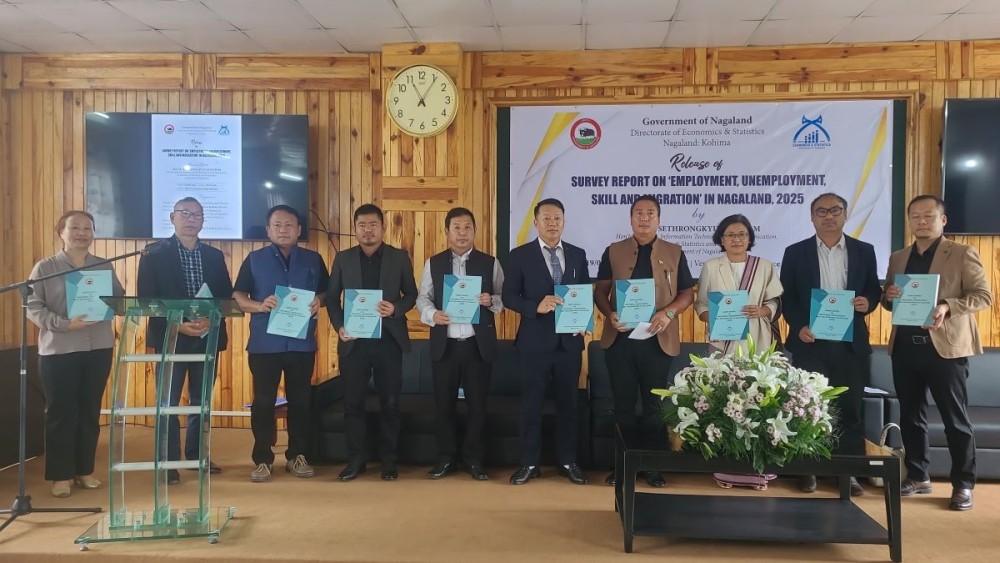

On September 19, a government survey revealed that about one in six working-age individuals in Nagaland, or 16.07%, are unemployed, even as the state boasts an employment rate of 83.92%. This finding underscores ongoing challenges, including skills shortages, income disparities, and evolving migration patterns that significantly impact the northeastern Indian state.
The “Survey Report on Employment, Unemployment, Skill and Migration in Nagaland 2025” was conducted by the Directorate of Economics and Statistics, covering 4,395 households-1,315 from urban areas and 3,080 from rural settings. The study aimed to assess human resource utilization by examining employment status and skill levels while analyzing migration trends.
At the report’s presentation, H. Sethrongkyu Sangtam, the adviser for Economics and Statistics, expressed hope that it would aid the state government in developing effective unemployment policies. He noted that under Chief Minister Dr. Neiphiu Rio’s leadership, the government is focusing on all facets of the economy, including enhancing data for informed decision-making.
Akunu S. Meyase, the secretary of Economics and Statistics, emphasized the survey’s utility for policymakers, scholars, and other stakeholders, while Director Neidilhou Keditsu highlighted the survey’s objective to provide a quantitative overview of employment and skills, along with insights into migration reasons.
The report indicated that the average monthly household expenditure in Nagaland stands at ₹16,522, varying widely from ₹1,133 to ₹361,647. Dimapur has the highest mean expenditure at ₹22,716, followed by Kohima at ₹18,549, and Longleng at ₹13,849, illustrating significant income disparities within the state.
Educational attainment varies: 26% of respondents completed secondary education, 21% stopped at middle school, and 2% are illiterate. A staggering 92% lack technical education or training, highlighting a significant skills gap that needs addressing. The report suggests that more training institutes, both private and governmental, are essential in Nagaland, where only 24% of respondents are registered with public employment exchanges.
The state’s labour force participation rate (LFPR) is estimated at 56%, with Wokha having the highest at 75% and Tuensang the lowest at 41%. Mon district records the highest employment rate at 91.08%, while Phek struggles with the highest unemployment rate at 25%. Self-employment is most prominent in Zunheboto at 40%, with lower rates in other areas.
Clarifying migration patterns, the survey reveals that 55% of migrants moved from rural to urban areas, 25% remained rural, and 17% shifted within urban settings. The primary motivations for migration include unspecified reasons (35%), public sector employment (27%), and business establishment (13%). Notably, 80% of migrant respondents originally earned ₹10,000 or less, while 33% in new locations earn between ₹10,000 and ₹20,000.
Overall, 24% of respondents reported being self-employed, 13% were salaried in public and private sectors, and 9% identified as casual workers. The report criticized the 16.07% unemployment rate, particularly given the state’s literacy levels. A majority of the unemployed cited vague reasons (59%), while only 8% pointed to limited job opportunities in their area.
Additionally, the report found that 65% of employed respondents lack written contracts, and 15% are unaware of their social security benefits.
Original Source: https://www.morungexpress.com/nagaland-one-in-six-unemployed
Category: Nagaland
Tags:
Publish Date: 2025-09-19 23:43:00