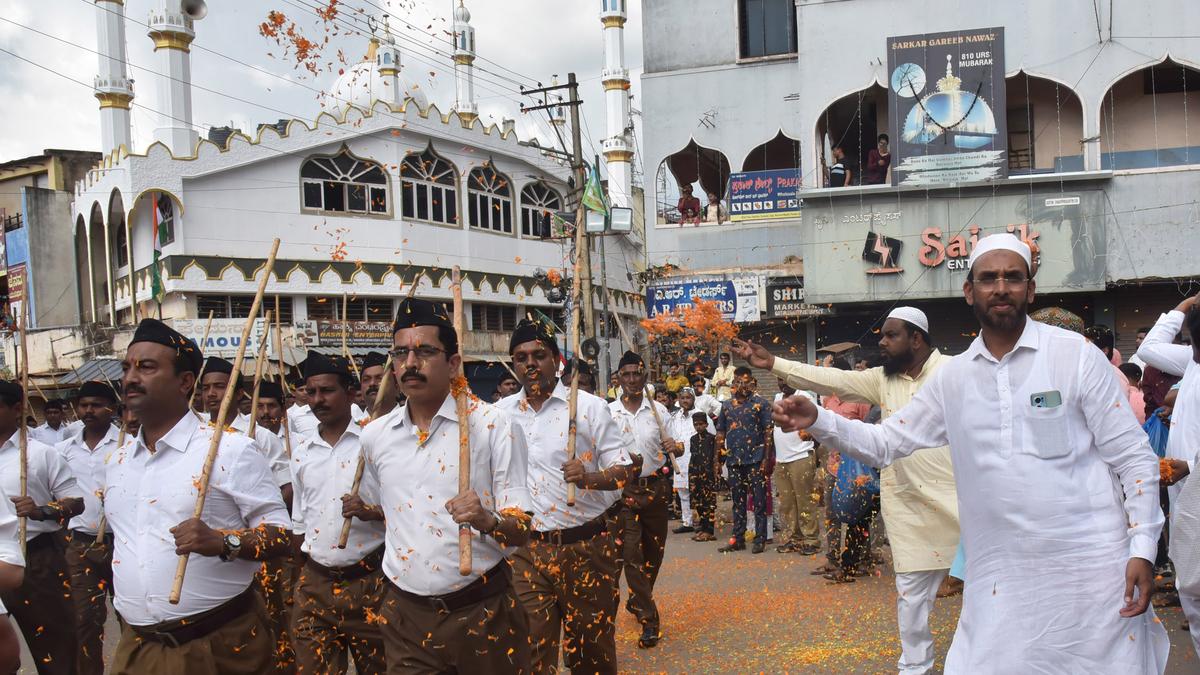

Mohan Bhagwat, the chief of the Rashtriya Swayamsevak Sangh (RSS), addressed an audience of approximately 1,000 attendees at Vigyan Bhawan in New Delhi over three days from August 26 to August 28. He contended that many misunderstandings about the RSS often dissipate as critics gain a deeper understanding of the organization. He referenced figures like Jayaprakash Narayan, Maulana Abul Kalam Azad, and Pranab Mukherjee, noting that even they had shifted their perspectives after engaging with the RSS.
Founded in 1925 by Dr. Keshav Baliram Hedgewar, the RSS is approaching its centenary in October 2025. Bhagwat, who will turn 75 on September 11, 2025, spoke extensively over the event, responding to audience questions that had been submitted previously.
When asked about the potential for change within the RSS, Bhagwat emphasized that three core principles remain immutable: the importance of individual formation, the necessity of societal change, and the belief that “Hindustan is a Hindu Rashtra.” He expressed a desire to attract a broader audience while retaining existing supporters, suggesting a delicate balance between flexibility and permanence in the organization’s approach.
The RSS’s claims to moral authority-discipline, sacrifice, and integrity-were more straightforward when it maintained a distance from political power. However, its close association with the ruling Bharatiya Janata Party (BJP) over the past decade has complicated this narrative. Bhagwat affirmed Prime Minister Narendra Modi’s leadership, highlighting a distinction between the RSS’s organizational role and governmental authority. “If our volunteers excel, they take the credit; if not, we face the blame,” he quipped.
Addressing the contentious question of the RSS influencing the BJP’s operations, Bhagwat remarked, “If we’d been deciding, it would not have taken this long!” This subtle indication of the RSS’s desire to weigh in on political matters surfaces amid delays in appointing a new BJP president.
On issues surrounding caste and social equity, Bhagwat publicly rejected outdated aspects of the Manusmriti, advocating for the creation of modern codes that embrace all castes and communities. He stated that historical injustices necessitate redress while reiterating the RSS’s commitment to fostering unity among different societal groups.
Tackling the complexities of Hindu-Muslim coexistence, Bhagwat acknowledged persistent divisions rooted in mistrust. He suggested that fostering a shared historical consciousness could bridge gaps. With a candid remark, he asserted that Hindu society is already unified, urging recognition of common ancestry over religious distinctions.
Bhagwat further clarified that although the RSS considers itself a cultural entity rather than a federation of communities, it does not support political entities perceived as obstructive. He recounted historical instances where the RSS aided Congress-affiliated student unions, emphasizing openness to collaboration.
As the RSS prepares for its centenary, Bhagwat faces the challenge of transforming the organization’s perception among critics and reinforcing unity among its supporters. The outcome of these endeavors may define the RSS’s legacy in modern Indian society and its influence on national identity. In the face of ongoing societal challenges, Bhagwat’s vision for unity, inclusivity, and social reform will be critical.
Original Source: https://www.thehindu.com/news/national/walking-a-thin-saffron-line/article70022567.ece
Category : India
Tags:
Publish Date: 2025-09-08 02:23:00