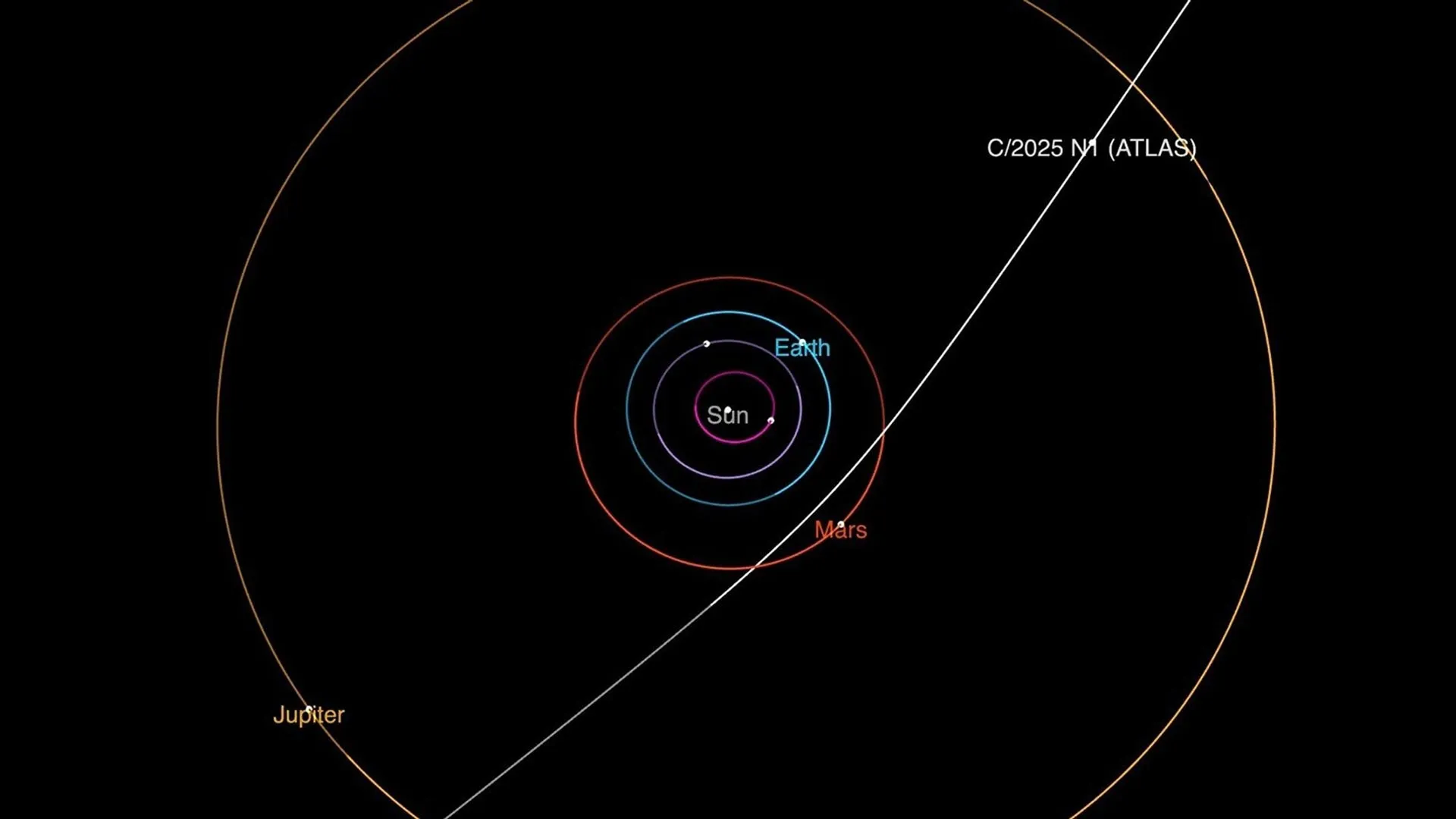

A team of international astronomers, including a doctoral candidate from the University of Michigan, announced the discovery of the third known interstellar object to visit our solar system on July 3. This object, designated 3I/ATLAS, has piqued the interest of researchers eager to learn more about its origins and characteristics. Aster Taylor, from the U-M Department of Astronomy, and Darryl Seligman from Michigan State University, have authored a new study aimed at characterizing this intriguing celestial body.
Unlike objects that orbit the sun, interstellar objects are formed outside our solar system and traverse through our celestial neighborhood without settling into stable orbits. The discovery of 3I/ATLAS, along with its predecessors 1I/’Oumuamua and 2I/Borisov, provides researchers with a rare opportunity to gain insights into the more distant regions of our galaxy.
“This is what we’re here for-finding objects like this, creating public awareness, and generating excitement,” said Taylor, a Fannie and John Hertz Fellow. The enthusiasm generated by such discoveries is vital for securing funding and advancing the tools necessary for future research. The recently operational Vera C. Rubin Observatory, supported by the U.S. National Science Foundation and the U.S. Department of Energy, is expected to identify one or two new interstellar objects annually.
Taylor expressed optimism about the future of interstellar discoveries: “We’re excited about three, but if we can get to 10 or more, we’ll have a reasonable sample to further our understanding.”
The identification of 3I/ATLAS was made possible by NASA’s Asteroid Terrestrial-impact Last Alert System (ATLAS), which consists of four telescopes located in Hawaii, Chile, and South Africa. These telescopes continuously scan the sky for moving objects. Notably, 3I/ATLAS poses no threat to Earth, as it won’t come closer than our distance from the sun. Preliminary assessments suggest it is likely a comet, surrounded by a coma-an envelope of gas and dust-around its rocky nucleus. As the object approaches the sun, its coma may evolve, allowing scientists to glean insights about its composition.
Seligman noted, “3I/ATLAS likely contains ices, especially beneath the surface. However, we need to detect specific gas emissions, like H2O, CO, or CO2, to confirm the types and amounts of ice present.”
Over the coming months, advanced space telescopes like Hubble and the James Webb Space Telescope will further investigate 3I/ATLAS, focusing on its size, spin, and thermal response as it nears the sun. Initial observations revealed that 3I/ATLAS is faster, larger, and older than its counterparts. It travels at a velocity of nearly 60 kilometers per second (about 130,000 miles per hour) and has an estimated diameter of up to 10 kilometers (6 miles), making it significantly larger than ‘Oumuamua and Borisov.
Despite these findings, Taylor anticipates smaller estimates as further observations refine our understanding. The age of 3I/ATLAS appears to range from 3 billion to 11 billion years, suggesting a potential link to the early formation of stars and planets in our galaxy.
Taylor’s involvement in this project began while she was on vacation in Fiji, underlining the urgency to confirm and publicize the discovery quickly. Seligman received word of the find shortly before its official announcement and immediately began coordinating telescope observations.
Once confirmed, the team rapidly organized efforts to collect and analyze data, enlisting major research facilities for early observational support. The collaborative effort includes contributions from numerous institutions and countries, underlining the global interest in interstellar research.
As 3I/ATLAS continues to be studied, its secrets may reveal more about the building blocks of our galaxy, sparking further exploration in the quest to understand the universe beyond our own solar system.
Original Source: http://www.sciencedaily.com/releases/2025/08/250829235726.htm
Category :
Tags:
Publish Date: 2025-08-30 09:36:00