Could Massive Interstellar Object 3I/Atlas Be a Groundbreaking Alien Craft? Harvard Astrophysicist Raises Astonishing Possibilities!

A Harvard astrophysicist, Avi Loeb, has sparked intrigue with claims that an object named 3I/Atlas, recently discovered by the ATLAS telescope, could potentially be an alien spacecraft rather than a natural celestial body. In an interview with Fox 10 Phoenix, Loeb highlighted several striking characteristics of the object, including its extraordinary size, which exceeds that of Manhattan Island, and its intense brightness, suggesting it reflects sunlight off a solid surface.
3I/Atlas, a comet first identified in July 2025, marks the third confirmed interstellar visitor to traverse our solar system, following 1I/’Oumuamua in 2017 and 2I/Borisov in 2019. Loeb raised concerns regarding the substantial difference in size among these interstellar objects, noting that the earlier visitors were hundreds of times smaller. He argued that considering the vastness of space and the rarity of rocky material, the emergence of a third object that dwarfs its predecessors raises profound questions about its origin.
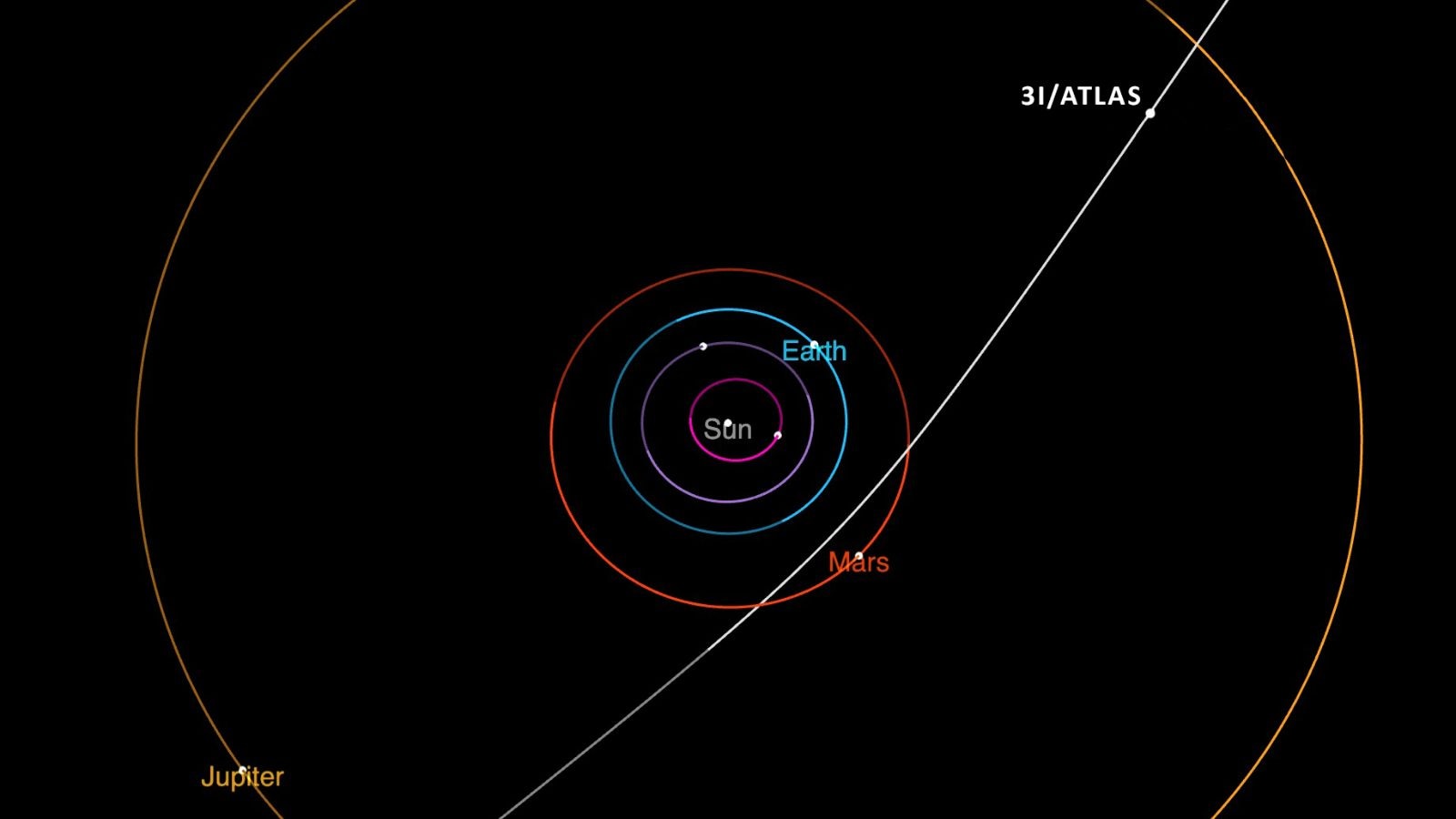
Loeb states that the likelihood of finding a massive object like 3I/Atlas in interstellar space is extremely low, given the estimated scarcity of rocky materials-calculated to be insufficient to yield an object of this magnitude, which would typically occur only once every 10,000 years or more. In contrast, NASA maintains that 3I/Atlas is indeed a comet, reassuring the public that it poses no threat, as it will remain at a safe distance of at least 1.6 astronomical units, equivalent to roughly 150 million miles from Earth. The object is expected to make its closest approach to the Sun on October 29, 2025, but is positioned such that Earth will be on the opposite side of the Sun during this event.
Interestingly, Loeb suggests that 3I/Atlas appears to be avoiding a direct encounter with Earth. He points out that the conditions for observing the comet are challenging, particularly during its closest approach to the Sun, where it is likely to undergo an eruption that would typically produce a dramatic cometary tail. However, he notes that no such tail has been observed yet.
Images captured by the Hubble Space Telescope reveal a glow emitted from the object, pointing toward the Sun, with no accompanying material evident behind it. This observation adds weight to Loeb’s theory that 3I/Atlas might be an artificial construct. The deliberations surrounding this mysterious object encapsulate a blend of curiosity and skepticism, as scientists and astronomers analyze its properties and origin.
As investigations into 3I/Atlas continue, the scientific community remains divided. While some experts affirm its classification as a comet, others, like Loeb, invite us to reconsider the possibilities, arguing for the exploration of all viable hypotheses, including the existence of advanced extraterrestrial technology. With continued scrutiny from astronomers around the world, the enigma of 3I/Atlas adds a fascinating layer to our understanding of interstellar objects that venture into our solar system.
In this era of rapid advancements in astronomy, 3I/Atlas has the potential not only to reshape our comprehension of celestial mechanics but also to reignite conversations about the existence of extraterrestrial life in the universe. As we await further data, all eyes will remain fixed on this intriguing visitor from beyond.
Original Source: https://indianexpress.com/article/technology/massive-interstellar-object-3i-comet-atlas-could-be-an-alien-craft-astrophysicist-10212911/
Category :
Tags:
Publish Date: 2025-08-28 15:46:00