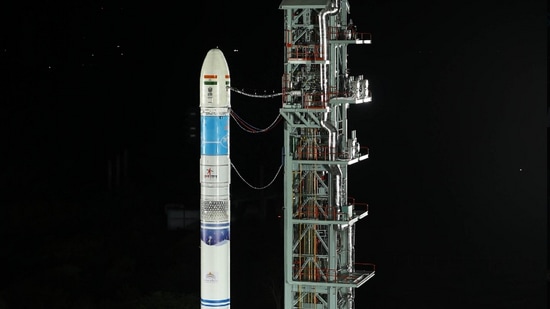
Don’t Miss the Thrilling LIVE Launch of ISRO EOS 08: Countdown Begins, 1-Hour Window at 9:17am!

ISRO EOS-08 Launch: Key Updates and Mission Highlights
Launch Objective:
The primary objective of the EOS-08 mission is to test and demonstrate new payload technologies compatible with the micro satellite bus, as well as to incorporate cutting-edge technologies for future satellites. The mission will highlight a micro satellite equipped with an integrated avionics package, advanced structural panels, flexible solar panels, and a micro-Displacement Gyro Assembly (m-DGA).
Launch Sequence:
The SSLV-D3/EOS-08 mission has a structured launch sequence involving several critical stages:
- Solid Stage 1 (SS1) Ignition at 0 seconds
- Solid Stage 2 (SS2) Ignition at 123.98 seconds, reaching 93 km
- SS1 Separation at 124.34 seconds, maintaining 93 km altitude
- Stage 2 Core Separation (S2C) at 129.34 seconds, reaching 101 km
- Satellite Payload Fairing (SPLF) Separation at 158.74 seconds, reaching 147 km
- SS2 Separation at 402.20 seconds, at 450 km altitude
- Solid Stage 3 (SS3) Ignition at 412.02 seconds, reaching 454 km
- SS3 Separation at 697.62 seconds, at 475 km
- Velocity Trimming Module (VTM) Ignition at 706.12 seconds, maintaining 475 km
- EOS-08 Separation at 808.90 seconds, and SR-0 DEMOSAT Separation at 994.90 seconds, both at 475 km altitude
Historical Context:
The first developmental flight of SSLV on August 7, 2022, failed to achieve its objective, but subsequent learnings led to a successful mission on February 10, 2023, marking the first successful SSLV mission.
Launch Vehicle – SSLV:
SSLV is a three-stage, 34-meter-long launch vehicle with a diameter of 2 meters, designed to carry a 500 kg satellite into a 500 km planar orbit. It uses three solid propulsion stages and a liquid propulsion-based Velocity Trimming Module (VTM) for terminal stage. Noteworthy for its cost efficiency and flexibility, SSLV can launch small satellites with minimal launch infrastructure requirements.
Payloads:
The SSLV-D3/EOS-08 mission includes three payloads:
- Electro Optical Infrared Payload (EOIR): Captures images in Mid-Wave and Long-Wave IR bands for surveillance and disaster monitoring.
- Global Navigation Satellite System-Reflectometry (GNSS-R): Tests remote sensing for ocean wind analysis, soil moisture measurement, and cryosphere research.
- SiC UV Dosimeter: Monitors UV radiation for the Gaganyaan manned mission, acting as an alarm for high gamma radiation doses.
EOS-08 Satellite:
The EOS-08 satellite, weighing 175.5 kg and with a power generation capacity of 420 watts, has a mission lifespan of one year. It’s based on the Microsat/IMS-1 design.
Significance:
A successful launch will complete the SSLV Development Project, positioning SSLV as a viable option for operational missions by the Indian industry, supported by NewSpace India Limited.
Keep following for more updates on ISRO’s developments.
Original Story https://www.hindustantimes.com/india-news/isro-launch-live-eos-08-mission-sslv-development-flight-from-sriharikota-august-16-today-latest-news-101723769644675.html
Category :
Tags: