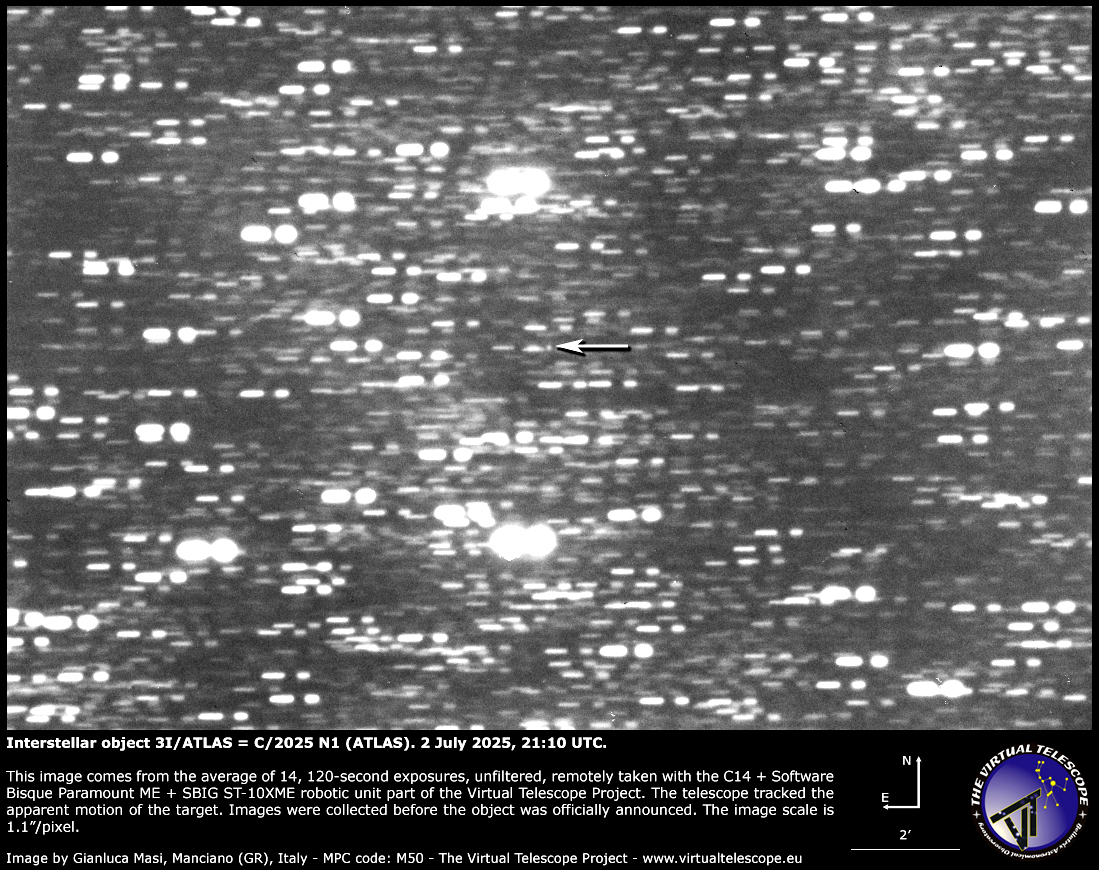
Unveiling the Cosmic Wonder: Stunning Image of Interstellar Object 3I/ATLAS (C/2025 N1) Captured on July 2, 2025!

On July 1, astronomers made a thrilling discovery: an interstellar object passing through our Solar System, now officially named 3I/ATLAS or C/2025 N1 (ATLAS). This marks only the third such celestial body identified, following the famed 1I/ʻOumuamua in 2017 and the 2I/Borisov in 2019. Initially dubbed A11pl3Z, the celestial body was spotted by the Chilean station of the ATLAS project, which specializes in tracking near-Earth asteroids. Interestingly, researchers soon unearthed earlier images of the object, prompting the Minor Planet Center to release preliminary data and call for follow-up observations.
Its interstellar origin has been underscored by its impressive hyperbolic excess velocity, nearing 60 km/s, resulting in an eccentricity value of 6.2-the highest recorded for an interstellar object. When discovered, 3I/ATLAS was approximately 520 million kilometers from Earth and 670 million kilometers from the Sun, situated just within Jupiter’s orbit and approaching rapidly. The object has a brightness of around magnitude 18.5, making it about 2.5 million times dimmer than Polaris, and it is currently observable with telescopes featuring 150–200 mm apertures.
Within 24 hours of its detection, astronomers noted signs of cometary activity, which led to its designation as C/2025 N1. Though estimates suggest its diameter is around 20 km, this figure carries uncertainty due to limited data and the possibility that its brightness is temporarily heightened by an outburst. The object is on course to reach its perihelion-the closest point to the Sun-on October 29, at a distance of approximately 200 million kilometers. Notably, on October 2, 3I/ATLAS will come within 30 million kilometers of Mars, and it will make its closest approach to Earth on December 19, passing about 270 million kilometers away.
Currently, 3I/ATLAS is visible in the constellation Sagittarius, traversing the southern sky during late-night hours. Although the full Moon on October 10 may complicate observations, future months will offer improved visibility, even for those with smaller telescopes. I had the unique opportunity to personally observe 3I/ATLAS on the evening of July 2, prior to its official announcement. Using a 360 mm telescope in Manciano, Italy, I captured an image of this remarkable object, which is included here.
In addition to the observation, I have crafted a star map detailing the trajectory of 3I/ATLAS until December 30, 2025. Enthusiasts interested in viewing the interstellar object live can tune into a streaming session by the Virtual Telescope Project, which kicks off tonight at 22:00 UTC.
The excitement surrounding 3I/ATLAS exemplifies ongoing advancements in astronomical research and observation. As we continue to explore the cosmos, discoveries like these remind us of the vastness and complexity of our universe, igniting curiosity and wonder among both scientists and the public alike.
Support for initiatives like the Virtual Telescope Project is essential for continuing this vital work in astronomy. Donations not only help sustain these efforts but also offer exclusive content, including stunning images of celestial events like C/2023 A3 Tsuchinshan-ATLAS.
Original Source: https://www.virtualtelescope.eu/2025/07/03/interstellar-object-3i-atlas-c-2025-n1-atlas-an-image-2-july-2025/
Category :
Tags:
Publish Date: 2025-07-03 14:19:00