
New Delhi, Delhi, 26 May 2025: The 2025 Breakthrough Prize in Fundamental Physics has been awarded to the co-authors of publications stemming from data gathered during CERN’s Large Hadron Collider (LHC) Run-2, covering the period from 2015 to July 15, 2024. The $3 million prize, shared among the ATLAS, CMS, ALICE, and LHCb collaborations, will fund grants for doctoral students from member institutions to conduct research at CERN. This initiative aims to provide students with cutting-edge scientific experience and expertise to take back to their home countries. The ATLAS experiment involved 5,345 researchers, while CMS had 4,550, ALICE included 1,869, and LHCb was supported by 1,744 researchers.
Indian scientists have played a crucial role in the international collaboration for the ALICE (A Large Ion Collider Experiment) and CMS (Compact Muon Solenoid) projects. Numerous Indian institutes and universities have contributed both intellectually and technically to the success of these experiments, engaging actively from the development of detectors to data analysis. These contributions highlight India’s dedication to global scientific collaboration and its significant involvement in the achievements of LHC experiments.
This prestigious award recognizes the collaborative research efforts that have enhanced our understanding of phenomena such as the Higgs boson, quark-gluon plasma, matter-antimatter asymmetry, and physics beyond the Standard Model. Research teams from various institutes worldwide have worked together to accomplish the goals of CERN’s experiments. As a committed partner in the LHC program, India proudly celebrates this international recognition of its contributions to the experiments and the overarching LHC infrastructure.
The Large Hadron Collider, operated by CERN, is the most powerful particle accelerator globally, allowing high-energy collisions of protons and heavy ions to investigate matter at the smallest scales. India’s association with CERN began in the 1960s when scientists from the Tata Institute of Fundamental Research (TIFR) visited CERN to study pion, kaon, and proton beams. Throughout the 1980s, Indian contributions included hardware and core software for the L3 project, one of the four large experiments in the Large Electron Positron Collider (LEP). In the 1990s, India expanded its involvement into heavy ion physics, contributing to a scintillator-pad-based photon multiplicity detector and playing significant roles in the WA93 and WA98 experiments at CERN-SPS.
In 1991, India, through the Department of Atomic Energy (DAE), formalized its cooperation with CERN. This partnership was bolstered by a Memorandum of Understanding (MOU) in 2009, which enhanced collaboration in accelerator technology and detector research and development. The agreement also paved the way for increased Indian participation in CERN’s long-term projects. India achieved “Observer” status in 2002 and became an Associate Member State of CERN in 2017. This recognition reflects India’s vital contributions to the LHC and highlights its ongoing partnership with CERN.
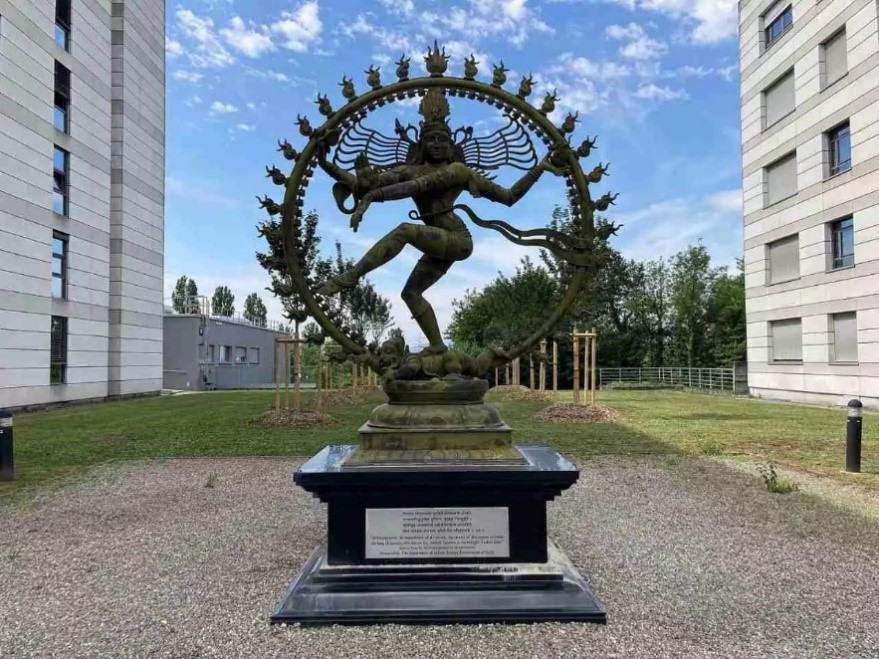
A symbol of this enduring collaboration is the 2-meter tall statue of Shiva Nataraja, gifted by India to CERN in June 2004. This depiction illustrates the metaphor of Shiva’s dance as interpreted by Carl Sagan in relation to the cosmic dance of subatomic particles studied by CERN physicists. The statue represents the unity of technology and cultural heritage, with a quote from physicist Fritjof Capra inscribed next to it, celebrating the intersection of ancient mythology, religious art, and modern physics.
India’s involvement in the LHC encompasses all levels-from accelerator technology to crucial physics experiments. Significant backing comes from the Department of Atomic Energy and the Department of Science and Technology. Indian institutions and scientists hold positions on various CERN boards and committees, including the Research and Resources Board and the Advisory Committee of CERN Users.
The ALICE collaboration in India comprises institutions such as VECC-Kolkata, SINP-Kolkata, IOP-Bhubaneswar, IIT-Mumbai, and more. Likewise, notable institutions involved in the CMS collaboration include Delhi University, IISc Bengaluru, and several IITs.
Indian teams from BARC, Mumbai, and RRCAT, Indore have made pivotal contributions to the LHC, focusing on components for cryogenics, superconducting magnets, and beam instrumentation necessary for high-energy collisions. The ALICE collaboration has seen Indian scientists lead in detector design and data analysis, creating components crucial for studying quark-gluon plasma.
In the CMS collaboration, Indian teams have excelled in designing trigger and data acquisition systems and have contributed essential components for searching new physics phenomena. Furthermore, India plays a vital role in the Worldwide LHC Computing Grid (WLCG), supporting a global network that processes data from LHC experiments. Significant computing resources and software contributions have made Indian institutions integral to the LHC data analysis efforts.
A large number of Indian students receive annual training through active participation in ALICE and CMS experiments. Their engagement during LHC Run 2 has led to over 110 Ph.D. theses and more than 130 published papers based on ALICE and CMS data. Indian scientists are important leaders in physics analysis, detector development, and machine learning applications.
“This recognition from the Breakthrough Prize Foundation honors decades of scientific endeavor and international collaboration. India’s researchers, students, and engineers have proudly contributed to this journey,” said Dr. A.K. Mohanty, Chairman of the Atomic Energy Commission. Prof. Abhay Karandikar, Secretary of the Department of Science and Technology, noted the profound impact of Indian contributions and emphasized that the Breakthrough Science Award 2025 underscores the significance of Indian scientific advancements.
India is now preparing to contribute to the p-type Silicon-based Forward Calorimeter (FoCal) detector in ALICE, which will facilitate precise measurements of direct photons and neutral pions. The Indian team also significantly contributes to the CMS Phase-2 upgrade in several sub-detector components, essential for future LHC experiments aimed at achieving precise physics results and exploring phenomena beyond the Standard Model. The Breakthrough Science Award 2025 not only celebrates the ALICE and CMS collaborations but also reflects the dedication of the global scientific community, positioning India as both a contributor and a beneficiary in groundbreaking discoveries that may redefine our understanding of the universe.
Original Source: https://www.tripurastarnews.com/india-celebrates-breakthrough-prize-in-fundamental-physics-awarded-to-large-hadron-collider-experiments/
Category:
Tags:
Publish Date: 2025-05-27 02:57:00