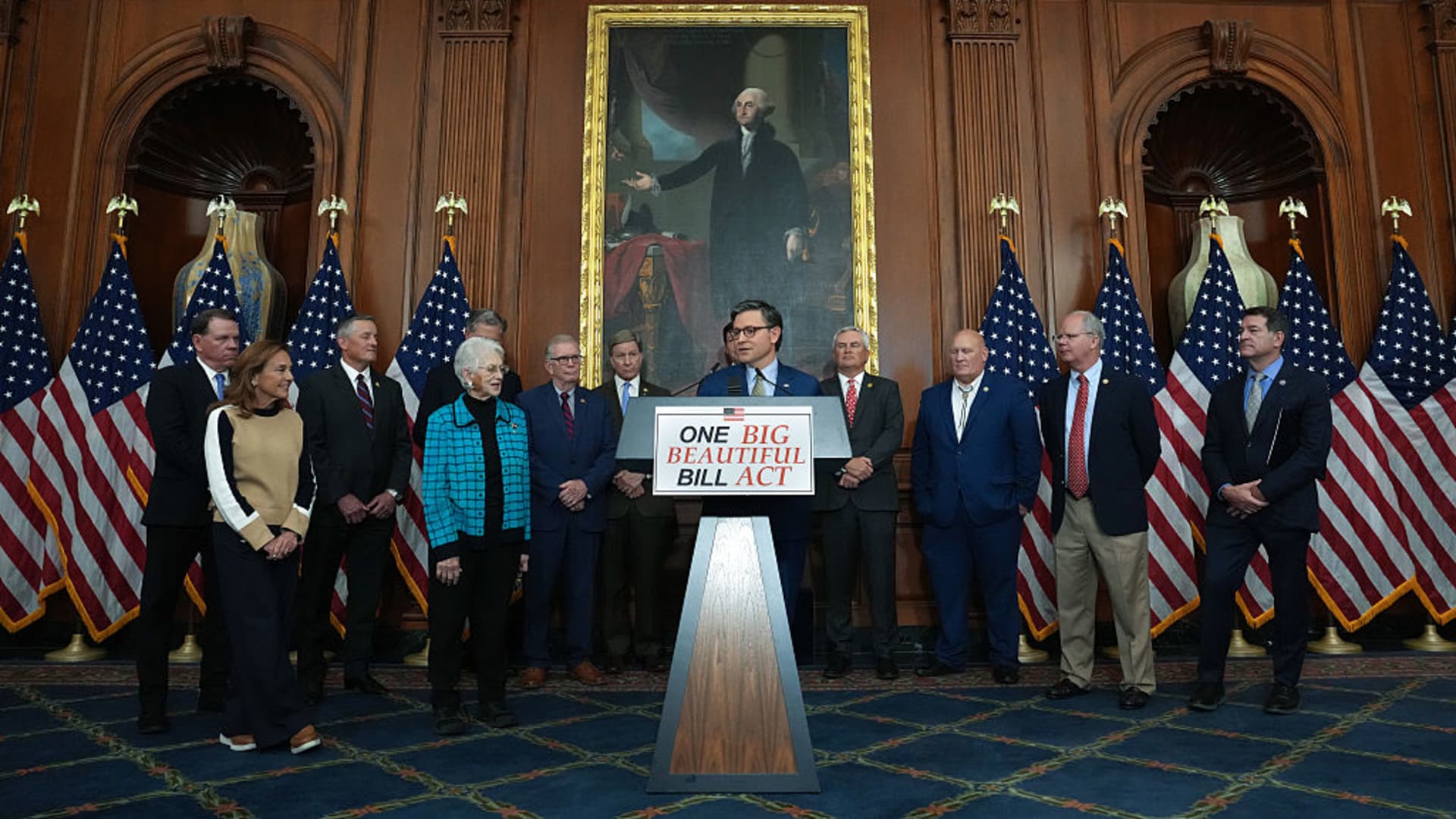

House Speaker Mike Johnson addressed the media following the House’s narrow passage of the “One Big Beautiful Bill Act,” a budget blueprint aimed at advancing former President Donald Trump’s agenda. This legislative package has sparked significant debate, particularly concerning its disproportionate benefits favoring wealthier Americans while potentially leaving low-income households worse off.
Experts warn that the major tax reductions outlined in the bill, estimated to cost at least $4 trillion, predominantly benefit the top earners. Tax cuts for business owners, investors, and homeowners in high-tax states are seen as amplifying existing economic disparities. In stark contrast, lower-income earners may experience declines in income due to proposed cuts to critical social safety net programs, including Medicaid and the Supplemental Nutrition Assistance Program (SNAP).
The Congressional Budget Office (CBO) suggests that households in the bottom 10% of earners could see their incomes drop by 2% by 2027 and 4% by 2033, whereas those in the top 10% might enjoy a 4% increase in 2027 and a 2% rise by 2033. A recent analysis from the Yale Budget Lab echoes these findings, estimating that the lowest-earning fifth of households-who earn less than $14,000 yearly-could lose about $800 in annual income by 2027, while the top 20%, earning over $128,000, would see an average increase of $9,700. Notably, the top 1% could benefit by $63,000.
Ernie Tedeschi, director of economics at the Yale Budget Lab, criticized the legislation for heavily favoring wealthy Americans, compounding the regressive effects of previous tariff policies enacted during the Trump administration. He emphasized that without these tariffs, the bill would overly disadvantage lower- and working-class families.
The House measure includes lucrative tax breaks related to business income, state and local taxes, and the estate tax, which largely benefit high-income earners. Taxation experts highlight that adjustments like raising the SALT cap from $10,000 to $40,000 will leave 80% of earners unaffected by these changes, as those below this threshold have limited state and local tax liabilities.
Despite these concerns, the Tax Policy Center reports that over 80% of households could receive tax cuts by 2026 if the bill passes. Lower earners would benefit from increased standard deductions and a temporarily enhanced child tax credit, among other provisions. However, many of these advantages may not be as beneficial as they seem. For instance, around 33% of tipped workers, who might benefit from proposed deductions for tip income, do not pay federal income taxes and would, therefore, see no advantage.
Moreover, the bill’s provisions for stricter work requirements for Medicaid and SNAP beneficiaries have raised alarms. Total federal spending on these programs is projected to decrease by about $700 billion and $267 billion through 2034, according to CBO analysis, amplifying the challenges faced by low-income households that rely on such assistance.
On the other hand, some high earners may face increased taxes due to changes limiting deductions for state and local taxes. Approximately 17% of the top 1% of households, earning over $1.1 million annually, might actually pay more under this tax framework.
As the “One Big Beautiful Bill Act” advances to the Senate, its implications for American families remain a critical topic of discussion, with both fiscal integrity and fairness under scrutiny. The outcome will have lasting effects on income inequality and the structure of U.S. tax policy, leaving many wondering who will truly benefit from these legislative changes.
Original Source: https://www.cnbc.com/2025/05/23/house-republican-big-beautiful-tax-bill-favors-the-rich.html
Category :
Tags:
Publish Date: 2025-05-23 16:06:00