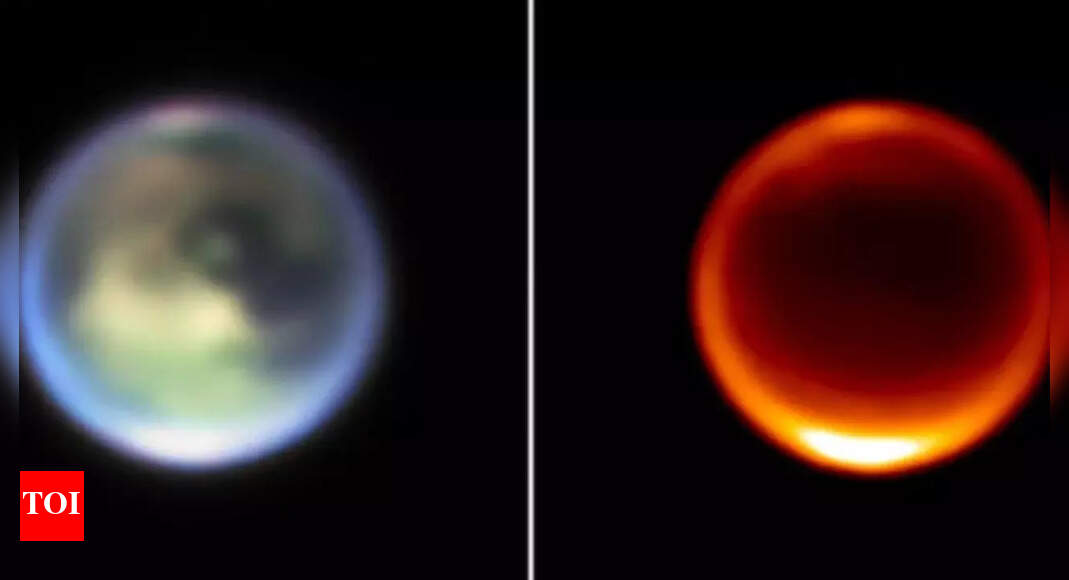

Scientists have made a groundbreaking discovery by observing clouds in the northern hemisphere of Titan, Saturn’s largest moon, for the first time, using the James Webb Space Telescope (JWST). This unprecedented sighting offers new insights into Titan’s complex atmospheric phenomena, highlighting its methane lakes and seasonal weather patterns. Titan, often regarded as one of the solar system’s most enigmatic worlds, has intrigued researchers for years.
The JWST captured images of unique cloud structures over Titan’s northern skies during observations conducted in late 2022 and mid-2023. Notably, these methane clouds appeared in a previously cloudless region. Independent verification from the W. M. Keck Observatory in Hawaii corroborated this finding, confirming the process of cloud convection akin to Earth’s weather systems.
Dr. Conor Nixon, a NASA scientist who led the study, emphasized the significance of this discovery: “Titan is special. It’s the only place in the universe, outside Earth, where rain and clouds engage with the surface. To observe those changes at the north pole in summer is a game-changer.” This observation during Titan’s northern summer presents fresh opportunities to explore its intricate climate dynamics, especially since clouds had only been detected in its southern hemisphere before, typically during summer months.
On July 11, 2023, the JWST captured high-quality photographs showcasing cloud activity at various altitudes. Just three days later, the Keck Observatory confirmed these findings, depicting methane clouds developing in the northern region through combined observations. This collaboration underlines the value of merging data from both space and ground-based observations in planetary science.
The research builds on prior work from the Cassini-Huygens mission, which studied Saturn and its moons from 2004 to 2017. Although Cassini documented cloud activity in Titan’s southern hemisphere, it was unable to capture imagery of the northern hemisphere during summer. JWST’s advanced imaging technology now fills in these seasonal gaps, providing a more comprehensive understanding of Titan’s meteorological patterns.
Additionally, JWST’s observations shed light on Titan’s atmospheric chemistry by identifying the presence of methyl radicals—reactive molecules essential in methane-centered atmospheric reactions. This finding is crucial, as it shows how sunlight and charged particles from Saturn’s magnetosphere break down methane, contributing to Titan’s thick, foggy atmosphere. Understanding the dynamics of methyl radicals is not just significant for comprehending Titan’s environment but also has implications for exploring prebiotic conditions and potential life-supporting environments throughout the cosmos.
Original Source: https://timesofindia.indiatimes.com/science/nasas-james-webb-space-telescope-captures-images-of-unusual-cloud-formation-of-saturns-biggest-moon-titan/articleshow/121205309.cms
Category:
Tags:
Publish Date: 2025-05-16 13:08:00