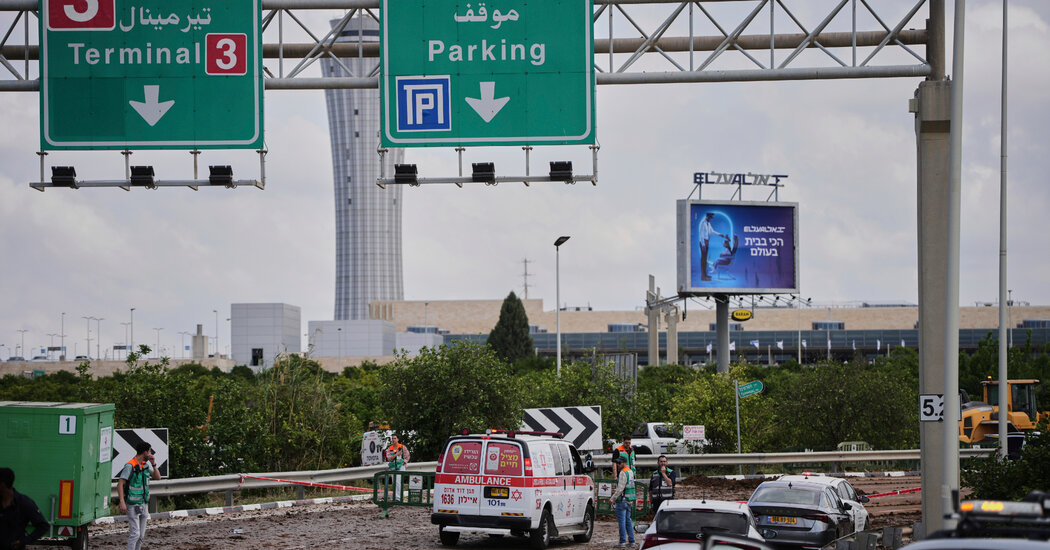

In a significant escalation in the region, a ballistic missile launched from Yemen struck near Ben Gurion Airport, Israel’s primary international terminal, close to Tel Aviv on Sunday. The Israeli military’s attempts to intercept the missile were unsuccessful, highlighting a critical lapse in defense around one of the nation’s most sensitive locations. The attack, attributed to the Iranian-backed Houthi militia, led to a temporary suspension of flights, although no fatalities were reported.
The incident has prompted an urgent security review within Israel’s military ranks. Prime Minister Benjamin Netanyahu convened an emergency session with his security cabinet and issued stern warnings of potential retaliation. Netanyahu emphasized the Iranian connection, asserting that “attacks by the Houthis emanate from Iran,” and vowed to respond strategically to the missile strike and its Iranian backers.
The attack comes amid ongoing negotiations by the United States with Iran over its nuclear program. This missile strike could complicate diplomatic efforts, further inflaming tensions in the already volatile region. Israel’s Defense Minister, Israel Katz, indicated a forceful response might be imminent, stating, “Whoever harms us will be harmed by us sevenfold.”
Following the missile strike, the airport resumed operations within an hour. However, the disruption caused several international airlines to cancel their flights. The Houthi militia, supporting Hamas, has stepped up missile attacks against Israel since a cease-fire with Hamas in Gaza ended in March.
This latest incident marks the fourth missile attack by the Houthis targeting Israel in the past 48 hours. The previous attacks were intercepted by Israel’s Arrow aerial-defense system, which has generally successfully countered long-range threats. The United States had previously bolstered Israel’s defenses by deploying a THAAD missile defense system as a protective measure against threats from Iran and its allies.
Despite these measures, the strike near Ben Gurion Airport represents a notable achievement for the Houthis and a severe setback for Israeli defenses. Houthi military spokesperson Yahya Saree claimed responsibility for the attack and issued a warning for international airlines to avoid Israeli airspace for safety reasons.
Hamas lauded the attack as Israel mobilized more reserve soldiers to bolster operations in Gaza. The conflict, intensifying since Hamas attacked Israel in October 2023, has led to significant casualties. According to health officials in Gaza, over 50,000 Palestinians have died, although these figures lack definitive breakdowns between combatants and civilians. Israel maintains that its military campaign aims to dismantle Hamas and secure the release of hostages.
The missile strike has sparked political criticism within Israel, with opposition leaders accusing Netanyahu’s government of failing to prevent the attack. Benny Gantz, a former military chief and leader of the centrist opposition, called for decisive action against Iran, arguing, “This isn’t Yemen — this is Iran.”
Social media circulated images and videos of the aftermath, showing smoke rising from the affected area near Terminal 3. Large missile fragments were scattered near the building, and a deep crater was observed near the site, with emergency services responding to the scene.
The attack provoked widespread concern over the region’s safety and security, prompting international airlines to reassess their operations in and out of Tel Aviv. The Israel Airport Authority reported that 422 flights were initially scheduled for the day, underscoring the strike’s significant impact.
Original Source: https://www.nytimes.com/2025/05/04/world/middleeast/houthi-missile-tel-aviv-israel.html
Category : Israel-Gaza War (2023- ),Missiles and Missile Defense Systems,Gaza Strip,Tel Aviv (Israel),Yemen,Houthis
Tags:
Publish Date: 2025-05-04 22:34:00