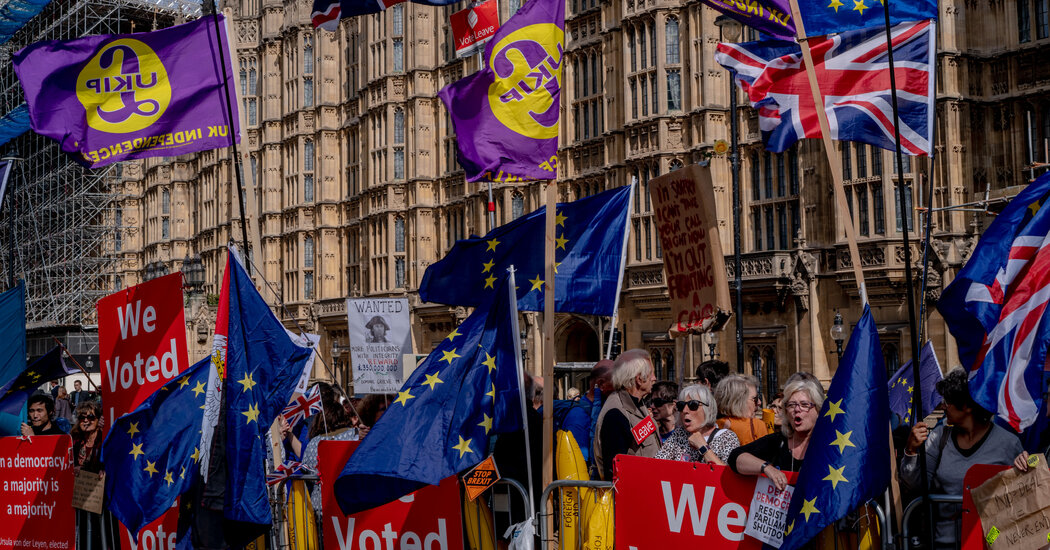
Unveiling the Shockwaves: How Brexit’s Economic Self-Harm Ignited Trump’s Devastating Tariff Storm

Britain’s experience with economic isolationism through Brexit has resurfaced in discussions surrounding former President Donald J. Trump’s tariff policies. The United Kingdom, having voted to leave the European Union in 2016, remains embroiled in the repercussions of that decision nearly nine years later. As Trump erected trade barriers around the United States, this historical parallel now holds fresh significance. Brexit, once labeled as one of the greatest self-inflicted economic harms by a Western nation, may now find itself in the shadow of similar actions across the Atlantic.
Trump’s recent abrupt reversal of some tariffs after market pressure is reminiscent of Britain’s economic turbulence under former Prime Minister Liz Truss. Her attempt at radical tax cuts was swiftly abandoned following a market backlash, reflecting the enduring economic instability Brexit infused into British politics. As Mark Malloch Brown, a former British diplomat, noted, Brexit’s legacy extends beyond its initial fallout. The UK faces a vital choice between rekindling trade ties with Europe or emphasizing relations with the United States, now more uncertain than ever.
Brexit’s economic drag continues to be evident. Britain’s trade volume has decreased by around 15% compared to if it had remained in the EU, as per the Office of Budget Responsibility. Additionally, long-term productivity has slipped by 4%, exacerbated by the trade barriers with Europe. The debate and uncertainty during the Brexit transition further stifled investment; by mid-2022, British investment was 11% lower than anticipated without Brexit, according to John Springford from the Centre for European Reform.
Amidst these observations, Trump’s tariffs have fomented global economic volatility, significantly impacting U.S. relations, particularly with China. The resultant market unease has even spurred recession predictions and inflationary concerns. This environment echoes Britain’s post-Brexit struggles, where political and economic fractures continue to unfold. Truss’s ill-fated tax policies highlighted vulnerabilities similar to those in America, with rising bond yields signaling investor anxiety over fiscal stability.
The geopolitical landscape has also shifted. Trump’s departure from NATO’s security assurances nudges Britain closer to Europe, despite unresolved tensions like France’s demands on fishing rights within a potential EU defense pact. Meanwhile, the lasting political impact of Brexit is unmistakable. Years of divisive debate radicalized Britain’s Conservative Party, culminating in electoral defeat and ushering Keir Starmer’s Labour Party into power last year.
With Trump stirring similar dynamics, the Republican Party in the United States could face comparable factionalization. The ideological disagreements between economic nationalists and globalists mirror those found among the Brexiteers. As Professor Tony Travers of the London School of Economics remarked, “Brexit did not solve the issues of deindustrialization; if anything, it exacerbated them.” Similar voices raise questions about whether post-Trump American politics will mirror post-Brexit Britain’s fractured political landscape. Will the Republican Party endure divisions akin to those that rendered Britain’s Conservatives unpalatable to voters?
As global economies brace for further fluctuations, the reminders of isolationist policies’ perils grow ever more potent, echoing from Britain to the United States.
Original Source: https://www.nytimes.com/2025/04/13/world/europe/how-brexit-a-startling-act-of-economic-self-harm-foreshadowed-trumps-tariffs.html
Category : Great Britain Withdrawal from EU (Brexit),Politics and Government,International Trade and World Market,United States International Relations,Government Bonds,Economic Conditions and Trends,Customs (Tariff),Protectionism (Trade),European Union,Republican Party,Trump, Donald J
Tags:
Publish Date: 2025-04-13 09:31:00