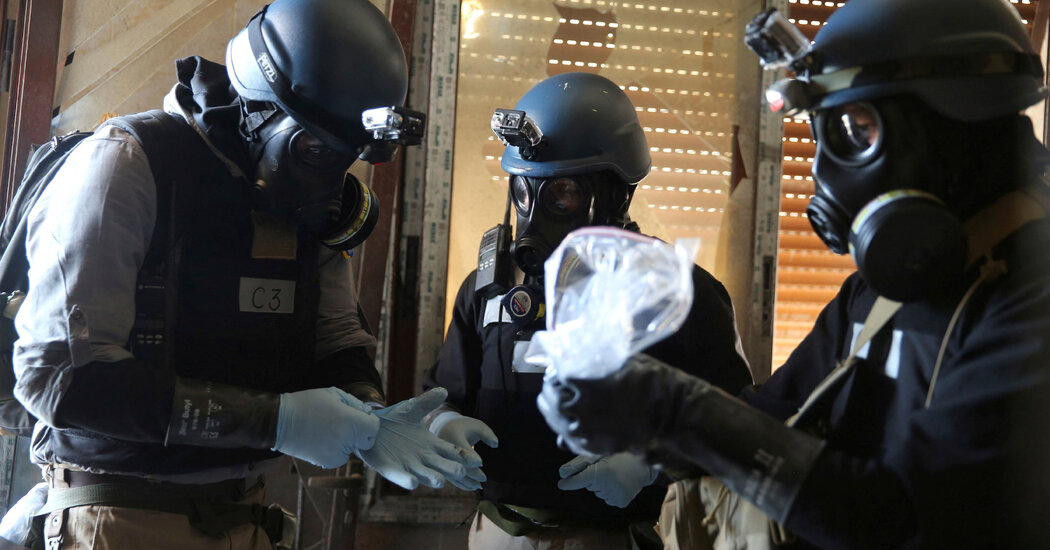

In a pivotal revelation, the Organization for the Prohibition of Chemical Weapons (OPCW) has estimated the existence of over 100 suspected chemical weapons sites in Syria. These sites, remnants of Bashar al-Assad’s regime, highlight a pressing international concern as efforts to assess and dismantle the legacy of chemical warfare in Syria intensify. Far surpassing any previously acknowledged figures by Assad’s government, these sites are believed to have been central to the research, production, and storage of chemical weapons such as sarin and chlorine gas, which were used against both rebel forces and civilians during Syria’s protracted civil war.
The significance of these findings poses a daunting challenge for Syria’s current caretaker government, led by Hayat Tahrir al-Sham—a group labeled as a terrorist organization by the United States despite its renunciation of ties with Al Qaeda. The current regime’s ability to secure these sites is crucial, especially given the deadly nature of chemical agents like sarin, which can kill within minutes. Experts warn of the grave risks if these weapons fall into the wrong hands, emphasizing the potential devastation in densely populated regions.
Despite international apprehension, Syria’s foreign minister assured cooperation during a surprise March visit to the OPCW’s headquarters in The Hague, promising the destruction of remaining chemical stockpiles. This pledge brought cautious optimism, as inspectors have finally gained access to Syria to begin cataloging the notorious sites. However, skepticism remains as the caretaker government has yet to appoint an ambassador to the OPCW—a key step signaling its commitment to addressing past atrocities.
Adding to the complexity is the recent resurgence of violence in Syria’s coastal areas, with clashes between government forces and factions aligned with Assad. Meanwhile, the Syrian defense ministry remains tight-lipped on the issue, citing jurisdictional reasons.
Historically, Assad’s regime had disclosed 27 sites to the OPCW, which were then shut down. Nevertheless, evidence suggests continued use and importation of required chemicals as recent as 2018. According to Raed al-Saleh, leader of the White Helmets, many undisclosed locations may remain hidden, complicating the task of securing and neutralizing the potential threat. Collaborations with Syrian scientists now living in Europe have uncovered dozens more suspected sites, according to Nidal Shikhani from the Chemical Violations Documentation Center of Syria.
Destruction of these sites is urgent not only for security but also for justice. International observers and Syrian humanitarian organizations aim to use collected evidence for ongoing investigations into chemical weapon usage under Assad. The infamous 2013 sarin gas attack in Ghouta, a tragic milestone in chemical warfare history, remains etched in collective memory, with the remains of victims both tangibly and metaphorically buried in forgotten graves.
In contrast to Syria’s promises, neighboring Israel has taken a less optimistic approach, targeting known chemical sites with airstrikes. However, experts like Natasha Hall from the Center for Strategic and International Studies critique these actions for potentially obscuring efforts toward accountability and destroying critical evidence, rather than aiding in disarmament.
Despite assurances of cooperation from the new regime, inspectors recall past deceptions and attacks, including an incident in 2014 where their convoy was targeted by a roadside bomb. These memories serve as poignant reminders of the precarious position Syria maintains on the global stage, where political promises often remain unrealized.
As Syria grapples with the remnants of chemical warfare, the world watches closely. The intricate web of politics, military activity, and international scrutiny underscores the volatile situation, urging concerted action to navigate one of the gravest challenges faced by the international community in disarming chemical threats.
Original Source: https://www.nytimes.com/2025/04/06/world/middleeast/syria-chemical-weapons-assad.html
Category : War and Armed Conflicts,Biological and Chemical Warfare,Civilian Casualties,Arms Control and Limitation and Disarmament,Organization for the Prohibition of Chemical Weapons,White Helmets (Syrian Civil Defense Volunteer Group),Assad, Bashar al-,Damascus (Syria),Ghouta (Syria),Politics and Government,Syria
Tags:
Publish Date: 2025-04-06 09:31:00