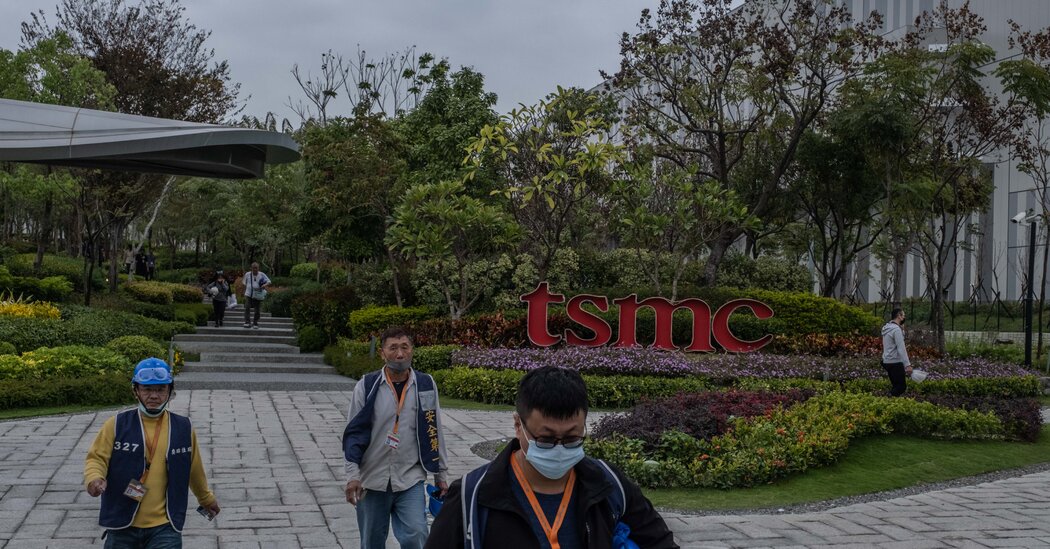

Taiwan, a pivotal player in the global computer chip supply chain, awoke to news that former U.S. President Donald Trump announced a 32% tariff on almost all Taiwanese goods exported to the U.S., with semiconductors notably exempt. This exemption, however, does not guarantee future immunity from tariffs, leaving Taiwan and other major chip producers like South Korea vigilant. Taiwanese firms have invested decades and billions into crafting a meticulous network of factories for producing these semiconductor chips, which are integral to a wide array of electronic devices and remain Taiwan’s most significant export.
The semiconductor sector has become the focal point of an evolving trade relationship between Taiwan and the U.S., which has adopted a more transactional hue under Trump’s administration. Trump had earlier criticized Taiwan for dominating the semiconductor industry, threatening eventual tariffs. At the same time, he reproached Taiwan for its reliance on U.S. political backing against China’s territorial claims while allegedly underinvesting in its security.
In response to potential tariff implications, Taiwanese officials and businesses have scrambled to mitigate impacts. President Lai Ching-te indicated Taiwan’s interest in purchasing natural gas from a previously stalled Alaskan project. Taiwan Semiconductor Manufacturing Company (TSMC), the world’s largest chipmaker, announced a $100 billion investment to bolster operations in Arizona, a plan that initiated under Trump and was financially supported by President Joe Biden’s administration.
While Trump’s tariff announcement included praise for TSMC’s U.S. investment, there is a push for other semiconductor companies, including South Korea’s Samsung and SK Hynix, as well as Taiwan’s GlobalWafers, to increase their U.S.-based investments. The inherently global and intricate nature of the semiconductor supply chain poses challenges to straightforward tariff implementations. Advanced chips often start in Taiwan, undergo testing in regions like Malaysia, and are integrated into electronics in countries such as Mexico or China before reaching global consumers. Jimmy Goodrich, a senior technology analyst at the RAND Corporation, notes, “Very few semiconductors are directly imported into the United States; most are incorporated into a final product.” Ming-Yen Ho, a fellow at the Research Institute for Democracy, Society and Emerging Technology in Taipei, adds that even chips originating from TSMC’s Arizona plant temporarily exit the U.S. for integration before returning in finished products.
Despite the tariffs, the American Chamber of Commerce in Taiwan emphasized Taiwan’s vital economic role in the U.S., urging both governments to enhance relations. The Taiwanese government has condemned the tariffs as unjust, with spokeswoman Lee Hui-chih stating their intent to formally protest to the U.S. Trade Representative. Taiwan’s exports of electronics and advanced technology, significant components of the U.S.-Taiwan trade, have surged recently, underlining the severity of trade disruptions.
Jason Hsu, a senior fellow at the Hudson Institute and former Taiwanese legislator, remarked that Taiwan may have been overly optimistic about its diplomatic relationship with Trump. He posits that the Taiwanese government was perhaps naïve in expecting benevolence post-TSMC’s U.S. investment announcement. This development highlights the complexity of international trade and the delicate balance countries must navigate in sustaining economic partnerships amid shifting geopolitical landscapes.
Original Source: https://www.nytimes.com/2025/04/03/business/trump-tariffs-taiwan-chips.html
Category : International Trade and World Market,Computer Chips,Customs (Tariff),Hynix Semiconductor,Taiwan Semiconductor Manufacturing Company Ltd,Trump, Donald J,Taiwan
Tags:
Publish Date: 2025-04-03 23:28:00