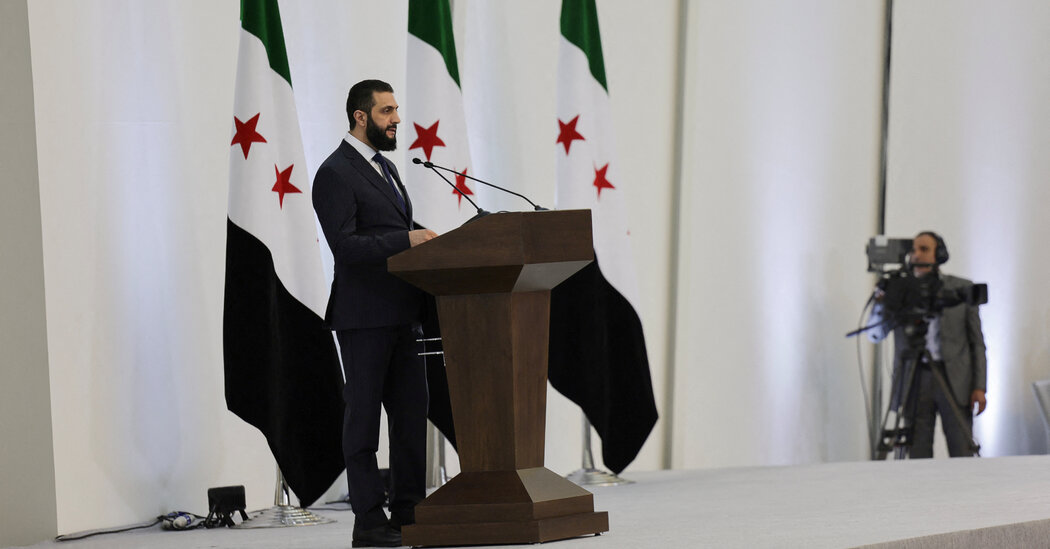

Syria’s interim leader, Ahmed al-Shara, has unveiled a caretaker government poised to guide the nation through a pivotal transformation after over five decades under the Assad family’s authoritarian rule. Over the weekend, al-Shara, who spearheaded the coalition that deposed Bashar al-Assad, announced the new cabinet amidst an assembly of dignitaries at the presidential palace in Damascus. This move is seen as a significant step in Syria’s ongoing transition from dictatorship to a more inclusive political entity.
Al-Shara’s appointments feature a mix of seasoned officials, introducing some new faces, including a key appointment of a Kurdish individual as Minister of Education—a nod to the country’s ethnic diversity. The cabinet also includes Raed al-Saleh of the White Helmets as Minister of Disasters and Emergencies, and Hind Kabawat, a recent national dialogue organizer, as Minister of Social Affairs, marking her the only female appointee.
The inclusion of various activists and minority representatives suggests al-Shara is partially succumbing to domestic demands and international pressures to form a diverse administration. Such changes come in response to intensifying calls from foreign governments poised to lift sanctions contingent upon a broader political process reflecting Syria’s ethnic and religious heterogeneity.
Syria’s new interim government will steer the country for a five-year period, during which a permanent constitution is expected to be ratified, and electoral processes established. While the interim constitution preserves a strong presidential system, it introduces a separation of powers and judicial independence—a marked departure from the previous regime’s authoritarian practices. However, certain stipulations, like the requisite that the president be Muslim, remain, inciting some criticism regarding inclusivity.
The constitutional framework, crafted by a committee led by a legal expert, draws mixed reviews. While some praise it for new constraints on emergency powers and military oversight, others point out insufficient checks on presidential authority.
Al-Shara’s government emerged after a nationwide conference convened to gather citizens’ input, aligning with his promise to craft a transitional body by March. Yet, recent violent outbreaks in Syria’s coastal regions have highlighted the delicate security situation, underscoring the urgency for stable governance. Collaboration agreements with Kurdish forces in northeastern Syria and cooperation with Druse communities in the south further demonstrate attempts to unify Syria’s fragmented landscape.
The international community keenly observes al-Shara’s maneuvers as many Arab and Western nations specify a diversified political process as a prerequisite for re-establishing full diplomatic relations and easing sanctions.
This transitional phase not only highlights al-Shara’s leadership but also tests his pledge to extend power beyond a close network of allies. As the country stands at the brink of potentially significant reform, the global community remains watchful, hopeful that Syria can pave a path towards a more inclusive and democratic future amidst its complicated political terrain.
Original Source: https://www.nytimes.com/2025/03/29/world/middleeast/syria-government-al-shara.html
Category : Politics and Government,War and Armed Conflicts,al-Shara, Ahmed (Abu Mohammad al-Jolani) (1982- ),Assad, Bashar al-,Idlib (Syria),Syria,United States
Tags:
Publish Date: 2025-03-30 04:29:00