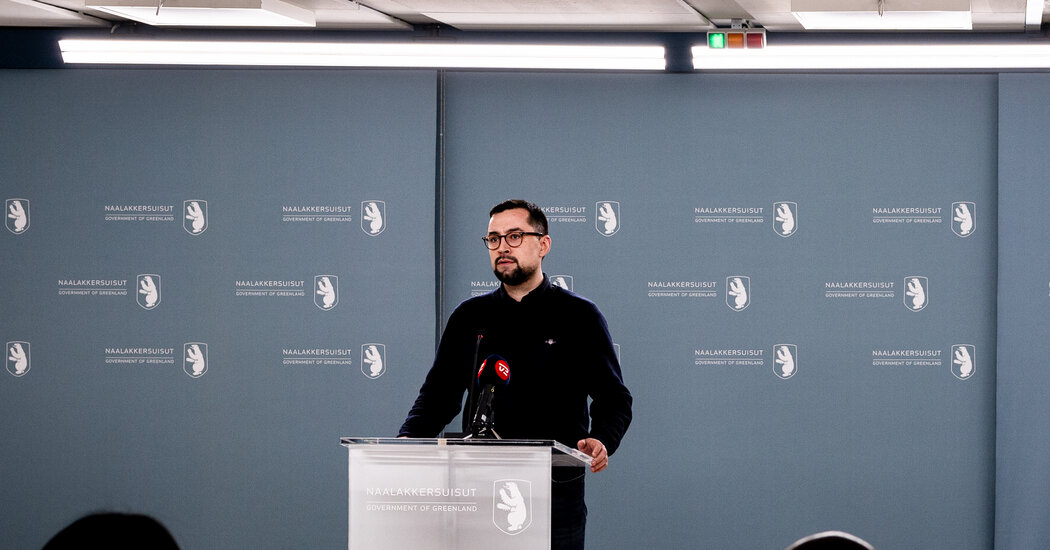

Relations between Greenland and the United States took a turn for the worse as Mute Egede, Greenland’s Prime Minister, decried the planned visit by a high-level U.S. delegation, which he labeled “highly aggressive.” Expressing concern over the intentions of the Trump administration, Egede criticized officials, including National Security Adviser Michael Waltz, stating that their presence would only serve to exert dominance over Greenland. Usha Vance, the Second Lady, is also part of the delegation visiting the island. President Donald Trump has made clear his desire to incorporate Greenland into the United States, a prospect that has left many Greenlanders feeling uneasy and cautious about future U.S. interactions.
The Trump administration has attempted to position the visit as cordial, noting that Vance will partake in cultural events, such as a national dog sled race, with one of her children. Still, skepticism remains high among Greenlandic leaders who are striving to affirm their sovereignty while avoiding conflict with the U.S. administration.
Meanwhile, Israeli military operations intensified in Gaza, with forces gaining ground throughout the north and south of the territory. The ongoing offensive prompted new evacuation orders for Palestinians who recently returned to their homes. As airstrikes targeted Hamas sites and infrastructure, the Palestinian Civil Defense issued warnings of a dire threat to tens of thousands in Rafah. Reports from Gaza’s health ministry put the overall death toll since hostilities began at beyond 50,000, including 39 casualties from recent strikes.
On the political front, Israel’s internal dynamics are also roiling, with a no-confidence vote in the cabinet against the nation’s attorney general, marking the initial steps towards her removal. Prime Minister Benjamin Netanyahu’s government accuses her of undermining authority, while she contends that Netanyahu’s administration is attempting to place itself above the law.
In Saudi Arabia, Ukrainian and U.S. officials embarked on discussions to explore a potential limited cease-fire in the conflict with Russia. Talks in Riyadh are anticipated to address the intricacies of a cease-fire concerning energy infrastructure attacks and guarantee Black Sea shipping security, following an agreement reached last week. A Ukrainian envoy revealed that further discussions with U.S. representatives might occur, although the journey toward a cease-fire remains fraught. Russia maintains firm demands, insisting on territorial claims and vetoing Ukraine’s potential NATO membership. Kyiv stands resolute against these conditions and accuses Russian President Vladimir Putin of trying to prolong the conflict. Despite talks, violence continues, with a Russian drone offensive killing at least three Kyiv residents.
Amid global news, we reflect on the life of Max Frankel, a Pulitzer Prize-winning former executive editor for The New York Times. Frankel, who fled Nazi Germany as a child, passed away at 94, leaving behind a legacy of distinguished journalism.
In a lighter touch, wedding toast blunders have become a cultural talking point, often remembered more for their missteps than their successes. Critic Jason Zinoman argues for embracing the imperfections of these speeches. He suggests that most are not catastrophic but simply forgettable and asserts that the most memorable toasts strike a balance between humor and sincerity, making guests and newlyweds alike squirm just enough to be endearing. For those crafting a speech, the key is maintaining that delicate balance to create a meaningful and memorable toast.
Original Source: https://www.nytimes.com/2025/03/24/briefing/greenland-trump-gaza.html
Category :
Tags:
Publish Date: 2025-03-24 10:30:00