Shocking Revelation: Educationist Declares NEP Unconstitutional, Sparks Outrage Over Rampant Commercialisation

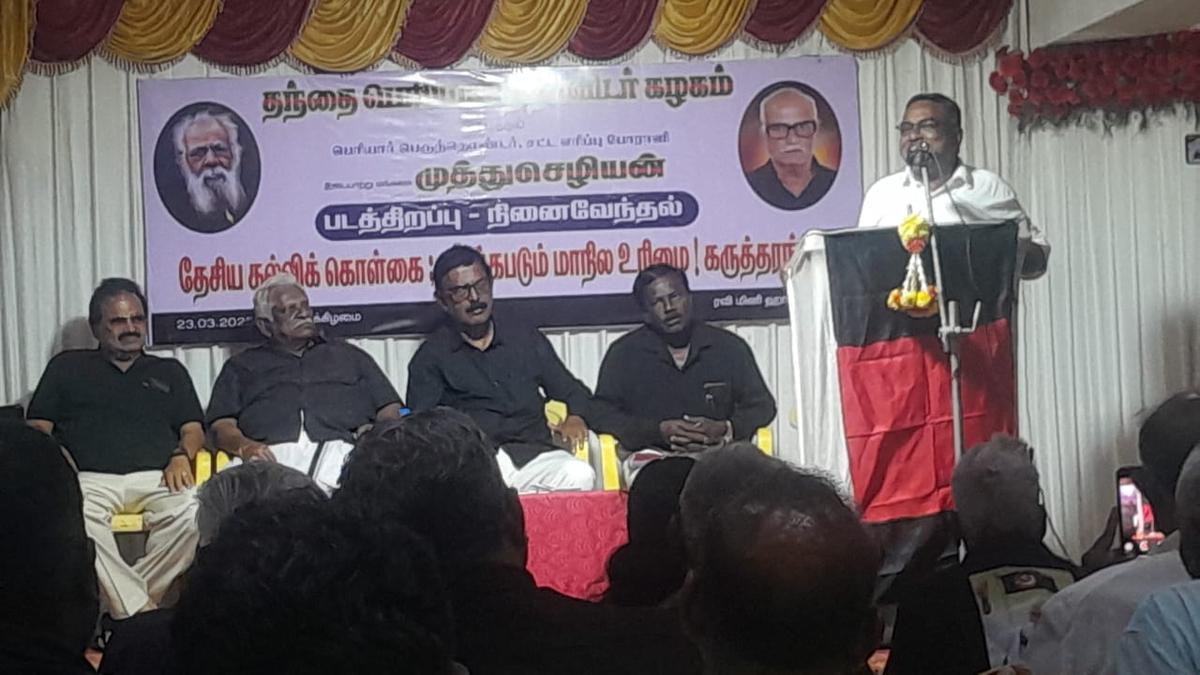
In a critical address delivered in Tiruchirapalli, P.B. Prince Gajendra Babu, the general secretary of the State Platform for Common School System-Tamil Nadu (SPCSS-TN), vehemently denounced the National Education Policy (NEP) 2020. Speaking at a meeting organized by the Thanthai Periyar Dravidar Kazhagam (TPDK), Babu accused the policy of fostering educational inequality and eroding state governance over education, labeling it as both unconstitutional and commercially driven.
Babu’s critique was wide-ranging, asserting that NEP 2020 undermines educational equality from early education through higher learning. He expressed concerns that the policy’s focus on establishing a limited number of PM SHRI schools, while ignoring the needs of numerous existing government schools, creates societal divisions, challenging the constitutional rights to equality and personal liberty enshrined in Articles 14 and 21. Furthermore, he cautioned against vocational training initiatives for young children, warning they could lead to an increase in child labor and confine youth to semi-skilled roles.
In addition to his critique of NEP 2020, Babu highlighted several structural issues, calling for the permanent inclusion of physical education and computer science teachers in all schools. He also condemned the Common University Entrance Test-based admissions, Outcome-Based Education (OBE), Blended Learning, and the Multiple Entry/Exit system for permitting unqualified individuals to occupy teaching and administrative positions, ultimately stripping states of their educational autonomy.
Babu urged the revocation of the Higher Education Commission of India (HECI) Bill, arguing its alignment with central rather than state governance violates the spirit of federalism as outlined under Article 246, which designates education as a State subject. He further encouraged the Tamil Nadu government to dissolve preferential categories like Schools of Excellence and Model Schools, advocating for equal fortification of all government schools. Emphasizing the importance of the Samacheer Kalvi framework, he reiterated its role in ensuring consistent and equitable learning opportunities.
TPDK’s general secretary, K. Ramakrishnan, joined the conversation by criticizing the Union government’s educational policies, commending the Tamil Nadu government’s initiatives, such as the Chief Minister’s Breakfast and Noon Meal Schemes, for their success in reducing school dropout rates. Ramakrishnan noted that these schemes demonstrate the quality and inclusivity of Tamil Nadu’s education system, as seen in the enrollment choices of migrant workers from Hindi-speaking regions who prefer Tamil Nadu’s government schools.
Ramakrishnan further accused the central government of increasing dropout rates intentionally to create a cheap labor force and suppress progress in states like Tamil Nadu. He condemned the proposed three-language policy, describing it as a covert attempt to impose Hindi and suppress regional identities. His remarks echoed a broader sentiment of resistance against central policies perceived as encroaching on state sovereignty and cultural diversity.
The outspoken opposition from figures like Babu and Ramakrishnan highlights the ongoing tensions between state and central government educational policies, stressing the significance of federalism and the pursuit of equal educational opportunities for all. These discussions continue to reverberate in Tamil Nadu and beyond, fueling ongoing dialogue about the future of education in India.
Original Source: https://www.thehindu.com/news/cities/Tiruchirapalli/nep-is-unconstitutional-promotes-commercialisation-says-educationist/article69365883.ece
Category : Tiruchirapalli
Tags:
Publish Date: 2025-03-24 00:40:00