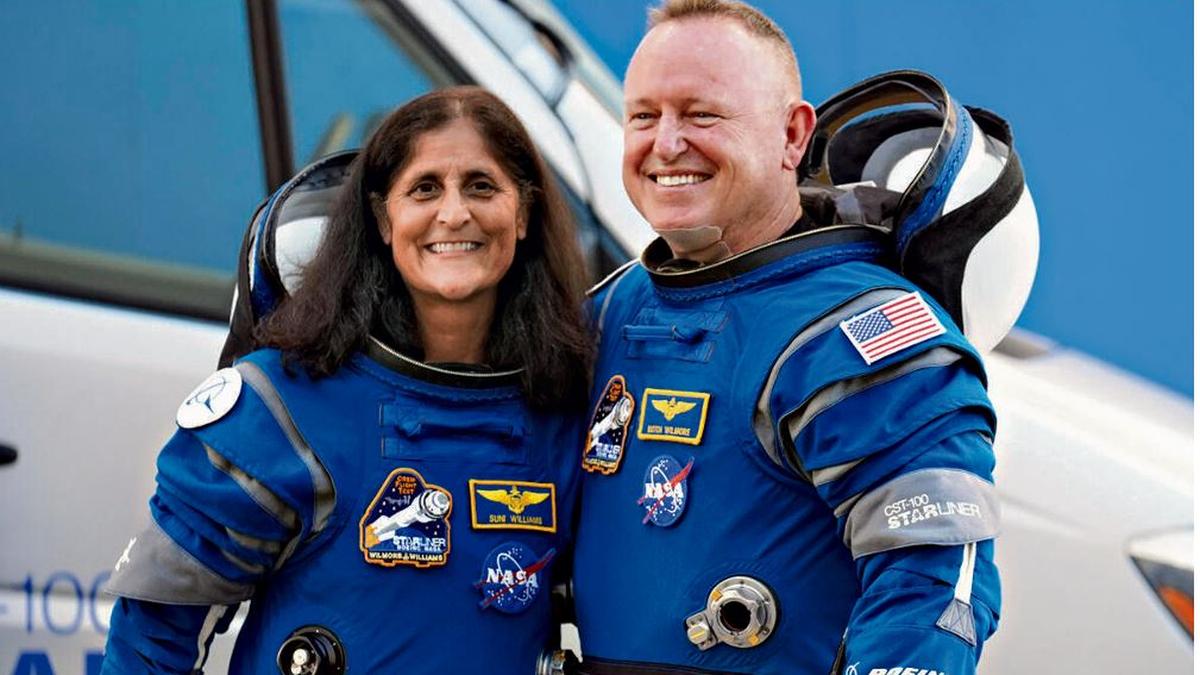
Astronauts Back at It: Sunita Williams and Barry Wilmore Embark on Epic Spacewalk Recon Mission

From Space Shuttle to Space Station, Sunita Williams’ Journey to the Stars
When Sunita Williams looks at the vast expanse of space, she doesn’t get overwhelmed by the enormity of it all. Instead, she takes it one day at a time, focusing on the present moment and the people she’s with. "That’s all teamwork, and that’s what space travel is about," she says. As a renowned astronaut and a symbol of women in space, Williams has made a lasting impact on the world of space exploration.
Born in Ohio in 1965 to a father who had left India seven years prior, Williams grew up with a strong sense of determination and a taste for adventure. After graduating from the US Naval Academy, she joined the Navy and became a naval aviator, flying support missions during the Gulf War and relief operations after Hurricane Andrew.
Her next move was to the US Naval Test Pilot School, where she graduated in 1993, qualifying her to test fly new aircraft. This paved the way for her selection as an astronaut in 1998. Williams’ first mission to the International Space Station (ISS) was in 2006 on the Space Shuttle Discovery, followed by a second stint on the ISS in 2012.
One of her most notable feats was completing the Boston Marathon in space in 2007, running 42 kilometers on a treadmill in 4 hours and 24 minutes. She also became the second woman to command the ISS in 2012, following in the footsteps of Peggy Whitson. Later, she became the first woman to test-fly an orbital spacecraft, flying on Boeing’s Starliner crew capsule in 2024.
Alongside her space travel, Williams has also made a significant impact on the world. She has been an advocate for greater representation of women in space and has lent her support to various initiatives promoting STEM education and diversity in the field. Her "one step at a time" approach has inspired many, including those in her home country of India, where she has been hailed as "India’s daughter" by politicians across the spectrum.
However, this has also led to some criticisms, with commentators highlighting the lack of representation of India’s own astronauts, such as Shubanshu Shukla, Prasanth Balakrishnan Nair, Ajit Krishnan, and Angad Pratap. Williams’ presence has, in turn, highlighted the absence of India’s own astronaut-designates from the limelight, a reminder that there is more work to be done to promote diversity and inclusion in the world of space exploration.
As Sunita Williams looks back on her remarkable journey, she remains committed to the power of teamwork and the spirit of exploration. "It’s not about looking at the big problem all at once," she says. "It’s about taking it one step at a time, meeting the people you’re working with, and doing the best job you can." And with her legacy serving as an inspiration to us all, we can only hope to realize the vast potential of human spaceflight, one step at a time.
Original Source: https://www.thehindu.com/sci-tech/science/sunita-williams-and-barry-wilmore-return-of-the-spacewalkers/article69362610.ece
Category :
Tags:
Publish Date: 2025-03-23 01:06:00