
Recent events in Syria’s coastal regions have led to increased concerns about the stability of the country’s security landscape. According to reports from the Syrian Observatory for Human Rights, Alawite civilians have become frequent targets of attacks by unknown gunmen. These tensions underscore the challenges facing Syria’s new rulers, who have vowed to bring all armed groups under state control. However, their efforts have been met with a series of violent incidents attributed to disparate pro-Assad factions, highlighting the fragile nature of the current peace.
The Institute for the Study of War, a Washington-based think tank, has attributed these attacks largely to small-scale cells loyal to the former Assad regime. Although no single entity has been identified as orchestrating these assaults on Syria’s western coast, recent developments suggest a shift towards organized resistance. Charles Lister, director of the Syria and counterterrorism programs at the Middle East Institute, noted that recent attacks demonstrate an unprecedented level of coordination among these pro-Assad forces.
Amid this turbulence, a newly emerged group, the “Military Council for the Liberation of Syria,” issued a statement on Thursday declaring its intention to overthrow Syria’s new leadership. This group’s formation was announced via a statement signed by Gaith Dalah, a former general in the elite Fourth Division of the Assad regime. Although it remains uncertain whether Dalah is actively leading this council or has been named by the group, his association underscores the lingering influence of former regime leaders.
In recent days, various pro-Assad groups have released videos on social media, showcasing calls to arms against the current government and claiming responsibility for attacks on security forces. While these videos have not been independently verified by The New York Times, their circulation hints at a growing insurgency. Anas Khattab, the new head of Syria’s intelligence services, echoed these concerns, attributing the violence to ex-leaders of the Assad military, supported by unnamed “fugitives” abroad.
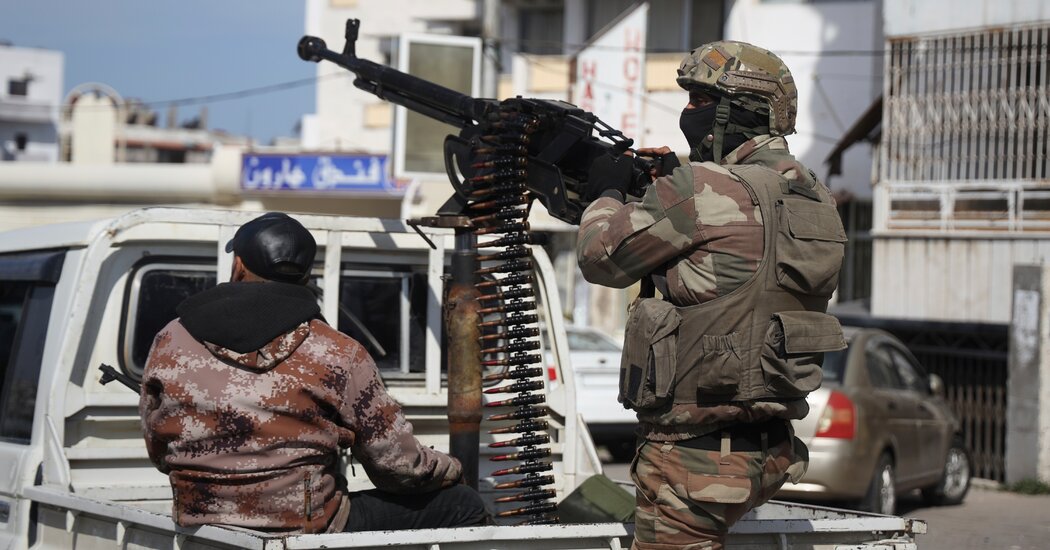
In response, Syria’s new government has intensified its security presence along the coastline, deploying armored vehicles to regain control over affected towns and villages. The Ministry of Defense spokesman, Col. Hassan Abdul Ghani, drew a hard line by urging militants to either surrender or face severe consequences. According to Col. Abdul Ghani, while many militants have laid down their arms, a significant number still resist.
This ongoing conflict in Syria is deeply rooted in a complex political and historical context. The regions of Latakia and Tartus, home to a significant population of Alawite Muslims, have been the epicenter of recent violence. The dynamics between pro-Assad loyalists and the new government, supported by figures such as Ahmed al-Shara (Abu Mohammad al-Jolani), are critical in shaping the nation’s future. The international community watches closely as Syria navigates these turbulent times, with war and politics deeply intertwined.
The challenge for Syria’s leadership is not only quelling the immediate threat posed by these armed groups but also stabilizing the nation in a post-conflict environment. Only time will tell if Syria’s new authorities can achieve their goals of reunification and lasting peace. As the situation evolves, the global audience remains engaged, seeking insights into the complex interplay of war, politics, and governance in this troubled region.
Original Source: https://www.nytimes.com/2025/03/07/world/europe/syria-coast-clashes-assad.html
Category : Syria,Assad, Bashar al-,Latakia (Syria),Tartus (Syria),Alawite Muslims,War and Armed Conflicts,Politics and Government,al-Shara, Ahmed (Abu Mohammad al-Jolani) (1982- )
Tags:
Publish Date: 2025-03-08 18:24:00