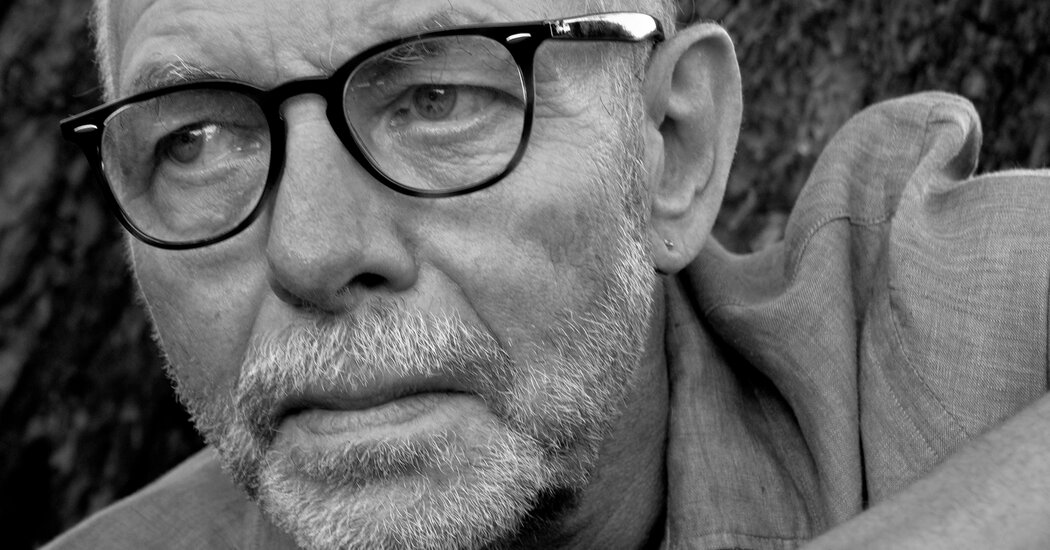

Renowned poet and translator Pierre Joris, celebrated for his English renditions of complex verse by German-Romanian poet Paul Celan, passed away on February 27 at his Brooklyn home at 78. His wife, Nicole Peyrafitte, confirmed that the cause was complications from cancer. Over his distinguished career, Joris authored numerous volumes of poetry and prose while primarily dedicating his efforts to interpreting Celan, who has been regarded by many critics as perhaps the most significant European poet of the postwar era.
Celan’s work, notoriously complex due to its roots in the horrors of the Holocaust—an event that claimed the lives of his parents—challenged translators with its intricate language. His tragic life ended in 1970 when he took his own life in France. A new form of German, purged of Nazi connotations, was necessary for Celan’s expression, resulting in what Joris described as “an invented German” in his preface to “Breathturn Into Timestead” (2014). A high school reading of Celan’s “Death Fugue” became a pivotal moment for Joris, igniting a lifelong commitment to translating the poet’s work.
Though “Death Fugue” remains influential, Celan later distanced himself from it, turning instead to the enigmatic poetry of his later years, which posed exceptional challenges in translation. As Adam Kirsch noted in The New York Review of Books, the perceived “untranslatability” of late Celan became a truism. Yet, Joris embraced this daunting task. He believed conveying the open-ended nature of Celan’s poetry, reflecting the physical and psychological aftermath of the Holocaust, required more than mere translation of words—it demanded an understanding of the underlying textures of language.
Joris’s approach, which avoided overly accessible American versions of German, captivated some critics. Michael Wood, writing in the London Review of Books, praised Joris’s ability to “recreate Celan’s striking neologisms,” acknowledging his aptitude for grasping the musicality and complexity of Celan’s diction. By forgoing simplicity, Joris aimed to echo Celan’s own grappling with language, producing translations that resonated with authenticity and depth.
Born Pierre Joseph Joris on July 14, 1946, in Strasbourg, France, Joris grew up in Luxembourg, a linguistically diverse environment that mirrored Celan’s own polyglot upbringing. He navigated the linguistic terrain by mastering Luxembourgish, German, and French. After graduating from Lycée Classique in Diekirch, Luxembourg, Joris briefly pursued medical studies in Paris before moving to the United States, earning a B.A. in 1969 from Bard College.
Joris’s academic journey continued with a master’s in literary translation from the University of Essex in 1975 and a Ph.D. in comparative literature from SUNY Binghamton in 1990. His academic career included teaching stints at Université Constantine 1 in Algeria and SUNY Albany.
Besides translating Celan’s works, Joris’s literary contributions include his poetry collections “Poasis: Selected Poems 1986-1999” and “Barzakh: Poems 2000-2012,” along with essays and translations of other notable poets. He also co-edited the influential anthology “Poems for the Millennium” with Jerome Rothenberg.
Pierre Joris is survived by his wife, Nicole Peyrafitte, a performance artist; his son, Miles Joris-Peyrafitte; stepson Joseph Mastantuono; and sister Michou Joris. Reflecting on his inclination towards translation, Joris shared with Arabic Literature in 2011, “I was blessed or damned with a batch of different languages and a perverse pleasure of pitting them and their different musics against each other.”
Original Source: https://www.nytimes.com/2025/03/05/books/pierre-joris-dead.html
Category : Joris, Pierre (Translator),Deaths (Obituaries),Celan, Paul,Translation and Interpreters,Poetry and Poets,Writing and Writers,Books and Literature,German Language,English Language,Holocaust and the Nazi Era
Tags:
Publish Date: 2025-03-07 10:53:00