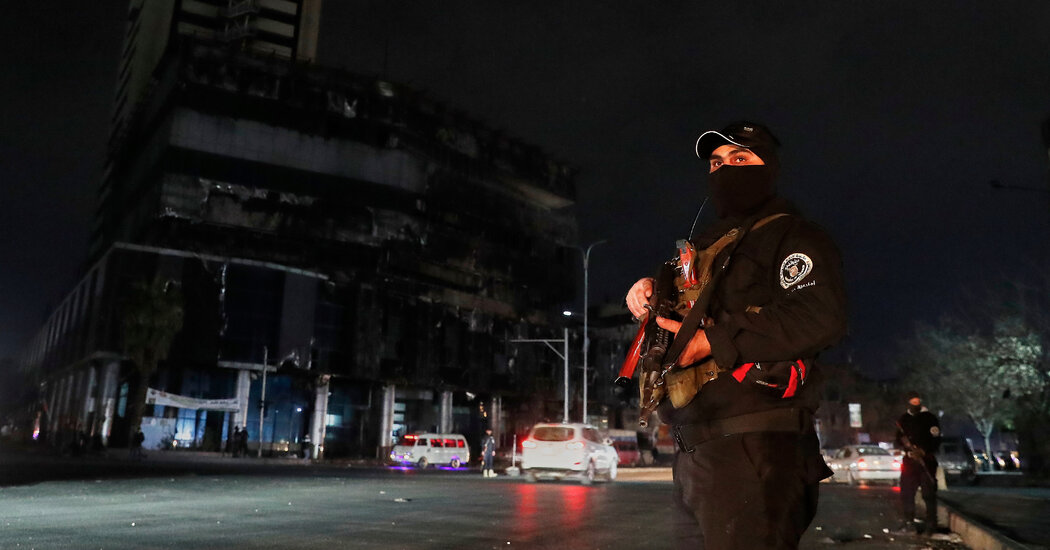

At least 16 security personnel were killed on Thursday in a violent ambush by gunmen loyal to Syria’s ousted leader, Bashar al-Assad, according to reports from the Syrian Observatory for Human Rights. This deadly confrontation unfolded in Latakia Province—an area that has historically backed Assad—marking one of the bloodiest incidents faced by Syria’s new leadership since the former regime’s fall. The attack spurred a fierce hours-long clash between government forces and the assailants as well as widespread protests across the coastal region calling for government withdrawal.
Alaa Mousa, a 30-year-old resident of the port city Tartous, described an atmosphere of mounting tension, noting demonstrators’ willingness to potentially escalate with arms. “The situation is on the verge of collapse,” he warned. These clashes are among the most serious since a coalition of rebels overthrew the Assad government in December and established an Islamist transitional administration aiming to unify the divided nation.
This coastal region, the Alawite heartland of Syria and home to the Assad family minority sect, presents a unique challenge for the Sunni Muslim-led government. Comprising roughly 10% of Syria’s population, the Alawites, an offshoot of Shiite Islam, wielded significant power under Assad, adding complexity to the current power dynamics.
Ibrahim al-Assil, a senior fellow at the Middle East Institute in Washington, emphasized the delicate situation faced by the new authorities. “If government forces act in a disciplined manner, they might succeed in restoring order and maintaining popular support. However, rogue actions could ignite sectarian clashes, destabilizing the country further,” he posited.
The skirmish erupted Thursday afternoon as government security, conducting operations in Latakia’s countryside, sought to detain an Assad official, according to an undisclosed government source. Upon exiting the village of Beit Aana, these forces were ambushed, resulting in multiple casualties, as reported by two local residents, igniting further clashes in nearby areas. Artillery and machine-gun fire echoed across the landscape, with at least one helicopter deploying in response, noted the war monitor and local witnesses. This violence compelled residents from Beit Aana and adjacent villages to flee to safer areas, though civilian casualties remain unclear.
Simultaneously, protests surged across the western coast, with thousands rallying in Latakia City and Tartous, demanding the retreat of government forces. In Tartous, demonstrators gathered at Al-Assadi Square, chanting solidarity slogans for Jableh—the site of the skirmish as local voices reported. Attempts by government security to disperse these crowds included firing into the air.
Parallel protests by those supporting the Islamist-led government erupted in key cities like Homs and Idlib. The current ruling coalition governed Idlib during the latter phase of Syria’s civil war, adding to the city’s political significance.
In response to the escalating unrest, Syrian authorities enforced a curfew across major cities from 10 p.m. Thursday to 10 a.m. Friday, confirmed by the Syrian Arab News Agency. Additional security presence was dispatched to the coast, leaving Tartous streets deserted under curfew yet charged with apprehension. The tranquility felt ominous, described by residents like Mr. Mousa as “the calm before the storm.”
This report leverages verified information while contextualizing the complex dynamics at play in a post-Assad Syria. The fluid situation calls for international vigilance as the country navigates its turbulent transition.
Original Source: https://www.nytimes.com/2025/03/06/world/middleeast/syria-clashes-assad.html
Category : Syria,War and Armed Conflicts,Demonstrations, Protests and Riots,Assad, Bashar al-,Latakia (Syria),Syrian Observatory for Human Rights
Tags:
Publish Date: 2025-03-07 04:24:00